

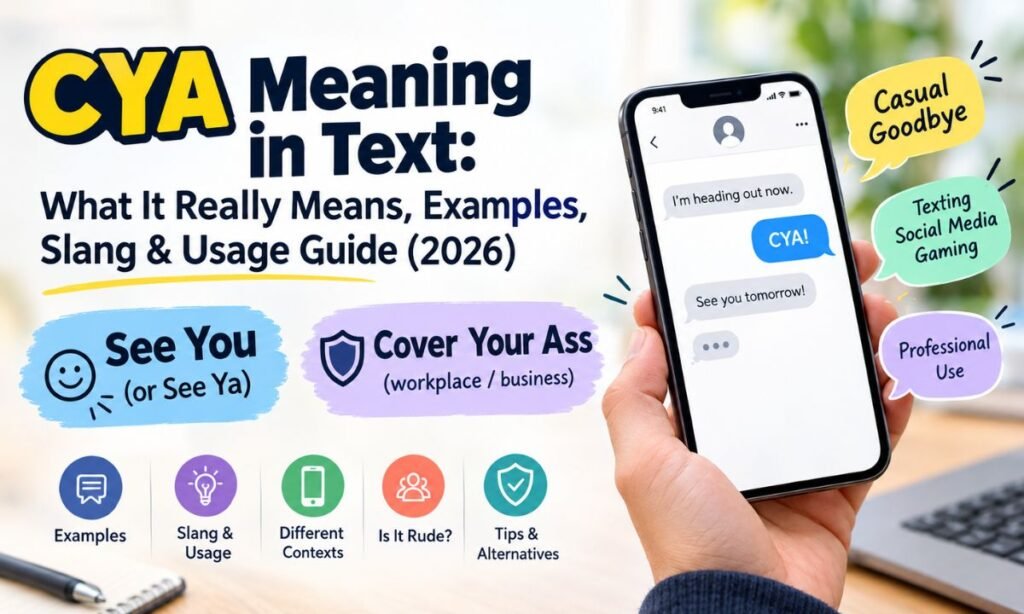
If someone sends you “CYA” in a text, you may wonder whether they are simply saying goodbye or using another slang expression. In most casual conversations, CYA means “See You” or “See Ya,” a short and informal way to end a conversation.
However, CYA has another established meaning: “Cover Your Ass.” This meaning is more common in workplace, business, or risk-related conversations, where someone is talking about protecting themselves from blame or future problems.
This guide explains the CYA meaning in text, its slang usage, examples, tone, social-media meanings, professional use, and how to respond naturally in 2026.
What Does CYA Mean in Text?
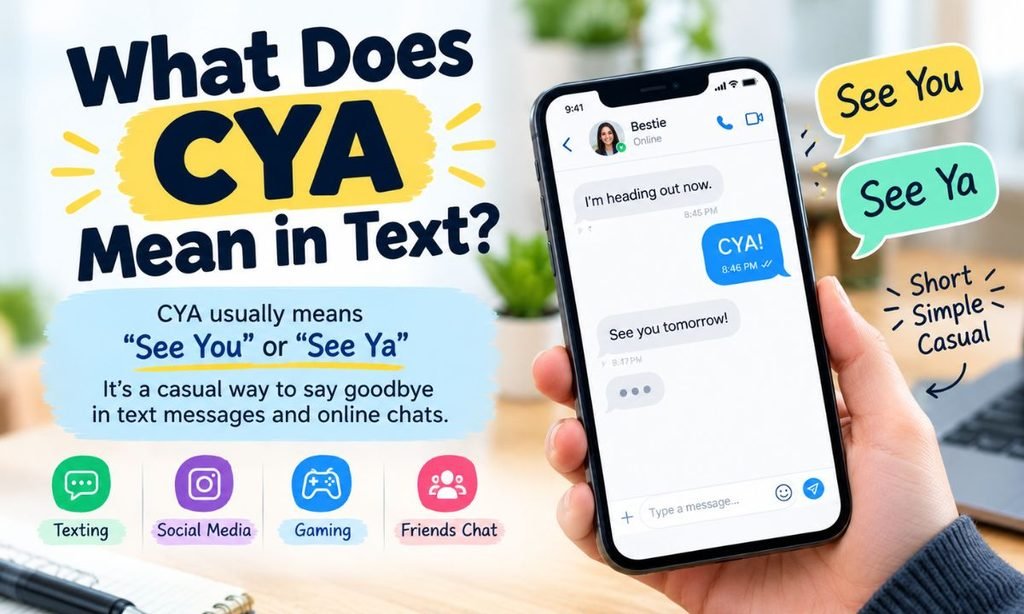
In everyday texting, CYA usually means “See You” or “See Ya.” It is a casual farewell used when someone is leaving a conversation, going offline, or expecting to see the other person later.
For example:
- “I have to go now, CYA!”
- “CYA tomorrow.”
- “Okay, I’m heading home. CYA later.”
- “Good game, CYA!”
The surrounding words normally make the intended meaning obvious.
CYA Meaning in Text and Chat
The CYA meaning in text and chat is generally a shortened version of “see ya,” which itself is an informal version of “see you.”
It works especially well in:
- Text messages
- Private chats
- Group conversations
- Gaming chats
- Social-media DMs
- Casual online conversations
CYA is informal, so it usually sounds more relaxed than “Goodbye” or “I will see you later.”
CYA Full Form and Slang Usage
CYA has two major meanings:
| CYA Meaning | Full Form | Common Context |
| See You / See Ya | See you | Texting, friends, social media |
| Cover Your Ass | Cover your ass | Workplace, business, documentation |
The first meaning is normally a casual farewell. The second is an informal expression about protecting yourself from blame, criticism, or possible consequences.
Definition & Meaning (Deep Explanation)
Main Meaning: See You
The most common CYA meaning in text is “See You” or “See Ya.” It is used as a quick goodbye when someone is ending a conversation or leaving.
Think of CYA as a shorter version of:
- See you later
- See ya
- Talk to you later
- Catch you later
Why People Use CYA
People use CYA because it is short, familiar, and casual. It allows them to close a conversation without typing a longer farewell.
For example, instead of writing:
“I have to leave now, but I will talk to you later.”
Someone might simply write:
“Gotta go, CYA!”
Real-Life Examples
Friend: “I’m going to grab some food.”
You: “Okay, CYA!”
Meaning: “Okay, see you!”
Another example:
A: “Are you coming to the game tomorrow?”
B: “Yep, CYA there.”
Meaning: “Yes, see you there.”
Emotional Tone of CYA
CYA is usually friendly, casual, and relaxed. The exact tone depends on the conversation and relationship.
It can feel:
- Friendly between close friends
- Neutral in a casual chat
- Playful when combined with jokes
- Slightly abrupt if sent alone during a serious conversation
Context matters more than the abbreviation itself.
Second Meaning: Cover Your Ass
CYA can also mean “Cover Your Ass.” In this sense, it refers to taking steps to protect yourself from blame, criticism, disputes, or other possible consequences.
This meaning is particularly associated with workplace or business situations.
Example
“Save the approval email for your records. CYA.”
Here, CYA does not mean “see you.” It means to protect yourself by keeping documentation.
Important Note
The phrase “Cover Your Ass” is informal and contains profanity. Some people may use the softer interpretation “Cover Your Assets” in professional environments, but the original slang expression is still recognizable as “Cover Your Ass.”
Why People Use CYA (Psychology Explained)
There is no single psychological reason everyone uses CYA. In ordinary communication, it mainly reflects convenience, familiarity, and an informal conversational style.
1. To End Conversations Smoothly
CYA provides a quick way to signal that the conversation is ending.
2. To Save Time
Three letters can replace a longer goodbye, making the message faster to type.
3. To Keep Tone Casual
“CYA” sounds less formal than “Goodbye” or “I look forward to seeing you.”
4. To Sound Relatable
Text abbreviations can make casual conversations feel more natural, especially among people who already use internet slang.
How to Use CYA in Text (Practical Guide)
Use CYA when the conversation is informal and the person understands casual texting language.
Examples
- “I’m off to class, CYA later.”
- “CYA tomorrow!”
- “Okay bro, CYA.”
- “I’m logging off now. CYA.”
- “Thanks for chatting. CYA soon.”
Quick Tips
- Use CYA with people you know.
- Use it mainly for casual conversations.
- Add “later,” “tomorrow,” or “there” when you want more context.
- Avoid it when a message needs a formal or unambiguous tone.
Usage in Different Contexts
Texting
In ordinary text messages, CYA usually means “See You” or “See Ya.”
Social Media
CYA can appear in comments, DMs, captions, and casual conversations as a short goodbye.
Gaming
Gamers may use CYA when leaving a match, ending a session, or saying goodbye to teammates.
Example: “I have work tomorrow. CYA guys.”
Friends Chat
Among friends, CYA is generally a relaxed way to leave a conversation.
Context Table
| Context | Likely Meaning | Tone |
| Friend texting | See You | Casual |
| Gaming chat | See You | Friendly |
| Snapchat DM | See Ya | Casual |
| Instagram DM | See You | Informal |
| Workplace documentation | Cover Your Ass | Informal |
| Formal email | Potentially unclear | Avoid |
CYA Meaning from a Girl
When a girl sends CYA in a casual conversation, it normally has the same basic meaning as when anyone else uses it: “See You” or “See Ya.”
Friendly Goodbye
“Okay, CYA later!”
This is usually just a friendly farewell.
Polite Ending
“Thanks for talking, CYA!”
Here, CYA closes the conversation in a relaxed way.
Neutral Exit
“CYA tomorrow.”
This simply indicates that she expects to see or speak with you again.
Do not assume that CYA itself carries a romantic meaning. The surrounding conversation provides more useful context.
Is CYA Rude in Text?
CYA is not normally rude. It is an informal farewell, but its tone can change depending on the situation.
When It’s NOT Rude
CYA generally feels normal when:
- Talking with friends
- Ending a gaming session
- Leaving a group chat
- Saying goodbye casually
- Confirming that you will meet later
When It Feels Rude
It can feel abrupt if someone sends only “CYA” during a serious or emotional conversation.
For example:
Person A: “I really need to talk about what happened.”
Person B: “CYA.”
In that situation, the short response could feel dismissive because of the surrounding context.
Example
Friendly: “I’m heading home. CYA tomorrow!”
Potentially abrupt: “CYA.”
The first message provides context, while the second depends entirely on the situation.
CYA Meaning on Snapchat, TikTok & Instagram
Snapchat
On Snapchat, CYA usually means “See Ya” or “See You.” It can be used when ending a private conversation or leaving a chat.
TikTok
On TikTok, CYA may appear in comments, direct messages, or live conversations as an informal goodbye.
On Instagram, CYA is commonly understandable as “See You” when used in DMs or casual conversations.
Across these platforms, the meaning generally comes from context rather than from the platform itself.
CYA Meaning in Chat vs Messages
The meaning is usually the same in both chats and text messages.
“CYA later” means “See you later.”
“CYA tomorrow” means “See you tomorrow.”
The main difference is the communication environment. In a casual chat, CYA can feel completely natural. In formal communication, it may be too informal or ambiguous.
Professional Communication
Avoid CYA (See You Meaning)
Although CYA can appear in casual workplace chats, it is better to use clearer language in formal emails, official documents, client communication, or important business messages.
Instead of:
“CYA tomorrow.”
Use:
- “See you tomorrow.”
- “Talk to you tomorrow.”
- “Speak with you soon.”
- “Thank you, and I’ll see you tomorrow.”
Note About “Cover Your Ass”
The second meaning creates another reason for caution at work. In a business conversation about documentation, responsibility, or risk, CYA may be understood as “Cover Your Ass.”
Better Alternatives
For professional communication, use direct wording such as:
- “Please keep a record of this.”
- “Please document the decision.”
- “Keep a copy for your records.”
- “This will provide supporting documentation.”
Hidden or Risky Meanings
Safe
When CYA appears at the end of a casual conversation, it is normally a harmless goodbye meaning “See You” or “See Ya.”
Risky
When CYA appears around workplace disputes, responsibility, documentation, or potential blame, it may mean “Cover Your Ass.”
Always examine the surrounding words before interpreting it.
Comparison with Similar Terms
| Term | Meaning | Tone |
| CYA | See You / See Ya | Casual |
| TTYL | Talk To You Later | Casual |
| BBL | Be Back Later | Casual |
| BRB | Be Right Back | Casual |
| GTG | Got To Go | Casual |
| L8R | Later | Very informal |
| CU | See You | Informal |
| Bye | Goodbye | Neutral |
| Take care | Goodbye/careful farewell | Friendly |
| Talk soon | Speak again soon | Friendly |
10 Slang Terms Related to CYA
Here are 10 common expressions that can serve a similar conversational purpose:
- TTYL — Talk To You Later
- CU — See You
- BBL — Be Back Later
- BRB — Be Right Back
- GTG — Got To Go
- L8R — Later
- Later — Casual goodbye
- Take care — Friendly farewell
- Talk soon — Intention to speak again
- Catch you later — Informal goodbye
How to Respond to CYA
Your response can match the tone of the original message.
Casual
“CYA!”
“Later!”
“See you!”
Funny
“CYA, don’t disappear!”
“Later, alligator!”
Professional
“See you tomorrow.”
“Talk to you soon.”
Safe
“Take care!”
“See you later!”
Dialogue Example
A: “I have to head out now.”
B: “No problem, CYA tomorrow!”
A: “Sounds good. See you!”
This is a typical casual use of CYA.
When NOT to Use CYA
Avoid CYA when clarity or professionalism is more important than brevity.
Do not rely on it for:
- Formal business emails
- Job applications
- Academic writing
- Official announcements
- Legal communication
- Important client messages
- Sensitive conversations
In these situations, write the full phrase instead.
Common Mistakes to Avoid
One common mistake is assuming CYA always means “See You.” The alternative “Cover Your Ass” meaning is established, particularly in business contexts.
Another mistake is assuming CYA is automatically rude. Its tone depends on the surrounding conversation.
You should also avoid assuming that CYA has a romantic meaning when someone sends it. In most casual messages, it is simply a farewell.
Finally, remember that CYA is informal slang, so it should not automatically replace clearer wording in professional communication.
FAQs
What does CYA mean in text?
CYA usually means “See You” or “See Ya,” a casual way to say goodbye in text messages and online chats.
Can CYA mean something else?
Yes. CYA can also mean “Cover Your Ass,” especially in workplace or business contexts involving protection from blame or consequences.
Is CYA rude in text?
Usually, no. CYA is generally a casual and friendly goodbye, although it can feel abrupt in a serious conversation.
What does CYA mean on Snapchat?
On Snapchat, CYA generally means “See Ya” or “See You” when someone is ending a conversation.
Should I use CYA at work?
Use caution. In formal workplace communication, “See you later” or “Talk to you soon” is clearer and avoids confusion with the alternative meaning.
Is CYA slang?
Yes. CYA is an informal texting abbreviation commonly used to mean “See You” or “See Ya.”
Conclusion
The most common CYA meaning in text is “See You” or “See Ya.” It is a short, informal farewell used in texting, social media, gaming chats, and conversations between friends.
However, CYA can also mean “Cover Your Ass,” particularly in workplace or business discussions about documentation, responsibility, and protecting yourself from possible consequences.
The easiest way to understand CYA is to look at the context. If someone writes “CYA tomorrow!”, they almost certainly mean “See you tomorrow.” If someone says “Keep that email for CYA,” the second meaning is more likely.
When in doubt, choose the meaning that fits the surrounding conversation rather than interpreting the three letters on their own.


3 thoughts on “CYA Meaning in Text: What It Really Means, Examples, Slang & Usage Guide (2026)”