

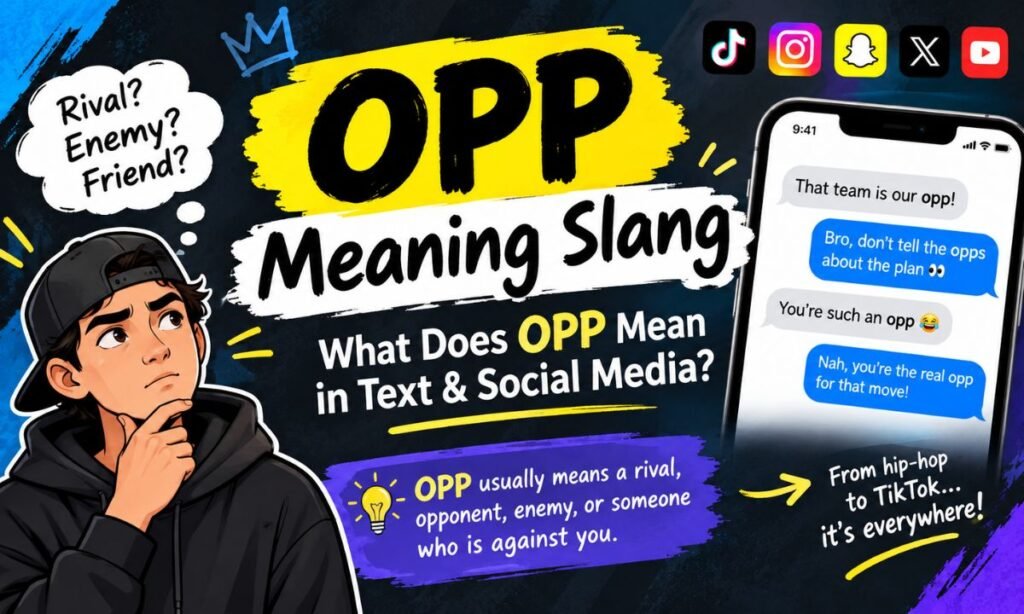
If you have recently noticed opp or opps in a TikTok comment, text, rap lyric, Instagram post, or gaming chat, you may have wondered what the word actually means. It is a short term, but its meaning can change depending on the situation and the relationship between the people using it.
The OPP Meaning Slang users commonly refer to is opponent, opposition, rival, or enemy. In casual internet conversations, however, the word is often used much more loosely. Someone might call a friend an “opp” after losing a game, or jokingly describe a difficult teacher, annoying alarm, or rival sports team as an opp.
Quick Answer
The OPP Meaning Slang most commonly refers to a person who is considered a rival, opponent, enemy, or someone who is against you.
The singular form is opp, while opps refers to more than one person. The seriousness depends on context. In some hip-hop and drill-related conversations, it can refer to genuine rivals, while social media users often use it humorously.
What Does Opp Mean?
The OPP Meaning Slang can be understood most simply as “someone on the opposing side.” It may describe a person you compete against, disagree with, distrust, or jokingly treat as an enemy.
The Core Definition
An opp is generally a rival, opponent, adversary, or enemy. If somebody says, “He is my opp,” they are saying that the person is against them or is viewed as being on the other side.
The word does not automatically mean that there is a serious conflict. Online users regularly stretch the term for jokes and playful rivalries.
The Plural Form: Opps
Opps is the plural form of opp. If one person is a rival, they can be called an opp; if several people are involved, they may be called the opps.
| Word | Meaning | Example |
| Opp | One rival or opponent | “He is an opp.” |
| Opps | Multiple rivals or opponents | “The opps are playing tonight.” |
The plural version is especially common in rap lyrics, gaming conversations, memes, and social media posts.
Opp as a Verb
Although opp is primarily used as a noun, people sometimes create informal expressions around it that make it sound verb-like. These uses are highly casual and are not standard English grammar.
For everyday communication, it is safest to understand opp as a noun rather than treating it as a formal verb.
The Origins of Opp Slang
Understanding the history helps explain why the word can sound serious in one situation and funny in another.
Early Roots in Hip-Hop
The modern OPP Meaning Slang is closely connected with hip-hop and street-influenced language. The idea centers on opposition—someone belonging to the other side or someone considered a rival.
The exact first use is difficult to assign to one individual because slang develops through communities rather than appearing at one clearly documented moment. Modern sources generally connect its widespread development to hip-hop culture.
The Chicago Drill Scene
Chicago drill music played an important role in making opp and opps widely recognizable during the early 2010s. In that environment, the term could refer to genuine rivals or people associated with opposing groups.
That background matters because the word can still carry a much stronger meaning in certain music or street-related contexts than it does in an ordinary TikTok joke.
From Street Slang to Mainstream
The OPP Meaning Slang changed as the term moved beyond its original cultural environments. Hip-hop, memes, gaming, and social media helped introduce the expression to much broader audiences.
Today, someone might say their “opps” are the other team in a video game. Another person might call a broken Wi-Fi connection their “biggest opp.” This broader, humorous usage is one reason the term appears so often online.
Context and Usage: How Opp Is Used Today
The Spectrum of Meaning
The OPP Meaning Slang is not always equally serious. Its tone can fall anywhere between genuine hostility and harmless teasing.
| Situation | Possible meaning | Typical tone |
| Serious dispute | Enemy or adversary | Strong |
| Sports | Rival team or player | Competitive |
| Gaming | Opposing player | Competitive |
| Friend group | Pretend enemy | Playful |
| Meme or TikTok | Annoying person or thing | Humorous |
The surrounding conversation is usually more important than the word itself.
When Context Matters
Consider the difference between these two statements:
“That team is our opp.”
This probably refers to a sports rival.
“Don’t tell the opps what we’re doing.”
That sounds more serious because the speaker appears to be talking about people they genuinely consider to be against them.
Context, tone, relationship, and platform all influence interpretation.
Who Uses Opp?
The word is now common across several online communities, including hip-hop fans, gamers, meme communities, and social media users.
Although younger internet users may use it frequently, opp is not restricted to one age group. Its meaning is better understood through context than by assuming who the speaker is.
Real-Life Examples of Opp in Conversation
1: Playful Rivalry Among Friends
A: “You joined their team again?”
B: “Yep.”
A: “You’re officially an opp.”
Here, the word is clearly being used as a joke.
2: Sarcastic Usage About a Teacher
Student: “We got homework for the holiday.”
Friend: “That is serious opp behavior.”
The speaker is exaggerating an ordinary complaint for humor.
3: Social Media Dramatic Usage
Comment: “She unfollowed me after one argument. Opp behavior.”
This usage turns a small social disagreement into exaggerated internet drama.
4: Competitive Gaming Context
Gamer: “The opp is hiding behind the wall.”
In gaming, opp can simply identify an opposing player.
5: Casual Flirtatious Usage
Person A: “You left me on read for six hours.”
Person B: “I was working!”
Person A: “Sounds like opp behavior to me.”
The tone here is teasing rather than genuinely hostile.
Platform-Specific Meaning
The OPP Meaning Slang generally stays the same across social platforms, but the tone can change considerably.
Opp on TikTok
TikTok has helped push opp into humorous everyday language. Creators may use it in skits, captions, comments, and reaction videos to describe someone or something supposedly working against them.
Opp on Instagram
On Instagram, the word can appear in Reels, comments, captions, Stories, and private messages. It may describe a rival, an unfriendly person, or someone who is jokingly being treated as an enemy.
Opp on Snapchat
Snapchat conversations tend to use opp casually. Someone might label a friend an opp after a disagreement, embarrassing joke, or playful betrayal.
Opp on Twitter/X
On X, opp frequently appears in sports debates, music discussions, fan arguments, memes, and online disagreements. The intended meaning can be either serious or exaggerated.
Opp on WhatsApp and Text Messages
In texting, the OPP Meaning Slang is usually understood from the surrounding conversation. A message such as “he’s an opp” generally means “he’s a rival” or “he’s against us.”
Alternative Meanings and Confusions
The Naughty by Nature Confusion
One reason people become confused about OPP is the famous Naughty by Nature song “O.P.P.” from 1991.
That title represents a separate acronym-based usage. It should not automatically be treated as the same thing as the modern slang word opp, which commonly refers to opposition or an opponent.
OP vs. Opp
Do not automatically treat OP and opp as the same word.
- OP can mean “original poster.”
- OP can mean “overpowered” in gaming.
- Opp commonly means opponent, rival, or opposition.
The additional p changes the slang meaning.
Opp as “Opposite”
Some people assume opp simply means “opposite.” While the abbreviation may look that way, that is not the main slang definition.
In most modern slang contexts, it is connected to opponent, opposition, rival, or enemy.
Related Terms and NLP Variations
Common Variations
The OPP Meaning Slang family includes several expressions you may encounter online:
- opp
- opps
- my opp
- the opps
- opp behavior
- opp activity
- real opp
- biggest opp
- opp check
Their precise meaning depends on the sentence and situation.
Synonyms
Depending on the context, related words include:
- opponent
- rival
- adversary
- enemy
- competitor
- antagonist
- hater
These words are not perfect substitutes because opp has a distinctly informal tone.
Antonyms
Possible opposites include:
- ally
- friend
- teammate
- supporter
- partner
If an opp is someone viewed as being on the opposing side, an ally generally represents someone on your side.
How to Respond If Someone Calls You an Opp
1: Assess the Context
Before responding, decide whether the person is joking, competing with you, or genuinely upset.
2: Respond Appropriately
If the exchange is clearly playful, you can answer with something like:
“How did I become the opp?”
If the situation is serious, a calmer response is usually better.
3: Match Their Energy
Do not turn a harmless joke into an argument. At the same time, avoid treating serious language as a joke when the conversation suggests real hostility.
Misinterpretations to Avoid
Don’t Assume It’s Always Hostile
The OPP Meaning Slang can describe a real rival, but social media users also apply the word to harmless situations for comedic effect.
Don’t Use It in Formal Settings
Opp is informal slang. In professional emails, academic work, or official communication, use words such as opponent, rival, or competitor instead.
Don’t Overuse It
Using slang naturally is more effective than putting it into every sentence. Forced slang can make a message sound unnatural.
Don’t Confuse It with “OP”
Remember that OP and opp have different common meanings online. Always look at the spelling and context.
When NOT to Use Opp
Professional Settings
The OPP Meaning Slang belongs mainly to casual communication. Formal situations call for clearer standard vocabulary.
With People Who Won’t Understand
If someone is unfamiliar with internet slang, saying “rival” or “opponent” will usually communicate your meaning more effectively.
In Serious Conflicts
Calling someone an opp during a genuine dispute may make the situation sound more confrontational. Choose your words carefully.
When You’re Not Sure of the Tone
If you cannot tell whether the speaker is joking or serious, avoid making assumptions. Look at the surrounding conversation first.
Usage Tips for Mastering Opp
1: Start with Friends
Use the term around people who already understand casual internet slang.
2: Match the Platform
Opp fits naturally in texts, gaming chats, social media comments, memes, and informal conversations.
3: Use the Plural Form
Use opp for one person and opps when referring to several people.
4: Don’t Force It
A slang term works best when it naturally fits the conversation rather than being inserted simply because it is trending.
5: Learn from Context
The easiest way to understand the OPP Meaning Slang is to study the words around it. The same term can sound funny, competitive, sarcastic, or serious depending on the situation.
Frequently Asked Questions
1. What does opp mean in slang?
Opp usually means an opponent, rival, enemy, or someone who is considered to be against you.
2. Where did opp slang come from?
Modern slang use is strongly associated with hip-hop and became particularly prominent through Chicago drill culture in the early 2010s.
3. Is opp always negative?
No. Online users often use opp jokingly for friends, competitors, annoying situations, or harmless rivalries.
4. What does “opps” mean?
Opps is the plural form of opp and generally refers to multiple rivals, opponents, or enemies.
5. What does “opp check” mean on TikTok?
“Opp check” is an informal phrase used jokingly to identify or call out someone considered to be on the opposing side.
6. What’s the difference between OP and opp?
OP can mean original poster or overpowered, while opp usually refers to an opponent, rival, or enemy.
Conclusion
The OPP Meaning Slang is easier to understand when you focus on the idea of opposition. An opp can be a rival, opponent, enemy, or someone perceived as being against you, while opps refers to multiple people.
The term has roots connected to hip-hop and became especially visible through Chicago drill before spreading into mainstream internet culture. Today, its use is much broader. A person might use it seriously in a discussion about rivalry or casually call their friend an opp after a silly disagreement.
Ultimately, context is everything. If you see opp in a text, TikTok comment, gaming chat, or rap lyric, look at the surrounding words before deciding how serious the speaker intends it to be.