

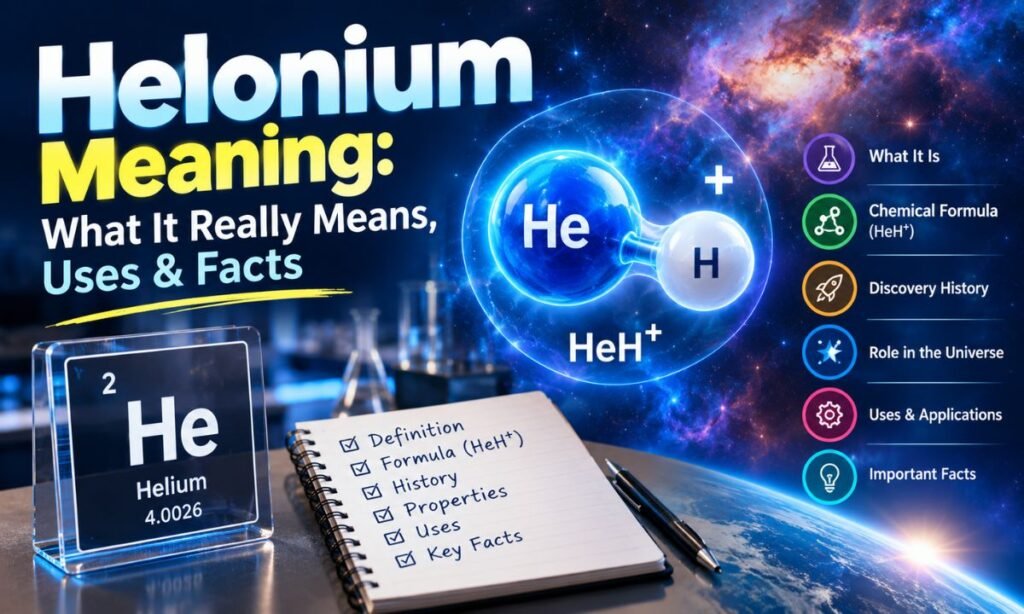
If you have searched for Helonium Meaning, you may be surprised to learn that helonium is not a chemical element. The term refers to HeH⁺, the helium hydride ion, an unusual positively charged molecular ion made from helium and hydrogen.
Helonium is especially interesting because of its connection to the chemistry of the early universe. Scientists first produced HeH⁺ in the laboratory in 1925, but its presence in space was not confirmed until 2019, when astronomers detected it in the planetary nebula NGC 7027 using the SOFIA airborne observatory.
Quick Answer: What Does Helonium Mean?
Helonium means the helium hydride ion, HeH⁺. It is a positively charged molecular ion consisting of helium bonded to hydrogen, more precisely a helium atom associated with a proton.
In simple terms:
- He = helium
- H = hydrogen
- + = one positive net charge
- HeH⁺ = helium hydride ion, also called helonium
It is a molecular ion, not an element on the periodic table.
What Is Helonium?
Helonium is the common name for HeH⁺, formally described as hydridohelium(1+). It is one of the simplest molecular ions that can exist and is important in both molecular physics and astrochemistry.
The species contains two nuclei but only two electrons. Its unusual electronic structure makes it a valuable test case for extremely accurate calculations of molecular structure, quantum mechanics, and chemical bonding. Modern theoretical work continues to use HeH⁺ as a benchmark molecular system.
What Does HeH⁺ Represent?
The formula HeH⁺ represents a helium hydride molecular cation. It can also be viewed as protonated helium, because a proton can associate with a neutral helium atom.
The positive charge is important. Ordinary helium is neutral, whereas HeH⁺ carries a net +1 charge.
Is Helonium a Chemical Element?
No. Helonium is not a chemical element.
The periodic table contains helium, which has atomic number 2. Helonium has no independent atomic number because it is a molecular ion made from existing atomic nuclei.
This distinction is essential:
| Name | What it is | Formula |
| Helium | Chemical element | He |
| Hydrogen | Chemical element | H |
| Helonium | Molecular ion | HeH⁺ |
| Helium hydride ion | Same molecular ion | HeH⁺ |
So, helonium should not be added to a list of chemical elements.
Helonium vs. Helium vs. Helium Hydride
These terms are related but do not mean exactly the same thing.
Helium is a neutral noble-gas element. It is extremely resistant to ordinary chemical reactions.
Helium hydride ion describes the molecular ion formed from helium and hydrogen.
Helonium is another name used for the helium hydride ion, HeH⁺. Chemical databases identify the species as hydridohelium(1+) and list helonium as an alternative name.
Origin and Etymology of the Word “Helonium”
The word helonium is derived from the helium-based name combined with the -onium naming pattern used for certain positively charged species.
The ending can make the term sound like the name of an element, but that interpretation is incorrect. In this case, helonium identifies a positively charged molecular species rather than a new entry on the periodic table.
For scientific accuracy, HeH⁺ or “helium hydride ion” is often the clearest terminology.
How Was Helonium Discovered?
The history of HeH⁺ goes back to 1925, when T. R. Hogness and E. G. Lunn observed evidence for the ion in laboratory experiments involving hydrogen and helium. Their mass-spectrometric work produced an ion with a mass-to-charge ratio consistent with HeH⁺.
This was an important laboratory result, but detecting the ion in space was much harder. Researchers spent decades searching for an astronomical signal that could provide direct evidence of naturally occurring HeH⁺.
Helonium and the Early Universe
HeH⁺ has a special place in cosmology because it is predicted to have formed during the early stages of molecular chemistry in the universe.
As the young universe cooled, helium recombined into neutral atoms before hydrogen had fully recombined. Neutral helium could then react with abundant protons through radiative association:
He + H⁺ → HeH⁺ + photon
The resulting HeH⁺ could then participate in chemical pathways leading toward molecular hydrogen formation.
How Does Helonium Form?
One important formation pathway is the radiative association of neutral helium with a proton:
He + H⁺ → HeH⁺ + hν
Here, hν represents the emitted photon that allows the newly formed ion to carry away excess energy.
In hot astrophysical environments, other reaction pathways can also contribute. In planetary nebulae such as NGC 7027, ionized helium and hydrogen chemistry creates conditions where HeH⁺ can form.
Why Can Helium Form Helonium if Helium Is Inert?
Helium is called inert because neutral helium has a filled electron shell and is highly resistant to ordinary chemical bonding.
However, “inert” does not mean that helium can never participate in any interaction. Under energetic or ionized conditions, helium can form unusual molecular ions.
HeH⁺ is an excellent example. Its formation involves a charged system and unusual bonding rather than the ordinary chemistry associated with stable neutral molecules.
Chemical Structure and Bonding of HeH⁺
HeH⁺ contains a helium nucleus and a hydrogen nucleus with two electrons in the molecular system. Because the two atoms have very different electronic properties, the bonding is unusual.
The ion is heteronuclear, meaning it contains two different types of nuclei. It also has a permanent dipole moment, which is important for its rotational spectroscopy and helped scientists identify its astronomical signal.
Physical and Chemical Properties of Helonium
Some useful facts about HeH⁺ include:
| Property | Information |
| Common name | Helonium |
| Scientific identity | Helium hydride ion |
| Formula | HeH⁺ |
| Systematic name | Hydridohelium(1+) |
| Charge | +1 |
| Type | Molecular cation |
| Approximate molar mass | 5.01 g/mol |
| Main elements | Helium and hydrogen |
| Atomic number | None of its own |
| Laboratory observation | 1925 |
| Astronomical detection | 2019 |
HeH⁺ is highly reactive and is not something that can be stored as an ordinary bulk gas under normal conditions. Its importance is primarily scientific rather than commercial.
Where Does Helonium Exist?
HeH⁺ can exist in laboratory environments under suitable conditions and can form naturally in certain astrophysical environments.
The most famous confirmed astronomical location is NGC 7027, a young planetary nebula. The detection there provided direct evidence that HeH⁺ exists in interstellar space.
Scientists also study HeH⁺ because theoretical models predict an important role for it in the chemistry of the early universe.
The 2019 Astronomical Detection of HeH⁺
In 2019, an international research team reported the first unambiguous astronomical detection of HeH⁺ in NGC 7027.
Researchers used the GREAT far-infrared spectrometer aboard SOFIA to observe the ion’s rotational ground-state transition at a wavelength of about 149.1 micrometres, corresponding to a frequency near 2.01 THz.
Why the 2019 Detection Mattered
The discovery solved a long-standing observational problem. Scientists had known about HeH⁺ from laboratory experiments and theoretical models for decades, but they lacked definitive evidence that the ion existed naturally in interstellar space.
The detection helped validate models of molecular chemistry in planetary nebulae and improved scientists’ understanding of chemical pathways involving helium and hydrogen.
How Scientists Detect Helonium
Scientists detect HeH⁺ through spectroscopy rather than by simply collecting a visible sample.
Molecules and molecular ions can absorb or emit electromagnetic radiation at characteristic frequencies. Researchers search for a spectral feature matching a known HeH⁺ transition.
For NGC 7027, the successful observation relied on far-infrared and terahertz spectroscopy. The distinctive rotational transition provided the evidence needed to identify the ion.
Where Is Helonium Used?
Helonium does not have many conventional industrial uses because HeH⁺ is extremely reactive and difficult to maintain as a bulk material.
Its value is mainly scientific. Researchers use it to investigate:
- Molecular structure
- Quantum chemistry
- Chemical bonding
- Spectroscopy
- Astrochemistry
- Early-universe chemistry
- Ion-molecule reactions
- Theoretical molecular physics
In other words, HeH⁺ is more important as a research subject than as a commercial chemical.
Why Is Helonium Scientifically Important?
HeH⁺ is important because it connects laboratory chemistry with cosmic history.
It is simple enough to serve as an excellent theoretical model, yet unusual enough to reveal important details about molecular bonding and ion chemistry. Its predicted role in primordial chemistry also helps scientists understand how the universe moved from simple atoms toward increasingly complex molecular systems.
Helonium in Astrophysics and Astrochemistry
In astrochemistry, HeH⁺ is particularly interesting because it can participate in reaction networks that eventually contribute to molecular hydrogen chemistry.
Molecular hydrogen was essential to the cooling and evolution of primordial gas. Therefore, understanding the earlier chemical pathways involving HeH⁺ can improve models of the early universe and the conditions that eventually supported the formation of the first stars.
Common Misconceptions About Helonium
“Helonium Is a New Element”
No. Helonium is a molecular ion, not a chemical element.
“Helonium Is Another Name for Helium”
No. Helium is the element He, while helonium refers to HeH⁺.
“Helonium Has Its Own Atomic Number”
No. Atomic numbers belong to elements. HeH⁺ is made from helium and hydrogen and therefore has no independent atomic number.
“Helonium Is a Stable Gas”
No. HeH⁺ can exist under suitable conditions, but it is extremely reactive and is not a normal stable gas that can be stored like helium.
“Helonium Has Many Industrial Uses”
No. Its main importance is in chemistry, spectroscopy, astrophysics, and studies of the early universe.
“Helonium Is Fictional”
No. HeH⁺ was observed in laboratory experiments in 1925 and was directly detected in interstellar space in 2019.
Helonium vs. Other “-onium” Chemical Species
The -onium ending appears in the names of various positively charged chemical species. Examples include protonated noble-gas species such as argonium and related ions.
However, the suffix alone does not tell you that something is an element.
For helonium, the key identity is:
Helonium = helium hydride ion = HeH⁺
Chemical databases list HeH⁺ under the systematic identity hydridohelium(1+).
Key Scientific Facts About Helonium
Here are the most important facts at a glance:
- Formula: HeH⁺
- Common name: Helonium
- Scientific name: Helium hydride ion
- Systematic name: Hydridohelium(1+)
- Charge: +1
- Type: Molecular cation
- Laboratory observation: 1925
- First confirmed astronomical detection: 2019
- Astronomical source: NGC 7027
- Detection method: Far-infrared/terahertz spectroscopy
- Research fields: Chemistry, quantum physics, astrophysics, and astrochemistry
Helonium Pronunciation and Spelling
The word helonium is generally pronounced with the emphasis on the middle syllable. In scientific writing, the spelling should be kept distinct from similar-looking words.
Do not confuse helonium with unrelated terms or assume that the ending means it is an element. When accuracy matters, using HeH⁺ or “helium hydride ion” removes most ambiguity.
How to Research Helonium Correctly
For reliable information about HeH⁺, prioritize scientific databases, peer-reviewed research, and established astronomy institutions.
Useful sources include:
- Peer-reviewed papers describing HeH⁺.
- Chemical databases such as ChEBI.
- NASA and SOFIA archival material.
- Nature and other scientific journals.
- Research from major astronomy and chemistry institutions.
Be cautious with pages that describe helonium as a new element or a normal gas. Those descriptions confuse the molecular ion with the element helium.
A Closer Look: The 1925 Laboratory Evidence vs. the 2019 Space Detection
The two milestones answer different scientific questions.
| Year | Event | Importance |
| 1925 | HeH⁺ observed in laboratory experiments | Established evidence for the molecular ion |
| Late 20th century | Astrophysical models predicted detectable HeH⁺ | Suggested where astronomers might find it |
| 2019 | HeH⁺ detected in NGC 7027 | Confirmed its presence in interstellar space |
The gap between these discoveries shows how difficult astronomical molecular detection can be. Scientists knew what signal to look for, but finding that signal in space required improved instruments and carefully selected targets.
A Scientific Case Study: NGC 7027
NGC 7027 is a young planetary nebula produced during the late evolutionary stages of a star similar to the Sun.
Its physical conditions are particularly useful for studying HeH⁺. The central star produces intense radiation, while regions containing ionized helium and hydrogen provide an environment where the molecular ion can form.
In 2019, SOFIA observations identified the characteristic rotational transition of HeH⁺ coming from NGC 7027. This became the first confirmed detection of the ion in space.
Why the “First Molecule in the Universe” Claim Needs Care
HeH⁺ is widely described as the first molecule of the universe, and this is useful shorthand, but the statement deserves some qualification.
Scientific discussions distinguish between the first molecular bond, the first molecule formed in significant abundance, and competing short-lived molecular species. Some theoretical work has considered species such as He₂⁺ in discussions of primordial molecular formation.
For that reason, a more careful statement is that HeH⁺ is widely regarded as the first important molecular species formed during primordial chemistry and is predicted to have been the first molecular bond involving neutral helium.
FAQs
What does helonium mean?
Helonium is another name for the helium hydride ion, HeH⁺, a positively charged molecular ion made from helium and hydrogen.
Is helonium an element?
No. Helonium is a molecular ion, not an element, and it has no independent atomic number.
What is the chemical formula for helonium?
The chemical formula is HeH⁺, representing the helium hydride molecular cation.
Is helonium the same as helium?
No. Helium is the neutral chemical element He, while helonium refers to the charged molecular ion HeH⁺.
Where was helonium detected in space?
HeH⁺ was first unambiguously detected in the planetary nebula NGC 7027 in 2019 using SOFIA’s GREAT spectrometer.
Why is helonium important?
Helonium is important because it provides insight into molecular bonding, astrochemistry, and the chemical processes that occurred during the early universe.
Conclusion
Helonium is not a mysterious new element or an alternative name for ordinary helium. It is the helium hydride ion, HeH⁺, an unusual positively charged molecular species with an important role in modern chemistry and astronomy.
Its story stretches from laboratory experiments in 1925 to the first confirmed detection in space in 2019. The discovery of HeH⁺ in NGC 7027 provided an important observational confirmation of a molecule that scientists had studied for nearly a century.
Most importantly, HeH⁺ offers a fascinating link between the smallest chemical systems and the largest questions in cosmology. By studying this simple ion, scientists can learn more about molecular bonding, interstellar chemistry, and how the universe began developing the molecular chemistry that eventually helped shape stars and galaxies.