

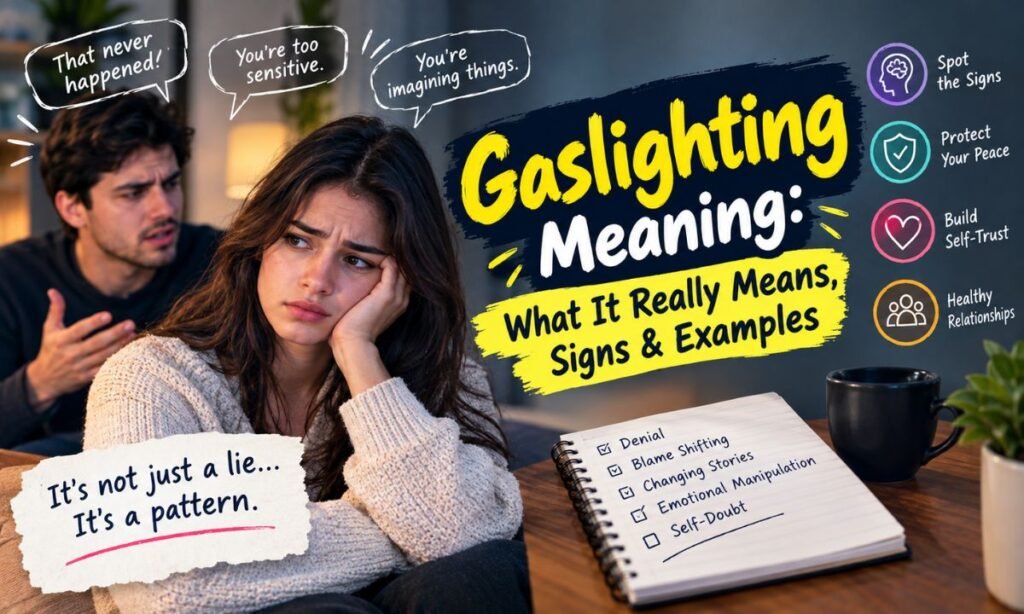
Understanding Gaslighting Meaning is important because the term is often used incorrectly online. Gaslighting refers to a repeated pattern of psychological manipulation that can make someone question their memory, perception, feelings, or understanding of events. It can occur in romantic relationships, families, friendships, workplaces, and social situations.
Unlike an ordinary disagreement, gaslighting can gradually weaken a person’s confidence in their own judgment. Someone may deny things that happened, change their story, shift responsibility, or dismiss another person’s feelings. Understanding the pattern can make it easier to recognize unhealthy communication and protect your self-trust.
Quick Answer: What Does Gaslighting Mean?
The simplest Gaslighting Meaning is a form of psychological manipulation in which a person repeatedly causes someone else to doubt their own memories, observations, feelings, or perception of reality.
Gaslighting does not necessarily mean that every statement is a lie. The important part is the repeated attempt to create confusion or make another person believe that their understanding of events cannot be trusted.
The key characteristics of gaslighting include:
- Repeatedly denying something that happened.
- Making someone question their memory.
- Dismissing reasonable feelings as excessive.
- Changing the explanation when challenged.
- Shifting responsibility for harmful behavior.
- Using someone’s past mistakes to discredit them.
- Making ordinary disagreements unnecessarily confusing.
- Gradually reducing a person’s confidence in their own judgment.
What Is Gaslighting?
A clear Gaslighting Meaning describes behavior that undermines someone’s confidence in their own perception or understanding of reality. The behavior may involve denial, manipulation, blame-shifting, minimization, or repeatedly presenting a different version of events.
The term is sometimes used for any frustrating conversation, but genuine gaslighting generally involves a pattern rather than one isolated disagreement.
How Gaslighting Works
Gaslighting can develop gradually. A person may first deny a small event, dismiss a concern, or insist that another person’s memory is wrong. If this happens repeatedly, the targeted person may begin questioning themselves before questioning the other person’s behavior.
A common pattern looks like this:
- Something happens that causes concern.
- The person responsible denies or minimizes it.
- The conversation shifts toward the other person’s reaction.
- The original issue becomes difficult to discuss.
- Repetition creates uncertainty and self-doubt.
Gaslighting vs. Lying
Gaslighting and lying can overlap, but they are not identical. A lie involves giving false information, while gaslighting specifically involves undermining another person’s confidence in their own perception, memory, or judgment.
| Behavior | Main characteristic |
|---|---|
| Lying | Providing false information |
| Gaslighting | Making someone doubt their perception or memory |
| Manipulation | Influencing someone through deceptive or controlling behavior |
| Disagreement | Two people hold different views or memories |
Therefore, one lie does not automatically mean someone is gaslighting you.
Gaslighting vs. Manipulation
Manipulation is a broad category of behavior designed to influence another person’s thoughts, emotions, or actions. Gaslighting is more specific because it focuses on creating doubt about someone’s own understanding or perception.
For example, guilt-tripping someone into doing a favor may be manipulative, but it is not necessarily gaslighting. Gaslighting becomes more relevant when someone repeatedly tries to convince the other person that their observations, memories, or feelings are unreliable.
Gaslighting vs. Disagreement
A disagreement is a normal part of relationships. Two people can remember the same event differently without either person attempting to manipulate the other.
Someone might say, “I remember that conversation differently,” and still respect your right to have another perspective. Gaslighting is more concerning when disagreements repeatedly become attacks on your memory, intelligence, emotions, or ability to understand reality.
The key difference is usually the pattern and intention or effect, not simply whether two people remember something differently.
Where Did the Term Gaslighting Come From?
The modern Gaslighting Meaning comes from the 1938 stage play Gas Light by Patrick Hamilton and its later film adaptations, particularly the 1944 movie Gaslight.
In the story, a husband manipulates his wife and causes her to question things she observes around their home. The changing gaslights become one of the memorable examples of this manipulation.
The word eventually entered psychological and everyday language to describe behavior that causes someone to doubt their own perception or understanding.
Common Signs of Gaslighting
Recognizing Gaslighting Meaning in real situations requires looking at repeated behavior rather than relying on one suspicious sentence.
“That Never Happened”
A person repeatedly denies events that you remember clearly. If the denial becomes a consistent way of avoiding responsibility, it can contribute to confusion and self-doubt.
“You’re Too Sensitive”
Instead of addressing the behavior that caused your reaction, the person focuses on portraying your emotional response as the problem.
“You’re Imagining Things”
This statement dismisses your observations by suggesting that the problem exists only in your mind.
Constantly Changing the Story
The explanation changes whenever you raise another detail. Rather than providing clarity, the shifting version of events leaves you unsure about what actually happened.
Shifting the Blame
Responsibility for the original problem is redirected toward you. You may eventually find yourself defending your behavior instead of discussing the issue that started the conversation.
Using Your Past Mistakes Against You
Old mistakes or personal vulnerabilities may repeatedly be introduced to discredit your current concerns. A past error does not automatically make a current observation invalid.
Making You Question Your Memory
Repeated claims that you “always remember things wrong” can gradually make you distrust your own recollection.
Real-Life Examples of Gaslighting
Understanding Gaslighting Meaning becomes easier when you see how the behavior can appear in different environments.
Gaslighting in Romantic Relationships
One partner repeatedly denies hurtful comments, refuses to acknowledge previous conversations, or tells the other person they are imagining relationship problems.
Gaslighting Between Family Members
A family member may deny making a hurtful statement and insist that another relative is exaggerating or inventing the event.
Gaslighting in Friendships
A friend may repeatedly dismiss your concerns, deny previous conversations, and make you feel unreasonable for establishing ordinary boundaries.
Gaslighting at Work
A coworker or manager may deny giving an instruction, change their account of a meeting, or make an employee question whether an important discussion actually occurred.
Gaslighting in Social Groups
A group may repeatedly dismiss someone’s experience, deny exclusion, or portray the person as unreasonable whenever they raise concerns.
What Does Gaslighting Sound Like?
Common phrases associated with gaslighting can include:
- “That never happened.”
- “You’re remembering it wrong.”
- “You’re making a big deal out of nothing.”
- “You’re imagining problems.”
- “You’re too sensitive.”
- “Everyone thinks you’re the problem.”
- “I never said that.”
- “You’re always confused.”
However, a single phrase does not prove gaslighting. Context, repetition, and the overall relationship pattern matter much more.
How Gaslighting Makes You Feel
The emotional impact of gaslighting can vary from person to person. Someone may feel confused, anxious, frustrated, isolated, defensive, or uncertain about their own judgment.
Another common experience is repeatedly apologizing just to end an argument. A person may also start checking their memories with others because they no longer feel confident about their own recollection.
Effects of Long-Term Gaslighting
The long-term Gaslighting Meaning becomes especially important when repeated manipulation begins affecting a person’s everyday confidence and relationships.
Self-Confidence
Constantly having your experiences dismissed can make you question whether your opinions and reactions are reasonable.
Decision-Making
You may begin asking others to confirm even simple decisions because you are afraid of trusting yourself.
Relationships
Repeated emotional manipulation can cause withdrawal, isolation, or difficulty trusting other people.
Work and Daily Life
Persistent self-doubt may affect communication, concentration, productivity, and confidence in everyday situations.
Boundaries
Someone who has repeatedly been told that their boundaries are unreasonable may become hesitant to say no or express discomfort.
Why Do People Gaslight Others?
There is no single explanation for gaslighting behavior. It may be associated with control, avoiding accountability, emotional manipulation, insecurity, unhealthy communication patterns, or abusive relationship dynamics.
It is also important not to assume that you can always determine someone’s private motivation. The effect of repeated behavior can matter even when the person’s intention is unclear.
Who Can Be Targeted by Gaslighting?
Anyone can experience gaslighting. It is not restricted to romantic relationships or a particular age, gender, personality, or social background.
It may occur wherever people have close relationships, emotional dependence, authority differences, or ongoing communication. The important issue is the behavior itself rather than the identity of the person experiencing it.
Is Gaslighting Always Intentional?
The Gaslighting Meaning does not necessarily require proving what another person intended internally. Some harmful behaviors may be deliberate, while others may happen through unhealthy communication patterns without complete awareness.
Regardless of intention, repeated behavior that makes someone chronically doubt their memory, perception, or judgment deserves attention.
How to Tell If You’re Being Gaslighted
Look for patterns rather than trying to diagnose the situation from one conversation.
Ask yourself:
- Do I frequently leave conversations feeling confused?
- Do I repeatedly question my own memory?
- Does the other person rarely accept responsibility?
- Are my feelings regularly dismissed?
- Does the story change whenever I raise details?
- Have I become dependent on the other person’s version of events?
- Do trusted people notice that I seem less confident?
These questions cannot provide a diagnosis, but they can help you identify unhealthy communication patterns.
How to Respond to Gaslighting
Knowing the Gaslighting Meaning can help you respond without getting trapped in endless arguments about every detail.
Trust Your Observations
You do not have to prove every part of your experience before taking your feelings and observations seriously.
Keep Records When Appropriate
For important workplace, financial, or practical matters, keep accurate records of dates, instructions, messages, and decisions when it is lawful and safe to do so.
Set Clear Boundaries
Explain what behavior you will accept and what you will do if the behavior continues.
Avoid Endless Arguments About Reality
You do not have to spend hours proving every detail of your memory. If a conversation repeatedly becomes circular, stepping away may be healthier.
Seek Outside Perspective
A trusted friend, family member, counselor, therapist, or another appropriate professional can provide a useful outside perspective.
Protect Your Safety
If manipulation occurs alongside threats, intimidation, stalking, physical violence, financial control, or isolation, prioritize your safety and seek appropriate support.
How to Stop Gaslighting From Affecting Your Self-Trust
Understanding Gaslighting Meaning is only one part of rebuilding confidence. The next step is learning to evaluate your own experiences without automatically dismissing yourself.
Separate Facts From Interpretations
Write down what you directly observed separately from what you believe it might mean. This can make confusing situations easier to evaluate.
Keep Track of Patterns
Look at repeated behavior instead of judging yourself based on one difficult conversation.
Make Small Decisions Independently
Start with ordinary choices and allow yourself to trust your judgment without constantly seeking approval.
Stay Connected to Healthy Relationships
Supportive relationships can remind you that healthy disagreement does not require humiliation, confusion, or control.
Gaslighting in Different Contexts: Quick Comparison
| Context | Possible pattern |
|---|---|
| Romantic relationship | Denying behavior, minimizing feelings, shifting blame |
| Family | Rewriting events or dismissing memories |
| Friendship | Invalidating concerns or boundaries |
| Workplace | Denying instructions or changing accounts |
| Social groups | Discrediting concerns or denying exclusion |
What Gaslighting Is Not
Normal Disagreement
Two people can genuinely remember an event differently without either person manipulating the other.
Forgetfulness
People naturally forget details or conversations. Ordinary forgetfulness is not automatically gaslighting.
Different Memories
Human memory is imperfect. A difference in recollection alone does not establish manipulation.
Constructive Criticism
Respectful criticism focuses on behavior and allows room for discussion. It does not require someone to distrust their entire perception.
Setting a Boundary
Saying that you are uncomfortable or choosing not to participate in a conversation is a boundary, not gaslighting.
Admitting a Mistake
Someone who admits uncertainty or accepts responsibility is demonstrating openness rather than necessarily engaging in manipulation.
Common Misconceptions About Gaslighting
The Gaslighting Meaning is frequently misunderstood because the term has become popular in social media conversations.
“Any Lie Is Gaslighting”
Not every lie qualifies as gaslighting. Gaslighting specifically involves undermining someone’s confidence in their own perception, memory, or judgment.
“Anyone Who Disagrees With Me Is Gaslighting Me”
Disagreement is normal. A person can have a different opinion without trying to manipulate your sense of reality.
“Gaslighting Always Looks Obvious”
Gaslighting may be subtle and develop over time through repeated conversations and small dismissals.
“You Need Perfect Proof Before Trusting Yourself”
You do not need perfect evidence to take your concerns seriously. Appropriate documentation and outside perspectives can help you evaluate patterns.
“Calling Someone a Gaslighter Fixes the Problem”
A label alone does not resolve an unhealthy relationship. Clear boundaries, support, practical decisions, and safety can be more useful.
How to Talk to Someone Who May Be Gaslighting You
If you suspect a repeated pattern, keep your communication specific and focused on observable behavior.
You might say:
“I remember the situation differently, and I am not comfortable continuing this conversation if my experience is being dismissed.”
Avoid getting pulled into an endless debate over every small detail. If the discussion becomes hostile or circular, you can pause it and return to the issue later if doing so is safe.
When to Seek Professional or Outside Help
A clear understanding of Gaslighting Meaning can help you recognize when outside support may be useful.
Consider speaking with a trusted person or qualified professional when the behavior is persistent, affects your confidence, interferes with daily life, isolates you from others, or occurs alongside other forms of abuse.
A counselor or therapist can help you examine relationship patterns and develop healthier boundaries. If there are threats, violence, stalking, coercive control, or immediate safety concerns, seek appropriate local support and prioritize your physical safety.
FAQs
What is the simplest definition of gaslighting?
Gaslighting is repeated psychological manipulation that causes someone to doubt their memory, perception, feelings, or understanding of events.
What are the biggest signs of gaslighting?
Common signs include repeated denial, blame-shifting, changing stories, dismissing feelings, and making you question your own memory or judgment.
Is gaslighting the same as lying?
No. Lying involves false information, while gaslighting involves undermining someone’s confidence in their own perception or understanding.
Can someone gaslight you without realizing it?
Yes. A person may engage in harmful communication without fully recognizing its impact, although repeated behavior can still be damaging.
How do you respond to someone who gaslights you?
Stay focused on observable facts, establish boundaries, avoid endless arguments, document important matters when appropriate, and seek support from trustworthy people.
Conclusion
A strong understanding of Gaslighting Meaning helps separate genuine psychological manipulation from ordinary disagreements, forgetfulness, or differences in memory. Gaslighting is generally about a repeated pattern that causes someone to lose confidence in their own perception, memory, feelings, or judgment.
If you notice repeated denial, blame-shifting, changing stories, emotional dismissal, or pressure to distrust yourself, pay attention to the overall pattern. You do not have to win every argument to take your experiences seriously. Healthy relationships should allow people to communicate concerns, disagree respectfully, admit mistakes, and maintain reasonable boundaries.