

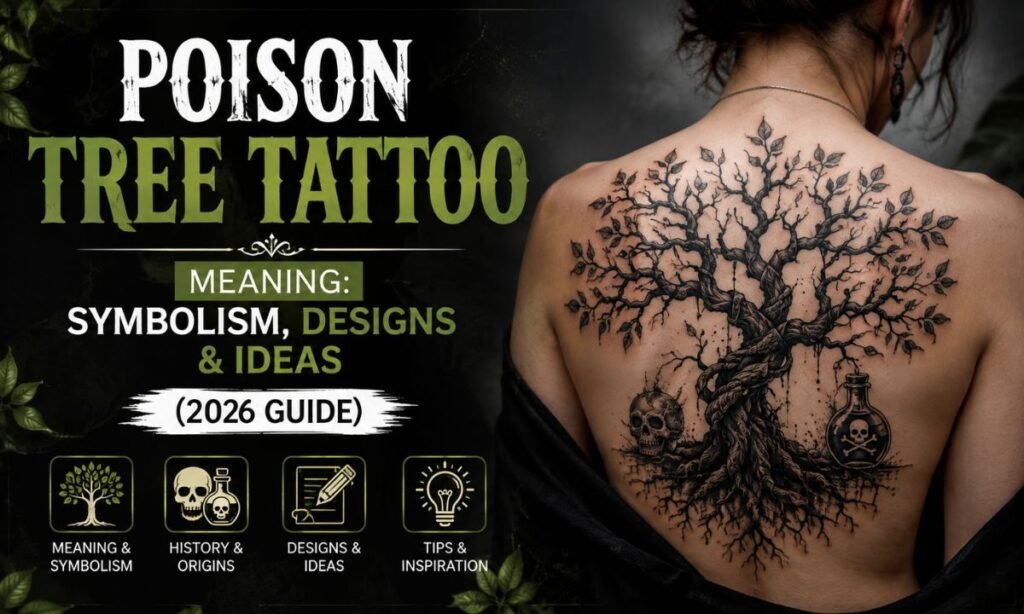
A poison tree tattoo isn’t your average nature piece. It’s dark, a little unsettling, and packed with meaning that goes way beyond “I like trees.” If you’ve been staring at these designs and wondering what they actually represent or whether one fits your story this guide covers everything: the literary roots, the symbolism, the styles, and how to make the design personal to you.
What Does a Poison Tree Tattoo Mean?
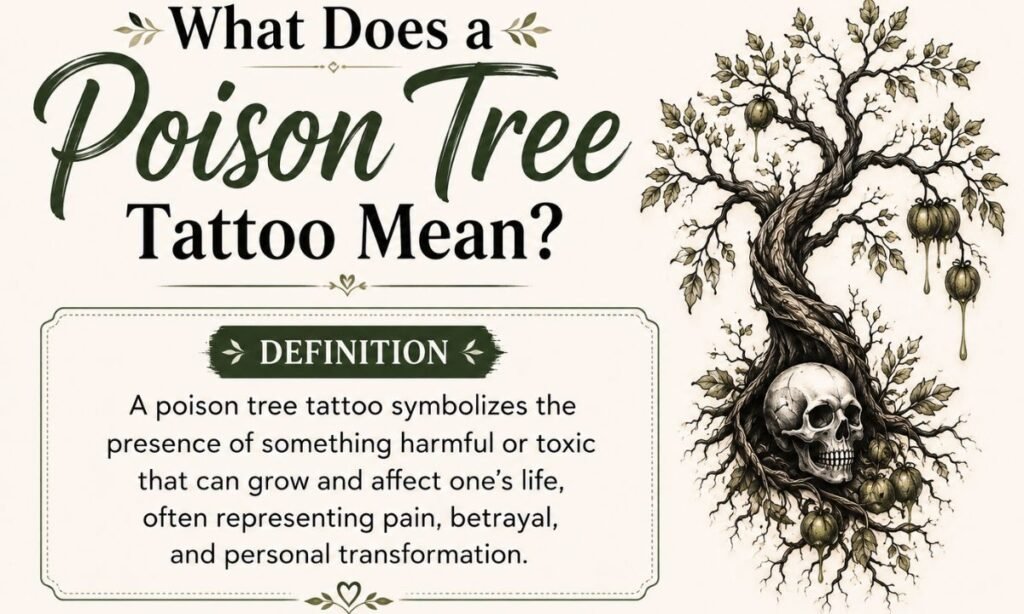
At its core, a poison tree tattoo represents hidden anger that grows in silence. It’s the idea that emotions you don’t express resentment, hurt, betrayal don’t just disappear. They take root. They grow. And if left unchecked long enough, they can turn into something toxic.
The Visual Feel of the Design
Most poison tree designs lean into this idea visually. The tree usually looks a little “off” on purpose: twisted branches, cracked bark, bare limbs, or fruit that looks too shiny to be safe. It’s not meant to be a pretty, peaceful tree tattoo. It’s meant to feel slightly uneasy, because the emotion behind it is uneasy too.
The Origins: William Blake’s “A Poison Tree” (1794)
The entire symbol traces back to a single poem. William Blake wrote “A Poison Tree” in 1794 as part of his collection Songs of Experience, and it’s only sixteen lines long but the message has stuck around for over two centuries.
The Two Reactions to Anger in the Poem
The poem describes two very different reactions to anger:
Anger at a friend The speaker talks it out, and the anger fades.
Anger at a foe The speaker stays silent, and the anger grows.
How the Metaphor Unfolds
That silence becomes a seed. The seed grows into a tree. The tree produces a poisoned apple, glowing and tempting. The enemy eats it and dies, and the speaker instead of feeling guilt wakes up glad.
Blake’s Actual Warning
Blake wasn’t celebrating that ending. He was warning readers about what secret resentment does to a person over time. That’s the exact emotional weight people are tapping into when they choose this tattoo.
Also Read This Meaning:ICL Meaning: What Does ICL Stand For in Texting? (Full Guide)
Poison Tree Tattoo Meaning: Core Symbolism
Once you strip away the literary reference, a few core themes show up again and again in how people interpret this design:
Symbol Elements at a Glance
| Symbol Element | What It Represents |
| Twisted or bare branches | Suppressed anger, inner turmoil |
| Poisoned or glowing fruit | Temptation, consequences of silence |
| Cracked or dark bark | Emotional damage, old wounds |
| Roots | Where the pain began, family or origin ties |
| A single bloom among decay | Healing, growth after pain |
Broader Themes Beyond Anger
Beyond anger specifically, people also connect the design to:
- Toxic relationships friendships or romances that quietly poisoned them
- Emotional boundaries a reminder to release what doesn’t serve them
- Self-awareness recognizing patterns before they turn destructive
- Transformation turning pain into something visible, and eventually, something they’ve made peace with
Spiritual and Biblical Meaning
Trees bearing forbidden or dangerous fruit show up throughout religious and spiritual storytelling, and it’s hard not to notice the overlap with the Tree of Knowledge of Good and Evil in Genesis, a tree whose fruit brings consequences once eaten.
Common Angles Wearers Lean Into
Some wearers lean into this angle deliberately, using the tattoo to represent:
- Temptation and the choices we make around it
- The idea that consequences follow silence just as much as action
- A personal fall and redemption story, similar to Eden imagery
Folklore Beyond the Bible
Older folklore carries similar warnings, too. In some Persian literature, a poisoned tree stood for betrayal hidden behind something beautiful, a theme that fits neatly into modern tattoo symbolism without needing any direct religious meaning at all.
Poison Tree vs Tree of Life Tattoo
People sometimes mix these two up, so here’s a quick side-by-side.
Feature Comparison Table
| Feature | Poison Tree Tattoo | Tree of Life Tattoo |
| Core meaning | Suppressed anger, hidden emotion, consequence | Growth, family, unity, balance |
| Visual style | Dark, twisted, gothic, unsettling | Lush, symmetrical, often glowing or vibrant |
| Emotional tone | Heavy, introspective | Hopeful, grounding |
| Common elements | Thorns, skulls, dripping fruit, serpents | Roots and branches mirrored, birds, sun or moon |
| Best for | Processing pain, personal storytelling | Celebrating family, resilience, connection |
Which One Should You Choose?
Both are tree tattoos with deep symbolism. The difference is really about which side of the emotional coin you want to wear.
Who Gets a Poison Tree Tattoo and Why
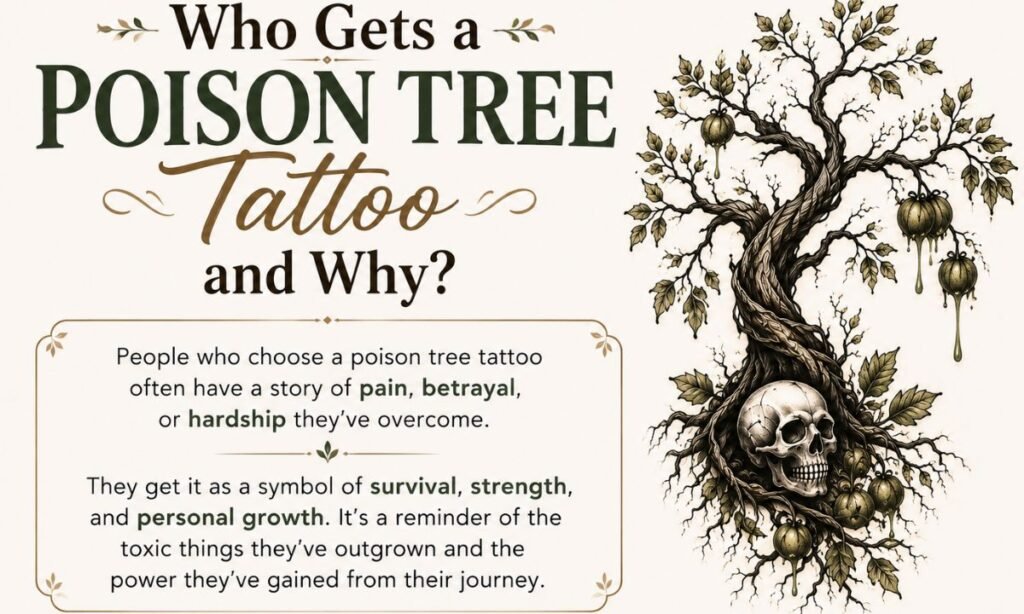
This tattoo tends to resonate with people who’ve been through something specific rather than picking a design purely for looks. Common reasons include:
Common Motivations
- Recovering from a toxic relationship a reminder of what silence cost them
- Processing anger in a healthy way choosing to “release” what the tattoo represents
- Literary appreciation fans of Blake or poetry-inspired ink
- Mental health awareness a visual metaphor for bottled-up emotion
- Setting boundaries going forward a permanent note-to-self
Who It Appeals To
It’s not gender-specific and doesn’t lean toward one particular age group. If anything, it tends to appeal to people who want a tattoo with intellectual depth, not just visual impact.
Popular Design Variations and Styles
The poison tree shows up in a wide range of tattoo styles, and the style itself often shifts the meaning slightly.
Style Breakdown
- Blackwork high-contrast, bold silhouettes; feels heavier and more dramatic
- Realism detailed bark texture and lifelike fruit, often unsettlingly lifelike
- Neo-traditional bold outlines with a splash of deliberate color
- Fine-line and botanical delicate, minimalist, good for smaller pieces
- Surrealism eyes hidden in leaves, fruit split open to reveal a serpent inside
- Illustrative incorporates story elements directly, like an apple or snake pulled straight from Blake’s poem
Symbolic Elements Commonly Paired With This Tattoo
Artists and wearers often build extra meaning into the piece by adding:
Popular Add-On Symbols
- Serpents temptation, deception, transformation
- Ravens or crows death, secrets, or watching over hidden truths
- Skulls hidden in the bark mortality, consequence
- Thorns or vines protection, pain, boundaries
- A single dove or bird in flight hope or release, balancing out the darker tone
- Script or a short line from the poem personal, direct storytelling
Color Meanings in Poison Tree Tattoos
Most poison tree tattoos stay black and gray, but color adds another layer when it’s used.
Color Meaning Table
| Color | Common Meaning in This Design |
| Black | Emotional darkness, mystery, the “hidden” part of the metaphor |
| Deep red | Anger, danger, the poisoned fruit itself |
| Green | A hint of growth or nature breaking through the darkness |
| Purple | Mystery, spirituality, transformation |
| Gold or glowing accents | Temptation making the fruit look almost too appealing |
Best Placement Options for a Poison Tree Tattoo
Placement really depends on how much detail you want and whether you want it visible day to day.
Placement Guide
- Forearm great visibility, plenty of room for branch detail
- Upper back or shoulder ideal for larger, more intricate scenes
- Calf or thigh good space for sprawling roots, easy to cover if needed
- Ribs or sternum a more private, intimate placement
- Ankle or wrist best for smaller, simplified versions
- Neck or hand bold, highly visible, often chosen by people who want the meaning on display at all times
How to Personalize the Design?
A few ways to make a poison tree tattoo feel like yours instead of a template:
Personalization Ideas
- Add a line from the poem even a few words can anchor the meaning
- Choose fruit color intentionally red for anger, black for grief, gold for temptation
- Include a specific animal one that means something personal to you
- Mix in a bloom or bird a small nod to healing, not just the pain
- Adjust the tree’s shape more twisted for raw emotion, more balanced for a healing-focused piece
- Work with your artist on placement flow roots and branches should follow your body’s natural lines, not fight them
Psychological Dimension: Why This Symbol Resonates So Deeply
There’s a reason this design keeps showing up across tattoo studios and Pinterest boards alike: it puts a very human experience into a single, striking image. Almost everyone has swallowed anger at some point instead of saying it out loud. Almost everyone knows what it feels like when that unspoken feeling doesn’t just vanish, but sits there and grows.
What Wearing It Represents
The tattoo works almost like a visual form of emotional honesty. Wearing it can be:
- A way of acknowledging a difficult period without having to explain it out loud
- A permanent reminder to speak up before resentment builds
- A quiet form of closure turning something painful into something intentional and chosen
From Warning to Full Story
That’s also why so many people pair the piece with a small symbol of hope, like a bloom or a bird. It turns the tattoo from a warning into a full story pain, recognition, and movement forward.
Common Mistakes to Avoid
Before booking your appointment, watch out for these:
Design & Sizing Mistakes
- Going too small for a detailed design intricate bark texture and branch work can blur over time if the tattoo is too tiny
- Overloading the piece trying to fit a serpent, raven, skulls, script, and roots into one small area often looks cluttered instead of intentional
Planning Mistakes
- Skipping the placement conversation a design that doesn’t follow your body’s natural curve can look stiff
- Choosing color without a plan for aging bright colors without black anchoring can fade unevenly
- Copying a design exactly instead of personalizing it this tattoo means the most when it reflects your specific story, not just a stencil you found online
- Not researching your artist’s style blackwork, realism, and fine-line all require different skill sets, so pick an artist whose portfolio matches the style you want
Frequently Asked Questions
What does a poison tree tattoo symbolize?
It symbolizes suppressed anger and hidden resentment, based on the idea that unspoken emotions grow into something harmful over time.
Where does the poison tree tattoo meaning come from?
It comes from William Blake’s 1794 poem “A Poison Tree,” about anger that grows in secret and turns deadly.
Is a poison tree tattoo good or bad luck?
It’s not tied to luck, it’s a symbolic reminder about emotional honesty, not a superstition.
What’s the difference between a poison tree and a tree of life tattoo?
A poison tree represents hidden anger and consequence, while a tree of life represents growth, family, and balance.
What’s the best placement for a poison tree tattoo?
The forearm, back, and calf work well for detailed designs, while the wrist or ankle suit smaller, simpler versions.
Can a poison tree tattoo represent healing instead of anger?
Yes many people add a bloom, dove, or lighter color accent to shift the meaning toward release and healing.
Conclusion
A poison tree tattoo is one of the rare designs that manages to be visually striking and emotionally specific at the same time. Rooted in William Blake’s warning about silent resentment, it’s become a modern symbol for suppressed anger, toxic relationships, boundaries, and for a lot of people the process of finally letting go. Whether you keep it simple with a small twisted tree on the wrist or go all-in with a detailed back piece full of serpents and roots, the meaning stays the same at its core: what you don’t say out loud still grows somewhere.