

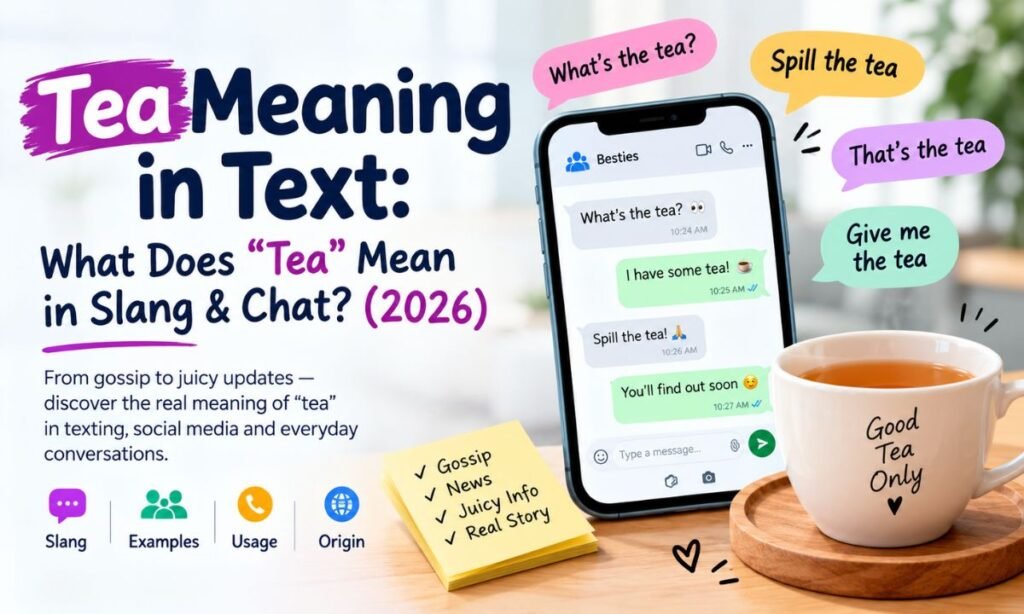
Have you ever received a message saying “What’s the tea?” and wondered what the person was actually asking? In modern texting, tea usually has nothing to do with the drink. The phrase commonly refers to gossip, interesting information, juicy details, or the real story behind a situation.
Understanding tea meaning in text can make social media comments, group chats, and casual conversations much easier to understand. Expressions such as “spill the tea,” “give me the tea,” and “that’s the tea” are now common examples of informal internet slang.
Whether you saw the word on Instagram, TikTok, Snapchat, or in a private chat, this guide explains tea meaning in text, its slang variations, history, examples, and when it is appropriate to use.
Quick Answer
Tea meaning in text is usually gossip, juicy information, interesting details, or the truth about a situation.
For example, “What’s the tea?” can mean “What happened?” or “What’s the latest?” while “Spill the tea!” means “Tell me the details.”
What Does “Tea” Mean in Text?
In texting and online slang, tea refers to information that is interesting, surprising, personal, or dramatic. Depending on the situation, it may mean gossip, an inside story, a secret, or simply an important update.
For example:
“I have some tea about yesterday.”
The speaker probably means they have some interesting information or a story to share.
The meaning of tea meaning in text depends heavily on context. It can describe harmless news between friends, but it can also refer to rumors or someone’s private business.
Tea Meaning Slang in Simple Words
In simple words, tea = gossip, juicy information, inside details, or the real story.
Common meanings include:
- Gossip
- Interesting news
- Juicy information
- Secrets
- Drama
- Inside information
- A personal story
- The truth about a situation
So, if someone asks you for the tea meaning in text, the simplest answer is: they usually want the interesting details or real story.
Tea Meaning in Different Contexts
The phrase changes slightly depending on how tea is used in a sentence.
1. “Spill the Tea”
“Spill the tea” means to share gossip, information, or the details of a situation. It is similar to saying, “Tell me everything.”
Example:
“Okay, you said something happened. Spill the tea!”
This is one of the most recognizable expressions associated with tea meaning in text.
2. “What’s the Tea?”
“What’s the tea?” means “What happened?”, “What’s going on?”, or “What’s the latest?”
Example:
“What’s the tea with those two?”
The person is asking for the story or details behind a situation.
3. “I Have Some Tea”
When someone says “I have some tea,” they are usually saying they have interesting information to share.
Example:
“I have some tea about our class meeting.”
It can be playful, but the information may be sensitive, so context matters.
4. “That’s the Tea”
“That’s the tea” can mean “That’s the truth,” “That’s how it is,” or “That’s the main point.”
Example:
“She worked hard for that promotion. That’s the tea.”
Here, tea does not necessarily mean gossip. It can simply emphasize the speaker’s view of the facts.
Is “Tea” Rude, Offensive, or Neutral?
Tea is generally informal slang rather than an inherently rude or offensive word.
However, what you share as “tea” can affect how the expression is received. Discussing harmless news with friends is very different from spreading someone’s private information.
Consider the setting:
- Friends: Usually casual and playful.
- Group chats: Common and informal.
- Social media: Widely understood.
- Workplace: May sound too casual.
- Sensitive situations: Use extra caution.
Knowing the context is an important part of understanding tea meaning in text correctly.
Where Is “Tea” Commonly Used?
Tea slang is especially common in informal digital communication, including:
- Text messages
- TikTok
- Snapchat
- X
- YouTube comments
- Group chats
- Online communities
It is mainly used in casual conversations rather than formal writing.
Real-Life Conversation Examples
Friendly Example
Alex: “You missed the party last night.”
Sam: “Really? What happened?”
Alex: “I’ve got the tea. I’ll tell you later.”
Casual Example
Mia: “I heard something happened at school.”
Lena: “What’s the tea?”
Argumentative Example
A: “Everyone is blaming him.”
B: “Okay, but what’s the actual tea?”
Here, tea means the real story rather than simply gossip.
Social Media Example
Comment: “Wait… what happened between them?”
Reply: “Someone please spill the tea!”
These examples show why tea meaning in text can change slightly according to tone and context.
Emotional and Psychological Meaning of “Tea”
Tea slang often adds curiosity, excitement, humor, or anticipation to a conversation.
Compare:
“What happened?”
with
“What’s the tea?”
The second expression sounds more playful and informal. It can make the person feel invited to share an interesting story.
At the same time, curiosity can encourage people to discuss information that is private or unverified. That is why understanding tea meaning in text should also involve understanding the social context.
Origin and Background of the Slang “Tea”
The slang use of tea has a history that predates modern social media. Historical sources connect the expression with Black LGBTQ+ communities and earlier uses of T associated with “truth.”
A 1991 anthropological source documented tea as gossip in Black gay culture, while historical discussions suggest the expression may have older roots. The exact etymology is debated, so there is no single universally accepted explanation for every stage of its development.
The expression later became increasingly visible in mainstream entertainment and internet culture, particularly during the 2010s.
Is “Tea” the Same as Gossip?
Not exactly.
Tea can mean gossip, but it can also mean an update, interesting information, inside details, or the truth about a situation.
For example:
- “I have some tea about the meeting.” → Interesting information.
- “I heard some tea about their relationship.” → Likely gossip.
- “That’s the tea.” → That’s the truth or main point.
Therefore, tea meaning in text is broader than simply “gossip.”
Tea vs. Gossip vs. Drama
| Term | Common Meaning | Typical Tone |
| Tea | Interesting information or gossip | Playful/informal |
| Gossip | Talk about another person’s private affairs | Neutral to negative |
| Drama | Conflict, tension, or problems | Often negative |
| News | New information or events | Neutral |
These terms can overlap, but they are not always interchangeable.
When Should You Use “Tea”?
You can use tea when the conversation is casual and the people involved understand internet slang.
It works well when:
- Talking with friends
- Messaging in group chats
- Commenting on social media
- Discussing harmless updates
- Making a playful joke
- Asking about the story behind something
Using the expression naturally is more important than forcing slang into every conversation.
When Should You Avoid Using “Tea”?
Avoid tea when you need professional, precise, or highly respectful language.
For example, instead of:
“What’s the tea about the meeting?”
you could say:
“Could you tell me what happened during the meeting?”
Also avoid spreading unverified claims or private information simply because someone calls it “tea.”
Polite Alternatives to “Tea”
Depending on the situation, you can say:
- “What happened?”
- “What’s the latest?”
- “Could you tell me more?”
- “What’s going on?”
- “What’s the story?”
- “Do you know what happened?”
- “Can you give me an update?”
These expressions are especially useful in professional conversations.
Why Do People Use “Tea” Slang?
People use tea because it is short, expressive, humorous, and easy to understand in online conversations.
Instead of asking:
“Can you tell me what happened?”
someone can simply say:
“What’s the tea?”
The shorter expression adds personality and makes the conversation feel more relaxed.
This helps explain why tea meaning in text remains popular across social media and messaging platforms.
Impact of Using “Tea” in Communication
Using tea can make a message feel:
- More casual
- More friendly
- More humorous
- More curious
- More conversational
However, the word can also make a person sound nosy if they are asking about sensitive personal information.
The effect depends less on the word itself and more on the relationship, topic, and setting.
Is “Tea” Safe for Social Media?
The slang word itself is generally safe for social media. The important question is what information you are sharing.
Before posting or forwarding someone’s “tea,” consider:
- Is the information verified?
- Is it appropriate to share?
- Does it involve someone’s privacy?
- Could it harm or mislead another person?
Using tea meaning in text does not make private information automatically acceptable to publish.
Common Misunderstandings About “Tea”
“Tea” Always Means Gossip
Not always. Tea can also mean an interesting update, inside information, or the truth about something.
“Spill the Tea” Means Literally Spill Tea
Usually not. In slang, “spill the tea” is figurative and means to reveal or share information.
Tea Has a Full Form
There is no standard full form of TEA for this slang meaning. Some explanations connect “T” with “truth,” but TEA should not be treated as a formal acronym.
Tea Is Always Negative
No. Tea can describe funny, surprising, harmless, or serious information. The context determines the tone.
Variations and Types of Tea Slang
“Spill the Tea”
Share the gossip, details, or story.
“What’s the Tea?”
Ask what happened or what is going on.
“Give Me the Tea”
Ask someone to provide the interesting details.
“Drop the Tea”
Ask someone to reveal or post information.
“That’s the Tea”
Emphasize that something is the truth or main point.
“Hot Tea”
Usually refers to especially interesting, juicy, or dramatic information.
These variations help explain the wider range of tea meaning in text across online conversations.
How to Respond When Someone Says “Spill the Tea”
If You Want to Share
Say:
“Okay, here’s what happened…”
If You Are Surprised
Try:
“Wait, seriously? Tell me everything!”
If You Don’t Want to Gossip
You can say:
“I’d rather not talk about someone else’s private business.”
If You Don’t Know
Simply say:
“I honestly don’t know what happened.”
Regional and Cultural Usage
Tea slang is now widely recognizable in English-language internet culture, but its cultural history is important. Historical sources connect the expression with Black LGBTQ+ linguistic and social traditions before it became widespread online.
Its mainstream popularity grew through entertainment, celebrity culture, and social media. However, frequency of use can still vary according to age, region, platform, and online community.
Frequently Asked Questions
What does “tea” mean in slang?
Tea usually means gossip, juicy information, inside details, or the truth about a situation.
What does “spill the tea” mean?
“Spill the tea” means to share gossip, details, or information about something that happened.
What does “what’s the tea?” mean?
“What’s the tea?” usually means “What happened?”, “What’s going on?”, or “What’s the latest?”
Is “tea” a rude word?
No. Tea is generally informal slang, although sharing someone’s private information can be inappropriate.
What does tea mean in text messages?
Tea meaning in text messages usually refers to gossip, interesting information, an update, or the real story behind a situation.
What does “that’s the tea” mean?
“That’s the tea” can mean “That’s the truth,” “That’s how it is,” or “That’s the important point.”
Conclusion
Understanding tea meaning in text makes it easier to follow modern texting, social media comments, memes, and group conversations. In most casual contexts, tea refers to gossip, juicy information, an interesting update, or the real story behind a situation.Expressions such as “spill the tea,” “what’s the tea,” “give me the tea,” and “that’s the tea” are informal and conversational. They can make a message sound playful and curious, but they should be used responsibly when personal or unverified information is involved.
In short, when someone asks “What’s the tea?”, they are usually asking you to tell them what happened, what is going on, or what the real story is.