

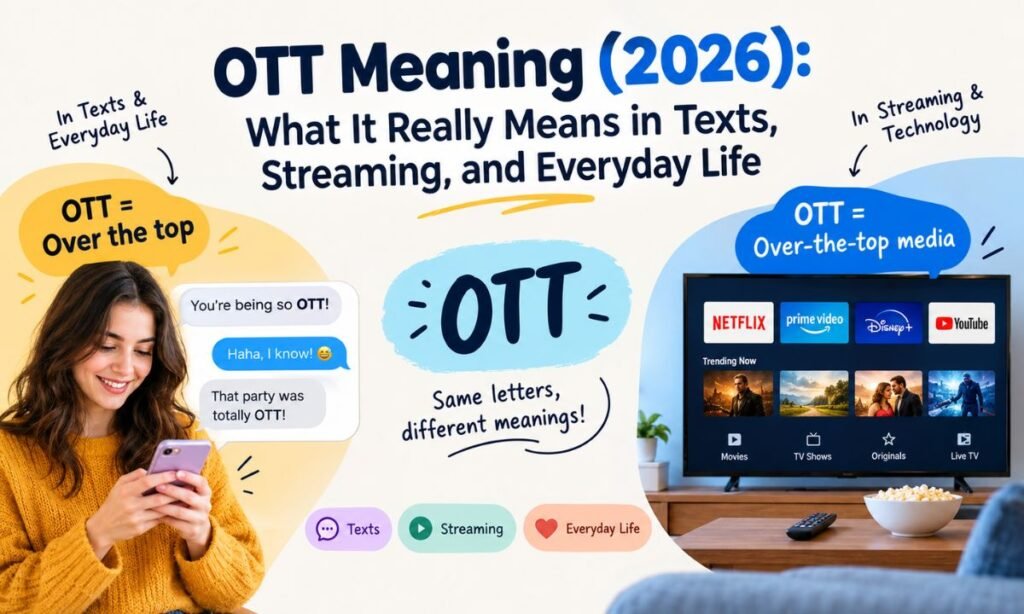
Have you ever received a message saying, “You’re being so OTT,” and wondered what the person meant? The OTT meaning can seem confusing because the same three letters are used in everyday conversations and the world of streaming.
In texting and casual conversations, OTT usually stands for “over the top.” It describes something that feels excessive, exaggerated, dramatic, or more elaborate than necessary. Dictionaries identify this as an informal usage, particularly associated with British English.
In entertainment and technology, however, OTT has another meaning. It describes media delivered through the internet rather than through traditional television distribution.
Understanding the surrounding conversation is the easiest way to know which OTT meaning someone intends.
Probably Why You Searched This
You may have noticed OTT in a text, Instagram comment, TikTok discussion, or conversation and wanted a simple explanation.
When someone says:
- “That reaction was OTT.”
- “Her outfit is a little OTT.”
- “He went completely OTT.”
- “The decorations were so OTT.”
they are generally saying that something was over the top.
In simple language, the OTT meaning in texting is usually connected with being too dramatic, excessive, extreme, or unusually elaborate.
It does not automatically mean something is bad. The speaker’s tone makes a major difference.
What’s Really Going On When People Say It
The basic OTT meaning is “over the top.” Cambridge defines the expression as something too extreme or demanding too much attention or effort, while Collins describes OTT as exaggerated and extreme.
For example, imagine someone puts on an enormous birthday celebration with fireworks, live music, dozens of decorations, and an elaborate cake. A friend might jokingly say:
“You really went OTT with this party.”
The comment could be criticism, admiration, or friendly teasing.
Here is how the word compares with similar expressions:
| Word | General idea | Typical feeling |
| OTT | Excessive or exaggerated | Casual |
| Extra | More elaborate than necessary | Playful |
| Dramatic | Highly emotional or intense | Often critical |
| Excessive | More than reasonable | More formal |
| Flashy | Designed to attract attention | Positive or negative |
| Overdone | Taken too far | Usually negative |
So, the OTT meaning depends not only on the word itself but also on what is being described.
How It Shows Up in Real Conversations
OTT can describe almost anything that seems unusually intense or excessive.
People commonly use it for:
- Emotional reactions
- Fashion choices
- Parties
- Decorations
- Romantic gestures
- Movies
- Jokes
- Arguments
- Social media posts
- Celebrity behavior
For example:
Friend: “I missed one call and he sent me eight messages.”
Reply: “That’s a little OTT.”
Here, the person is saying the reaction seems unnecessarily intense.
Another example:
Friend: “I booked an entire restaurant for her birthday.”
Reply: “That’s seriously OTT!”
This could actually be a compliment because the speaker may admire the effort.
The OTT meaning therefore changes slightly with the speaker’s attitude.
Context Is Everything: When the Vibe Shifts
One of the most important things to remember about OTT is that it does not always carry a negative meaning.
Consider these examples:
“Your reaction was OTT.”
This probably means the reaction was unnecessarily dramatic.
“That dress is OTT, but I love it.”
Here, OTT suggests something bold or extravagant.
“The final scene was completely OTT.”
This means the scene was unusually extreme or exaggerated.
“Her wedding was beautifully OTT.”
This can suggest something spectacular, luxurious, and intentionally extravagant.
The surrounding words tell you whether OTT is being used as criticism, humor, or praise.
Don’t Use OTT Here (Trust Me)
Although the OTT meaning is easy to understand, the abbreviation is generally informal.
It works naturally in:
- Text messages
- Group chats
- Social media
- Casual conversations
- Informal entertainment discussions
It may be less appropriate in formal business writing.
For example, instead of writing:
“Your proposal is OTT.”
you could write:
“The proposal includes more detail than necessary.”
That version is clearer and more professional.
If your audience may not know the abbreviation, writing “over the top” instead of OTT can also prevent confusion.
Better Words for Different Situations
Sometimes OTT is not the most precise word. Choose an alternative based on exactly what you want to communicate.
| If you want to say… | A better option may be… |
| Too emotional | Overly emotional |
| Too dramatic | Dramatic |
| More than necessary | Excessive |
| Very expensive-looking | Extravagant |
| Attention-grabbing | Flashy |
| Too complicated | Overdone |
| Playfully extreme | Extra |
| Calm and simple | Understated |
For instance, calling a business proposal “excessive” communicates more precisely than saying it is OTT.
Examples Actual Messages People Send
Here are some natural examples showing how the OTT meaning works in everyday texting:
- “Why are you being so OTT about this?”
- “That outfit is definitely OTT.”
- “Your reaction was a little OTT.”
- “He went OTT with the birthday decorations.”
- “That movie was completely OTT.”
- “The proposal was romantic but slightly OTT.”
- “She loves going OTT for Halloween.”
- “That party was seriously OTT.”
- “You’re making this way more OTT than it needs to be.”
- “The special effects were OTT, but fun.”
These examples show why context matters. The same abbreviation can sound critical in one message and enthusiastic in another.
Platform Quirks and Regional Differences
The OTT meaning in casual language is particularly associated with British informal English. Oxford describes OTT as British English and informal, while Cambridge also labels it as a UK informal abbreviation.
You may therefore encounter the abbreviation frequently in British conversations, entertainment discussions, and online communication.
However, the full phrase “over the top” is much broader than the abbreviation and is understood by English speakers in many regions.
There is also a completely different technology-related use.
In streaming, OTT refers to media delivered through the internet instead of depending on traditional cable or satellite television systems. This is why you may hear phrases such as:
- OTT platform
- OTT service
- OTT streaming
- OTT content
- OTT television
So, always consider the subject of the conversation before deciding what OTT means.
Where People Get Confused
The biggest source of confusion is that OTT has two major modern uses.
OTT in texting
The OTT meaning in texts is usually “over the top.”
It can describe something:
- Excessive
- Dramatic
- Exaggerated
- Extreme
- Elaborate
- Attention-grabbing
For example:
“Your reaction is so OTT.”
OTT in streaming
In technology and entertainment, OTT refers to content delivered over the internet rather than through traditional television distribution.
For example:
“This company is launching a new OTT streaming service.”
In this sentence, OTT has nothing to do with someone’s behavior being dramatic.
How to tell which meaning is intended
Use the subject as your clue.
If the conversation is about behavior, reactions, clothes, celebrations, or drama, OTT probably means “over the top.”
If the discussion involves streaming, television, movies, subscriptions, apps, or digital content, OTT probably refers to internet-based media.
This simple distinction clears up most questions about the OTT meaning.
Your Burning Questions Answered About “OTT” Term
Is calling something OTT rude?
Not necessarily. OTT can be critical, playful, humorous, or even complimentary depending on the context and tone.
Can OTT be a compliment?
Yes. Calling something OTT can praise an extravagant, bold, glamorous, or entertaining choice.
Does OTT mean the same thing everywhere?
No. In casual language it generally means “over the top,” while in streaming it refers to internet-delivered media.
Is “Oyt” a real variant of OTT?
“Oyt” is not a standard variant of OTT meaning “over the top” and is more likely to be a typo or a separate abbreviation.
When did people start using OTT for streaming?
The streaming-related use developed as internet distribution became an alternative to traditional television delivery; today’s major streaming platforms helped make the term widely recognized.
Can I use OTT in work emails?
You can, but “excessive,” “overly elaborate,” or “over the top” may be clearer in formal workplace communication.
Why does OTT sound British?
OTT is commonly identified by major dictionaries as a British informal abbreviation for “over the top.”
Is there a difference between OTT and extra?
Yes. Both can suggest excess, but “extra” is often more playful, while OTT more directly suggests something exaggerated or beyond what is reasonable.
Wrapping This Up
The easiest way to remember the OTT meaning is to look at the context.In texting and everyday conversation, OTT usually means “over the top.” It describes something that goes beyond what seems normal, necessary, or expected. It can refer to a dramatic reaction, extravagant outfit, huge celebration, exaggerated joke, or intense situation.
The word does not always carry a negative tone. Someone can call an event OTT because they think it is ridiculous, or because they think its extravagance is entertaining and impressive.
In streaming and technology, however, OTT has a different meaning connected with delivering media through the internet.
So, the next time you see OTT, don’t assume it has only one definition. Look at the conversation around it. If the topic is someone’s behavior or something excessive, think “over the top.” If the topic is streaming or digital entertainment, think internet-delivered media.


1 thought on “OTT Meaning (2026): What It Really Means in Texts, Streaming, and Everyday Life”