

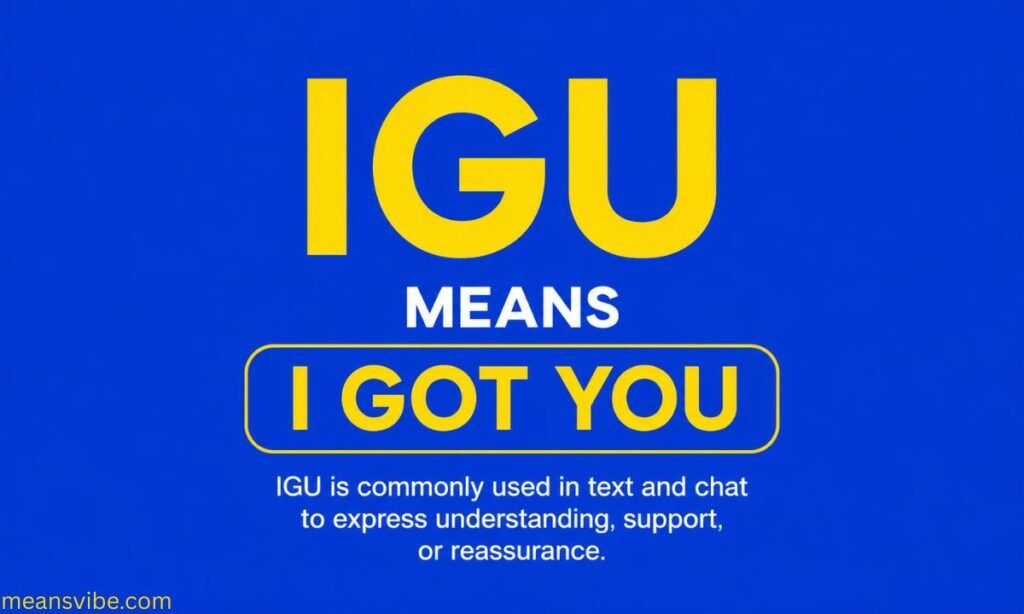
If you’ve searched for IGU meaning in text, you may be wondering what this popular abbreviation means in chats, social media, and everyday online conversations. IGU commonly stands for “I Got You,” and it is often used to show understanding, support, or reassurance. Depending on the conversation, it can mean “I understand,” “I’ll help you,” or “Don’t worry, I’ve got this.”
Understanding the IGU meaning in text can make online conversations much easier to follow. This short slang term is popular because it quickly communicates support without requiring a long response. Whether you see IGU in a text message, comment, or social media chat, the exact meaning can usually be understood from the context surrounding it.
What Does IGU Mean in Text?
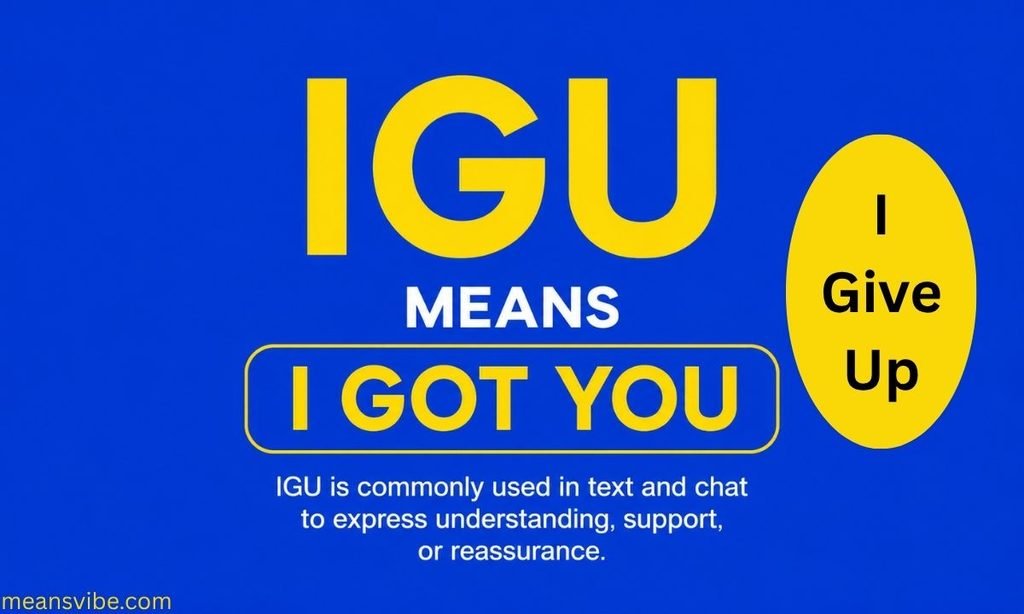
So, what does IGU mean in text, exactly? In everyday texting, IGU is a dual-meaning abbreviation, and both meanings are genuinely common:
- “I Got You” a supportive reply that signals agreement, reassurance, or a promise to help.
- “I Give Up” a frustrated or joking way to admit defeat, exhaustion, or resignation.
There’s no single “correct” reading. The letters stay the same; the emotion behind them changes with tone, punctuation, emojis, and the relationship between the people texting. A warm, upbeat IGU after someone asks for help usually means support. A flat, one-word IGU after a long back-and-forth argument usually means someone is done trying.
The Origin and Evolution of IGU
Where does IGU mean in text actually come from? No one invented it on one single day. It grew slowly, like most texting slang.
Here’s the simple version:
- People wanted to type fast.
- Full sentences felt slow.
- So they shortened phrases into letters.
- IGU became one of those shortcuts, alongside BRB, IDK, and TBH.
How “I Give Up” started:
- Gamers used it first.
- They typed it after losing a tough level.
- It also showed up in arguments people wanted to end.
- Over time, it picked up a lighter, joking tone.
How “I Got You” started:
- This version grew separately.
- Friends used it to confirm plans fast.
- It became a quick way to offer support.
- No long explanation needed just three letters.
How the two meanings merged:
- Both versions spread across chats, comments, and DMs.
- They landed on the exact same letters: IGU.
- That’s why context matters so much today.
- The words are short, but the meaning depends on the moment.
Why People Prefer Using IGU Instead of Full Sentences
Texting rewards speed, and IGU delivers a full emotional message in a fraction of the keystrokes. A few reasons it has stuck around:
- Speed three letters beat typing out “I’ve got this handled” or “I don’t want to keep arguing about this.”
- Casual tone abbreviations feel more relaxed and friend-to-friend than a full sentence.
- Emotional shorthand IGU carries feeling, not just information, which fits how people actually text.
- Shared understanding once a friend group knows the term, it becomes a quick, private-feeling signal.
- Low commitment a short reply lets someone respond without over-explaining how they feel.
How IGU Is Used in Different Contexts
IGU mean in text doesn’t stay fixed everywhere. The platform, the audience, and the pace of the conversation all shape which meaning is more likely.
Why Platform Matters for IGU Mean in Text
A quick breakdown of what shifts the meaning:
- Audience familiarity close friends read tone faster than casual acquaintances
- Platform culture comment sections skew joking; DMs skew personal
- Conversation pace fast group chats favor the surrender sense; slower one-on-ones favor support
- Emoji use laughing emojis push toward “I Give Up”; heart or thumbs-up emojis push toward “I Got You”
IGU Meaning on TikTok
On TikTok, IGU shows up most often in comment sections, and it usually leans playful. Someone might reply IGU under a funny or relatable video to mean “I give up trying to explain this” or “same, I get it,” often paired with laughing emojis rather than serious ones.
IGU Meaning on WhatsApp
WhatsApp conversations tend to be more personal, often between people who already know each other well. Here, IGU leans supportive more often a quick way to say “I’ve got it covered” when someone asks for help with a task, a plan, or a favor.
IGU Meaning on Facebook and Messenger
On Facebook and Messenger, IGU appears in both comments and private chats, and the meaning splits fairly evenly. In comment threads under a frustrating post, it often means resignation. In direct messages between friends, it tends to mean reassurance.
IGU Meaning Across Platforms Table
| Platform | Common Meaning | Typical Tone |
| TikTok | I Give Up | Playful, joking |
| I Got You | Supportive, personal | |
| Facebook Comments | I Give Up | Frustrated or sarcastic |
| Messenger (DMs) | I Got You | Reassuring |
| Discord / Gaming Chats | I Give Up | Competitive, resigned |
| Instagram DMs | Either | Depends on relationship |
Real-Life Examples of IGU in Conversations
Supportive meaning:
- “Can you grab the tickets before they sell out?” → “IGU, on it now.”
- “I’m nervous about the interview.” → “IGU, you’re going to do great.”
Surrender meaning:
- “I’ve tried fixing this bug for two hours.” → “Same. IGU.”
- “Are you still trying to convince him?” → “Nah, IGU.”
The wording is nearly identical in both cases a single word or two before “IGU” but the emotional weight is completely different depending on what came before it.
How IGU Prevents Long Conversations
IGU meaning in text is especially useful when people want to communicate quickly without explaining everything in detail. Instead of writing phrases like “I understand what you mean” or “Don’t worry, I’ll take care of it,” someone can simply say “IGU.” This makes digital conversations shorter, faster, and more natural.
In texting and social media chats, IGU can also keep a conversation flowing without unnecessary explanations. A quick “IGU” may show that you understand the situation, agree to help, or have already understood the message. This simple abbreviation saves time while still adding a friendly and supportive tone.
When Should You Use IGU?
IGU works well when:
- You’re replying to a close friend or someone familiar with texting slang
- The conversation is casual, fast-paced, or already using abbreviations
- You want to confirm help or support without a long reply
- You’re being playful about giving up on something low-stakes
When You Should Avoid Using IGU
Skip IGU when:
- You’re texting someone who may not know the abbreviation
- The conversation is professional, formal, or work-related
- The topic is serious and deserves a full, clear response
- Misreading the tone could cause real confusion or hurt feelings
Common Misunderstandings About IGU
A few mix-ups come up often:
- Assuming it always means the same thing. Both meanings are common, so context always matters more than the letters themselves.
- Confusing it with similar acronyms like IG (Instagram) or IDK (I don’t know), which look similar but mean something entirely different.
- Missing the technical meaning. In construction, architecture, and window manufacturing, IGU stands for “Insulated Glass Unit,” a completely unrelated term that occasionally causes confusion outside of casual texting.
- Reading a supportive IGU as sarcastic, or vice versa, when there’s no emoji or prior message to clarify tone.
How to Respond When Someone Says IGU
The safest approach is to match the tone of the conversation rather than the letters themselves:
- If it sounds supportive, reply with a simple thanks or move the plan forward a “got it” or “thank you” keeps things natural.
- If it sounds like surrender, offer encouragement or let it go gracefully, depending on how serious the topic was.
- If you’re not sure, look at the last few messages for emojis, punctuation, or context clues before reacting.
- If it’s clearly a joke, feel free to joke back playful IGU rarely needs a serious reply.
Why IGU Remains Popular in Internet Culture
Short-form slang like IGU thrives because texting culture rewards speed and shared understanding over spelled-out sentences. It fits naturally into comment sections, group chats, and fast-moving conversations where a full sentence would slow things down. As long as digital conversations stay quick and emotionally expressive, compact terms like IGU are likely to stick around, even as new slang keeps appearing alongside it.
Conclusion
To sum up IGU mean in text: it’s a small abbreviation with a surprisingly wide emotional range, swinging between quiet support and playful (or genuine) surrender depending on tone, platform, and relationship. Once you know both meanings exist, reading IGU correctly comes down to context: what was said right before it, how it’s punctuated, and who sent it. Keep that in mind, and three letters stop being confusing and start being exactly as clear as they were meant to be.
FAQs
What does IGU mean in a text message?
When people ask about IGU mean in text, the answer is usually either “I Got You” (support) or “I Give Up” (surrender), depending on the tone of the conversation.
Does IGU mean in text always sound negative?
No. IGU is often positive or neutral, especially when it’s used to offer help or agreement.
Does IGU mean the same thing on every platform?
Not exactly. It leans more playful on TikTok, more supportive on WhatsApp, and mixed on Facebook and Messenger.
Can IGU be used in professional messages?
It’s best avoided in formal or work settings, since not everyone recognizes the abbreviation.
Is IGU related to “Insulated Glass Unit”?
Only in technical or construction contexts. In everyday texting, that meaning almost never applies.
How do I know which meaning someone intended?
Check the message right before it, along with any emojis or punctuation tone almost always gives it away.