

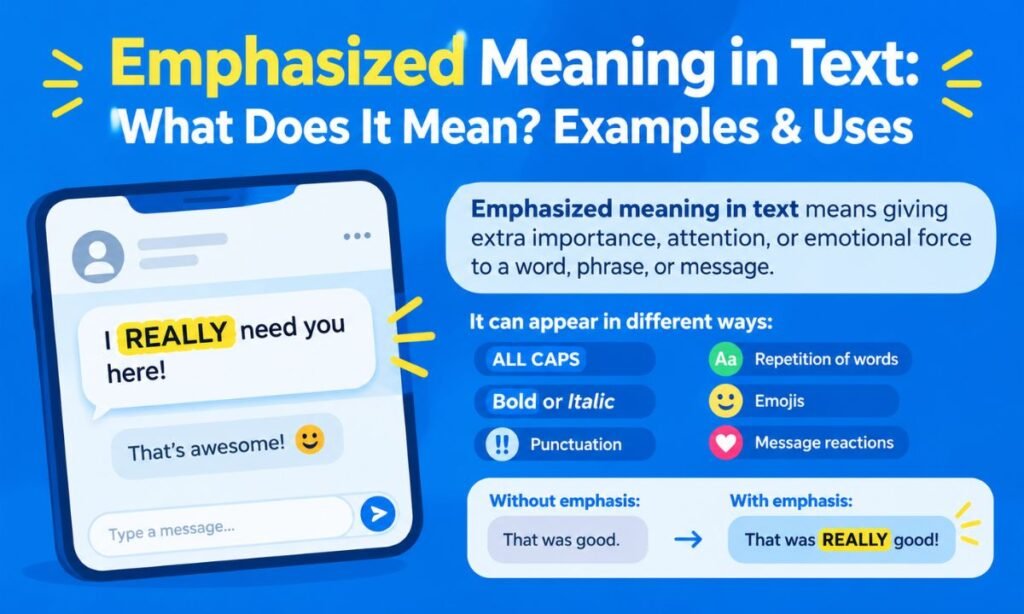
If you searched for Emphasized meaning in text, you may have seen the word in a message, reaction, or online conversation and wondered what it means. In simple terms, Emphasized meaning in text refers to giving extra importance, attention, or emotional force to a word, phrase, or message.
Emphasized meaning in text usually means that something has been made more noticeable or strongly expressed. The exact meaning depends on the wording, formatting, reaction, and context of the conversation.
For example, someone might write “I REALLY need you here” to stress urgency. On some messaging services, “emphasized” can also describe a reaction attached to a message.
What Does Emphasized Mean in Text?
The basic Emphasized meaning in text is connected to the word “emphasize,” which means to give something special importance or attention. In digital conversations, people have many ways to make certain words or ideas stand out.
Common examples include:
- Using ALL CAPS
- Repeating letters, such as “soooo good”
- Adding extra punctuation
- Using bold or italic formatting
- Repeating an important word
- Adding emojis
- Reacting directly to a message
For example:
Normal: “That was good.”
Emphasized: “That was REALLY good!”
Both sentences express a positive opinion, but the second one puts more weight on the person’s reaction.
How Does Emphasis Change a Text Message?
Understanding Emphasized meaning in text requires looking beyond the individual word. Emphasis can change the feeling or tone of a sentence without completely changing its literal meaning.
Compare these examples:
| Message | Possible tone |
| “Okay.” | Neutral or brief |
| “OKAY!” | Excited or energetic |
| “I said okay.” | Frustrated or defensive |
| “I said OKAY.” | Strong emphasis |
| “Okayyy 😂” | Playful or teasing |
This shows why context matters. The same type of emphasis can communicate different emotions depending on the conversation.
Can Emphasized Text Sound Angry?
Sometimes, but not always.
ALL CAPS may look like shouting when used during an argument. However, people also use capital letters when they’re excited, surprised, or joking.
For example:
“I GOT THE JOB!” usually sounds excited.
“I TOLD YOU NOT TO DO THAT.” may sound angry.
The words surrounding the emphasized part help reveal the intended tone.
Why Do People Emphasize Messages?
A major part of Emphasized meaning in text comes from the limitations of digital communication. When people speak face-to-face, they can use their voice, facial expressions, pauses, and gestures to show emotion.
Text doesn’t provide those natural signals. Because of this, people use visual and written techniques to add emotional clues.
People may emphasize something to:
- Make an important point clear
- Show excitement
- Express urgency
- Show strong agreement
- Highlight a warning
- Add humor
- Express frustration
- Make a feeling stronger
Good emphasis helps the reader understand which part of the message deserves attention.
Emphasized Meaning in Text Across Different Platforms
The general Emphasized meaning in text stays the same across messaging and social platforms, but the way emphasis appears can be different.
iMessage and iPhone Messages
One important use appears in Apple’s Messages app. Tapbacks allow users to quickly react to individual messages with symbols and emoji, including exclamation-point reactions.
When a message is described as “Emphasized” in this context, it can refer to an exclamation-point reaction attached to a message. That doesn’t automatically mean the person is angry.
Depending on the conversation, it could communicate:
- “Exactly!”
- “That’s important.”
- “Yes!”
- “I strongly agree.”
- “Wow!”
- “Pay attention to this!”
Always consider the original message before interpreting the reaction.
On WhatsApp, Emphasized meaning in text is usually connected to formatting or writing style. People can use bold text, italics, punctuation, capitalization, emojis, and repeated words to make something stand out.
For example:
“Please remember this.”
sounds straightforward.
“Please remember this!!!”
has stronger visual and emotional force.
Instagram users commonly emphasize words in DMs, captions, comments, and text-based posts. Capital letters, emojis, repeated words, and punctuation can make a reaction appear stronger.
For example:
“THIS LOOK 😍”
sounds much more enthusiastic than simply saying, “This look.”
TikTok and Snapchat
On TikTok and Snapchat, emphasis is often casual and expressive. Users may stretch words, use capital letters, repeat punctuation, or combine words with emojis.
The style can communicate excitement, disbelief, humor, surprise, or frustration.
How Is Emphasis Used in Different Situations?
The purpose of emphasis depends heavily on the setting. Emphasized meaning in text can be casual in a friendship but more controlled in professional communication.
Personal Chats
Friends often emphasize messages to express excitement, affection, surprise, or humor.
“You HAVE to watch this 😂”
The capitalized word shows that the recommendation is especially strong.
School and Education
Students and teachers use emphasis to make important information easier to identify. Bold text, headings, italics, and carefully chosen wording can direct attention toward key concepts.
Here, emphasis is usually designed to improve clarity rather than create emotion.
Workplace Messages
Professional communication generally benefits from simple and controlled emphasis.
For example:
“Please submit the report by Friday.”
is clear without excessive punctuation or capital letters.
Using too much emphasis at work can make a message seem demanding or aggressive, even when that isn’t the intention.
Marketing
Marketers use emphasis to draw attention to important information such as benefits, deadlines, new products, and special offers.
Words such as NEW, LIMITED, or TODAY may receive stronger visual treatment so readers notice them quickly.
Does Emphasized Have Other Meanings?
Yes. The concept behind Emphasized meaning in text also exists outside texting.
In education, a teacher might emphasize an important idea during a lesson. In public speaking, a speaker can emphasize a phrase through volume, timing, pauses, or repetition.
In writing, emphasis can come from sentence structure, word choice, italics, or other formatting. In graphic design, size, spacing, placement, and contrast can direct attention toward a particular element.
Technical writers also use emphasis to help readers identify warnings, instructions, definitions, and critical information.
The core idea remains the same: something receives extra attention or importance.
Common Misconceptions About Emphasized Text
A common misunderstanding about Emphasized meaning in text is assuming that one visual style always represents one emotion. In reality, the meaning depends on context.
Myth 1: Emphasized always means angry.
False. It can show excitement, agreement, importance, surprise, or humor.
Myth 2: ALL CAPS always means shouting.
Not necessarily. Friends often use capital letters to express excitement.
Myth 3: An emphasized reaction is always negative.
No. A reaction can express support, excitement, agreement, or surprise.
Myth 4: Emphasis always changes the sentence’s literal meaning.
Often, it changes the tone or focus instead.
Emphasized vs. Similar Words
Understanding related terms can make Emphasized meaning in text easier to recognize.
| Term | Basic meaning |
| Emphasized | Given extra importance or stress |
| Highlighted | Made easier to notice |
| Stressed | Given special importance |
| Underlined | Marked for attention |
| Featured | Given a prominent position |
| Exaggerated | Made stronger or greater than reality |
These words overlap, but they’re not identical. Something can be highlighted visually without being emotionally emphasized.
How Should You Respond to an Emphasized Message?
If someone sends an emphasized message, don’t immediately assume they’re upset. Look at the subject, their usual communication style, and what was said before the message.
For a positive message, you might reply:
- “Exactly!”
- “Right?!”
- “I know!”
- “That’s what I meant too.”
For a serious message, a calm response works better:
- “Got it.”
- “I understand.”
- “Thanks for clarifying.”
If the tone is unclear, asking a simple question can prevent a misunderstanding.
Why Does Emphasis Matter in Online Conversations?
The importance of Emphasized meaning in text comes from the way digital communication replaces some of the signals we normally get from spoken conversation.
Consider:
“You came.”
This could sound neutral or surprised.
Now compare:
“YOU came!”
The second version looks much more excited.
Emphasis therefore helps readers understand what the sender considers important. It can be especially useful in group chats, social media, dating conversations, and quick messages where tone can easily be misunderstood.
What Does Emphasized Mean in Dating Texts?
In dating conversations, Emphasized meaning in text can sometimes make a message sound more emotional, enthusiastic, or flirtatious. However, emphasis alone doesn’t prove romantic interest.
For example:
“I REALLY enjoyed tonight.”
could communicate genuine enthusiasm.
“You are SO cute.”
may sound flirtatious.
Still, the surrounding conversation matters more than capitalization or punctuation. Look at the person’s overall behavior and wording rather than relying on one emphasized phrase.
Frequently Asked Questions
What is emphasized meaning in text?
Emphasized meaning in text refers to giving extra importance, attention, or emotional force to a word, phrase, or message. It can be created through capitalization, punctuation, formatting, repetition, emojis, or reactions.
Does emphasis change the meaning of a sentence?
It can change how a sentence feels without changing its literal meaning. Emphasis may make the message sound more urgent, excited, serious, or emotional.
Why do people use ALL CAPS?
People use ALL CAPS to make words stand out. Depending on context, it can show excitement, urgency, strong emotion, or shouting.
Is emphasized text rude?
No. Emphasized meaning in text isn’t automatically rude. The same style can be friendly, funny, excited, serious, or affectionate depending on the situation.
How can I emphasize text in messages?
You can use capitalization, punctuation, repetition, formatting options, emojis, or available message reactions. Use these tools carefully so your main point remains easy to understand.
Why is emphasis important online?
Emphasis gives readers extra clues about tone and importance. Since digital messages don’t include every vocal or facial signal, these clues can make communication clearer.
Final Thoughts
The simplest Emphasized meaning in text is giving extra importance, attention, or force to part of a message. It can appear through capitalization, punctuation, formatting, repeated words, emojis, or message reactions.
The key is context. An emphasized phrase isn’t automatically angry, rude, romantic, or sarcastic. Read the entire conversation and consider what the sender is trying to highlight.
Once you understand the Emphasized meaning in text, it’s much easier to interpret messages accurately and respond in the right tone.