

The elegy meaning is connected with grief, remembrance, loss, and reflection. In literature, an elegy is traditionally a poem written to mourn the death of a person. However, modern writers may also use the form to express sadness about other kinds of loss, such as a relationship, place, tradition, or period of life.
Understanding the elegy meaning becomes easier when you look at how the word is used in poetry and everyday language. An elegy does more than express sadness; it often remembers, honors, and reflects on what has been lost.
What Does Elegy Mean?
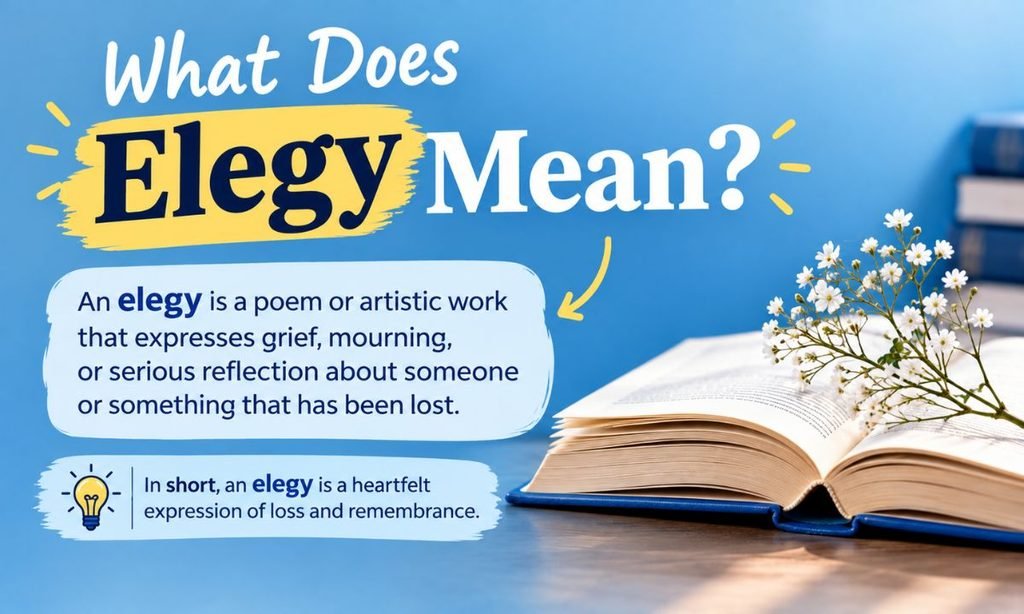
An elegy is a poem or artistic work that expresses grief, mourning, or serious reflection about someone or something that has been lost.
In simple terms, the elegy meaning can be described as:
Elegy means a mournful poem or expression of sorrow and remembrance, traditionally written about someone who has died.
For example, a poet might write an elegy after losing a close friend. The poem may describe memories of that person, express grief, celebrate their life, and consider the meaning of death.
The word can also be used more broadly when a work mourns the disappearance or end of something meaningful.
The Main Elegy Meaning in Literature
In literature, the traditional elegy meaning centers on mourning and remembrance. An elegy commonly addresses death, grief, mortality, and the emotional experience of losing someone.
Traditional elegies often contain three broad movements:
- Lament – The speaker expresses sadness and grief.
- Praise – The person who has died is remembered or honored.
- Consolation – The poem may move toward acceptance, hope, or comfort.
Not every modern elegy follows this exact pattern. Contemporary poets often use the form more freely, focusing on personal memories, historical events, cultural changes, or different types of loss.
Is an Elegy Always About Death?
No. Death is the most traditional subject of an elegy, but an elegy can also deal with other forms of loss.
For example, a writer might create an elegy about:
- A lost friendship
- The end of a relationship
- A disappearing hometown
- A lost childhood
- A destroyed natural environment
- A declining culture or tradition
- A historical period that has ended
Therefore, the modern elegy meaning can extend beyond death while still retaining its central connection to mourning and remembrance.
Key Features of an Elegy
Several characteristics can help you identify an elegy.
Common features include:
- Grief: The speaker expresses sorrow or emotional pain.
- Loss: Someone or something meaningful is no longer present.
- Remembrance: Memories are used to keep the subject alive in thought.
- Praise: The subject may be honored or celebrated.
- Reflection: The writer considers life, death, memory, or change.
- Mourning: The work acknowledges emotional suffering.
- Consolation: Some traditional elegies eventually offer comfort or acceptance.
An elegy does not need a specific rhyme scheme or length. Modern examples can be written in traditional verse, blank verse, or free verse.
How Context Changes the Elegy Meaning
The context in which the word is used can slightly change its meaning.
In literature, an elegy usually refers to a poem or literary work about grief and loss. In music, an elegy can describe a mournful musical composition. In everyday language, it can describe something that symbolically mourns a person, place, era, or way of life.
For example:
- “The poet wrote an elegy for his father.”
- “The song became an elegy for a lost generation.”
- “The documentary feels like an elegy for the old neighborhood.”
These examples show how the elegy meaning can move from personal mourning to broader cultural or historical reflection.
Famous Examples of Elegies
English literature contains many famous elegies. These works demonstrate how poets have used grief and remembrance in different ways.
| Famous Elegy | Poet | Main Focus |
| Elegy Written in a Country Churchyard | Thomas Gray | Mortality and ordinary lives |
| Lycidas | John Milton | Mourning a deceased friend |
| In Memoriam A.H.H. | Alfred Lord Tennyson | Grief and faith after a death |
| Adonais | Percy Bysshe Shelley | Death and remembrance |
| When Lilacs Last in the Dooryard Bloom’d | Walt Whitman | Mourning Abraham Lincoln |
| In Memory of W. B. Yeats | W. H. Auden | Death and the legacy of a poet |
These examples show that an elegy can explore much more than immediate sadness. It can raise questions about mortality, memory, art, society, and the lasting influence of a person’s life.
Real-World Examples of the Word Elegy
The word elegy can appear in both formal and figurative contexts.
Here are some natural examples:
- “The poet wrote an elegy after the death of his close friend.”
- “The memorial song sounded like an elegy for the victims.”
- “Her poem became an elegy for her childhood.”
- “The old building stood like an elegy to another era.”
- “The documentary is an elegy for a disappearing community.”
In each example, the word suggests remembrance, loss, or mourning.
The Tone and Emotional Meaning of Elegy
An elegy usually has a mournful, serious, emotional, or reflective tone. However, it does not necessarily remain completely hopeless.
A traditional elegy may begin with intense grief and eventually move toward acceptance or consolation. A modern elegy may instead leave the sadness unresolved.
This emotional range is an important part of the elegy meaning. The purpose is not simply to make the reader sad but to encourage reflection on what has been lost and why it mattered.
Is Elegy a Sad Word?
Yes, elegy generally has a sad or mournful association because it is connected with grief, death, and loss. However, it can also communicate love, respect, admiration, and remembrance.
Is Elegy the Same as a Eulogy?
No. An elegy is traditionally a poem or artistic expression of grief, while a eulogy is usually a speech or written tribute praising someone who has died.
How to Recognize an Elegy
You can identify an elegy by looking for several clues.
Ask yourself:
- Is the work about death or meaningful loss?
- Does the speaker express grief?
- Is someone or something being remembered?
- Does the writer reflect on mortality or change?
- Is the subject honored or praised?
- Does the work search for comfort or acceptance?
If several of these elements appear together, the work may be an elegy.
The elegy meaning is especially clear when a piece combines mourning with remembrance and deeper reflection.
When to Use the Word Elegy
Use elegy when describing a work that seriously mourns, remembers, or reflects on loss.
For example:
- “This poem is an elegy for her mother.”
- “The novel reads like an elegy for a disappearing culture.”
- “The musician composed an elegy after the tragedy.”
- “The film serves as an elegy for the city’s old neighborhoods.”
The word is especially appropriate when the work has an emotional or reflective quality rather than simply mentioning that something has ended.
When to Avoid the Word Elegy
Not everything sad should be called an elegy.
A breakup song, sad story, or ordinary complaint is not automatically an elegy. The work should have a meaningful connection to mourning, remembrance, or loss.
You should also avoid using elegy when you actually mean eulogy. Although the two words are related to death and remembrance, they have different meanings and uses.
Common Mistakes About Elegy
Here are some common misunderstandings about the word:
- Every elegy must rhyme: False. Modern elegies can use free verse and many other forms.
- Every elegy must be about a funeral: False. An elegy can mourn many types of loss.
- Elegy and eulogy are identical: False. Their forms and purposes are different.
- An elegy must have a happy ending: False. Modern elegies may end with uncertainty or continuing grief.
- An elegy can only be a poem: Not necessarily. The word can also describe mournful music or figurative works.
- Elegy only means sadness: Not quite. It also involves memory, honor, reflection, and the significance of loss.
Elegy vs. Similar Literary Terms
Understanding related terms makes the elegy meaning easier to remember.
| Term | Meaning | Key Difference |
| Elegy | A work expressing grief or reflection on loss | Often literary and mournful |
| Eulogy | A tribute praising someone who has died | Usually delivered as a speech |
| Lament | An expression of sorrow | Broader than an elegy |
| Dirge | A mournful song | Traditionally connected with funerals |
| Epitaph | Words written in memory of the dead | Usually a short inscription |
| Ode | A poem of praise or serious reflection | Does not necessarily involve loss |
These terms may overlap, but they should not be treated as synonyms.
Origin and Literary Tradition
The word elegy comes from an ancient Greek literary tradition. The Greek term elegeia was associated with elegiac verse, which originally referred to a particular poetic meter rather than exclusively to poems about death.
Over centuries, especially in English literature, the term became strongly associated with mourning and remembrance.
The pastoral elegy became an important literary tradition. Poets used rural or natural settings to explore death, grief, friendship, mortality, and consolation.
This historical development helps explain why today’s elegy meaning combines both an old poetic tradition and the broader idea of mourning a significant loss.
Quick Recap
Here is the elegy meaning in a few simple points:
- An elegy is traditionally a poem about death and grief.
- It often remembers or honors someone who has died.
- It can also address non-death forms of loss.
- Traditional elegies may move from grief to praise and consolation.
- Modern elegies do not require a specific rhyme scheme.
- An elegy is different from a eulogy.
- The word can also describe mournful music or figurative works.
- Its central ideas are loss, remembrance, grief, and reflection.
Frequently Asked Questions
What does elegy mean in text?
In text or everyday communication, elegy meaning usually refers to a sad or reflective expression that remembers someone or something that has been lost.
Is an elegy the same as a eulogy?
No. An elegy is generally a mournful literary or artistic work, while a eulogy is usually a speech or tribute honoring someone who has died.
Can an elegy be about something other than death?
Yes. An elegy can mourn the loss of a relationship, place, tradition, childhood, culture, or another meaningful part of life.
Is an elegy always a poem?
No. Although an elegy is traditionally associated with poetry, the term can also describe mournful music or other artistic expressions of loss.
What is the main purpose of an elegy?
The main purpose of an elegy is to express grief, remember what has been lost, and reflect on its emotional or lasting significance.
Conclusion
The elegy meaning is rooted in grief, remembrance, and reflection. Traditionally, an elegy is a poem mourning someone who has died, but the form has developed to include many different experiences of loss.
An effective elegy does more than express sadness. It preserves memories, honors what mattered, and encourages readers to think about mortality, change, love, and the impact of loss. Whether you encounter an elegy in poetry, music, literature, or everyday descriptions, its central idea remains the same: turning loss and remembrance into meaningful expression.
Once you understand the elegy meaning, it becomes easier to recognize this important literary form and distinguish it from related terms such as eulogy, lament, dirge, and epitaph.