

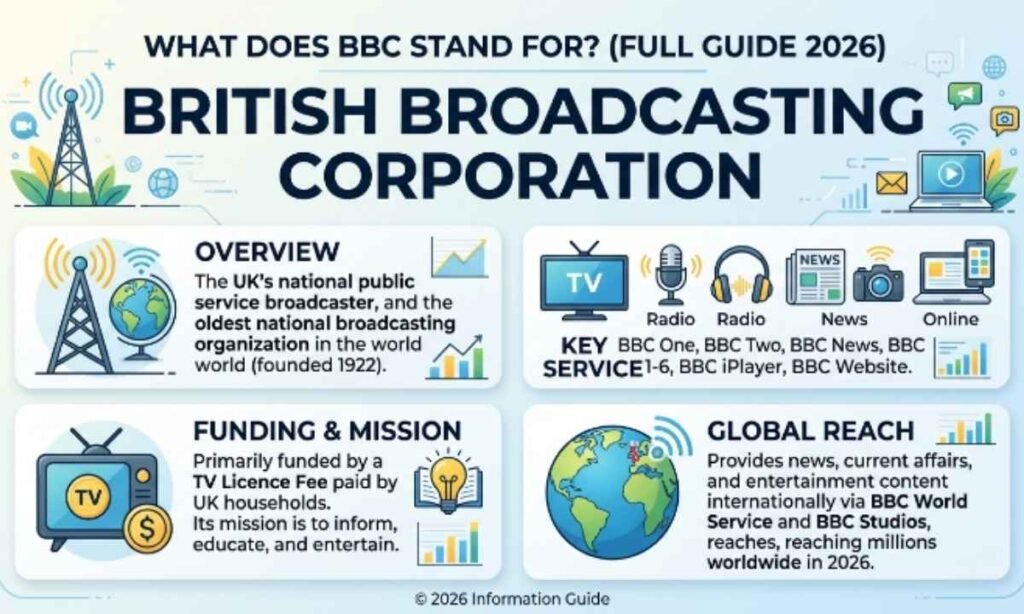
If you’ve ever come across the letters “BBC” in a news article, a school assignment, or a casual conversation, you’ve probably wondered what it actually stands for. The BBC meaning is simpler than most people expect, but there’s more to the story than just three letters.
In this guide, we’ll break down where BBC comes from, how it’s used across different platforms, and why it remains one of the most recognized abbreviations in the English language.
What Does BBC Mean?
BBC stands for British Broadcasting Corporation. It is the United Kingdom’s public service broadcaster, responsible for producing and airing television, radio, and online content across the world. The BBC meaning in a formal context always refers to this organization, regardless of where you encounter the term.
The BBC is funded primarily through a television license fee paid by UK households, which makes it one of the few major broadcasters not directly dependent on advertising revenue. This funding model is part of why the BBC is often associated with editorial independence and a strong reputation for factual reporting.
BBC Meaning in Text
When people search for the BBC meaning in text, they’re usually trying to confirm whether the abbreviation changes depending on where it’s useda text message, a group chat, or a social media caption. In the vast majority of everyday text conversations, BBC still refers to the British Broadcasting Corporation, especially when the context involves:
- Sharing a news link
- Discussing a TV show or documentary
- Referencing a radio program
If someone sends a link starting with “bbc.com” or “bbc.co.uk,” the BBC meaning is almost always the broadcaster. Context is the biggest cluepay attention to what’s being discussed around the abbreviation.
Background of BBC Meaning
The BBC was founded in October 1922 as the British Broadcasting Company, a private entity created by a group of leading wireless manufacturers. It wasn’t until it received a Royal Charter that its name changed to British Broadcasting Corporation, transforming it into the public institution we know today.
Some key milestones in BBC history include:
- 1922 The British Broadcasting Company was founded.
- 1927 Royal Charter granted; renamed British Broadcasting Corporation.
- 1936 BBC launched the world’s first regular high-definition television service.
- 1939–1945 BBC radio became a critical source of information during World War II.
- 1953 BBC broadcast the coronation of Queen Elizabeth II, a landmark television moment.
- Today BBC operates dozens of TV channels, radio stations, and a global news website reaching hundreds of millions of people.
This long history is a major reason the BBC meaning has stayed remarkably consistent for over a century, unlike many newer internet abbreviations.
BBC Meaning in Different Platforms
The BBC meaning can shift slightly depending on the platform, though the broadcaster meaning remains dominant almost everywhere.
| Platform | Most Common BBC Meaning | Notes |
| News websites | British Broadcasting Corporation | Refers directly to BBC News content |
| Text messages | British Broadcasting Corporation | Usually shared alongside a news link or show reference |
| Academic exams | British Broadcasting Corporation | Common in general knowledge and media studies questions |
| British Broadcasting Corporation | Often used in professional or media-related correspondence | |
| Radio | British Broadcasting Corporation | BBC Radio 1, 2, 3, 4, etc. |
Understanding the platform you’re on is the fastest way to confirm the intended BBC meaning in any conversation.
BBC Slang Meaning
Like many short abbreviations, BBC has occasionally been repurposed informally online for things unrelated to broadcasting, including as shorthand for unrelated organizations, fan clubs, or brand names in specific niche communities. However, these alternative uses are far less common and typically only make sense within a very specific context that has nothing to do with news, media, or general conversation.
If you’re unsure which meaning is intended, the safest and most accurate assumption in nearly all everyday, academic, and professional contexts is the British Broadcasting Corporation.
Tone and Context Variations
The tone around BBC usually depends on what’s being discussed:
- Neutral/informational tone“Did you see that BBC documentary last night?”
- News-sharing tone“BBC just posted an update on the story.”
- Academic tone“Explain the role of the BBC in UK media history.”
In each case, the BBC meaning stays the same; only the surrounding conversation changes.
Real Chat Examples
Here are a few examples of how BBC naturally appears in everyday messages, broken down by context.
News Sharing Example
“Did you catch the BBC News segment on the election results?”
Here, “News” immediately confirms the BBC meaning as the broadcaster.
Radio Reference Example
“I’m listening to BBC Radio 4 on my commute.”
The mention of “Radio 4” makes it clear this refers to a specific BBC radio station.
Entertainment/Documentary Example
“BBC just dropped a new nature documentaryyou’d love it.”
“Documentary” signals that BBC is being used as the content producer, not any other meaning.
In each example, the BBC meaning is instantly clear from the surrounding words like “News,” “Radio,” and “documentary.”
See ALSO :BMF Meaning: What Does BMF Mean in Text & Slang? (2026)
What Does BBC Mean in Email?
In professional or academic email threads, BBC almost always refers to the British Broadcasting Corporation for example, in a media inquiry, a journalism course reference, or a citation. It’s worth noting that BBC is easily confused with BCC (blind carbon copy), an email function used to hide recipients from each other. These two terms look similar but mean completely different things:
| Term | Meaning | Used For |
| BBC | British Broadcasting Corporation | Referring to the broadcaster |
| BCC | Blind Carbon Copy | Hiding email recipients from one another |
Double-checking which one you meant to type can save you from an awkward mix-up.
Grammar and Language Role
Grammatically, BBC functions as a proper nounspecifically, the name of an organization. This means:
- It’s always capitalized (BBC, not bbc, unless used stylistically online).
- It doesn’t take a plural form.
- It’s often preceded by “the,” as in “the BBC,” when used in a sentence (e.g., “I work at the BBC”).
Unlike casual internet slang, the BBC meaning doesn’t shift with grammar rules or sentence structureit remains a fixed, formal name.
How to Reply When Someone Says BBC
If someone mentions BBC in conversation and you’re unsure of the context, a simple clarifying question works well:
- “Are you talking about the BBC News story?”
- “Which BBC show do you mean?”
- “Is that from BBC Radio or BBC iPlayer?”
These replies keep the conversation natural while confirming you’re both on the same page about the BBC meaning being discussed.
Who Uses the BBC?
The BBC serves a broad and diverse audience. Here’s a closer look at who relies on it and why.
General Viewers and Listeners
The everyday UK and international audience who watch BBC TV channels or listen to BBC radio stations for news and entertainment.
Students and Researchers
Many students cite BBC News as a reliable source for current events, essays, and media studies assignments.
Journalists
Journalists worldwide reference BBC reporting standards and coverage as a benchmark for accuracy and editorial independence.
Language Learners
Non-native English speakers use BBC Learning English resources to improve vocabulary, grammar, and listening skills.
Global Audiences
Millions of people outside the UK access BBC World Service content for international news coverage.
Its reach extends far beyond the UK, with BBC News being one of the most visited news websites in the world.
Is BBC Rude?
No. The BBC, referring to the British Broadcasting Corporation, is not rude or inappropriate in any way. It’s a globally respected public broadcaster used in formal, academic, and everyday contexts without any negative connotation.
Should You Use BBC at School or Work?
Yes. Referencing the BBCwhether citing a news article, discussing a documentary, or mentioning BBC Radio is completely appropriate in academic and professional settings. It’s a credible, well-established source frequently used in essays, presentations, and media literacy discussions.
Experience-Based Insight
Anyone who has grown up watching or listening to BBC content knows how deeply it’s woven into everyday British culture from morning radio shows to evening news broadcasts. For non-UK audiences, BBC News often serves as a go-to source for international coverage precisely because of its long-standing reputation for balanced reporting. This real-world familiarity is a big part of why the BBC meaning rarely needs explanation once the context is clear.
Frequently Asked Questions
What is the full form of BBC?
BBC stands for British Broadcasting Corporation, the UK’s public service broadcaster.
When was the BBC founded?
The BBC was founded in October 1922 and became a corporation in 1927 after receiving a Royal Charter.
Is BBC a government-owned company?
No, the BBC is a public service broadcaster funded mainly by license fees, not a government department.
Does BBC have a different meaning in slang?
In rare informal contexts it may be repurposed, but in everyday, academic, and professional use, it refers to the British Broadcasting Corporation.
What’s the difference between BBC and BCC?
BBC refers to the broadcaster, while BCC (blind carbon copy) is an email feature used to hide recipients.
Is the BBC only a TV channel?
No, the BBC operates television, radio, online news, and educational content across multiple platforms.
Conclusion
At its core, the BBC meaning comes down to one clear answer: the British Broadcasting Corporation, one of the world’s most recognized and trusted public broadcasters. Whether you encounter it in a text message, an email, a school assignment, or a casual chat, context almost always confirms this meaning instantly. Understanding its history, platform use, and proper grammar helps you use and recognize the term with confidence in any setting.