

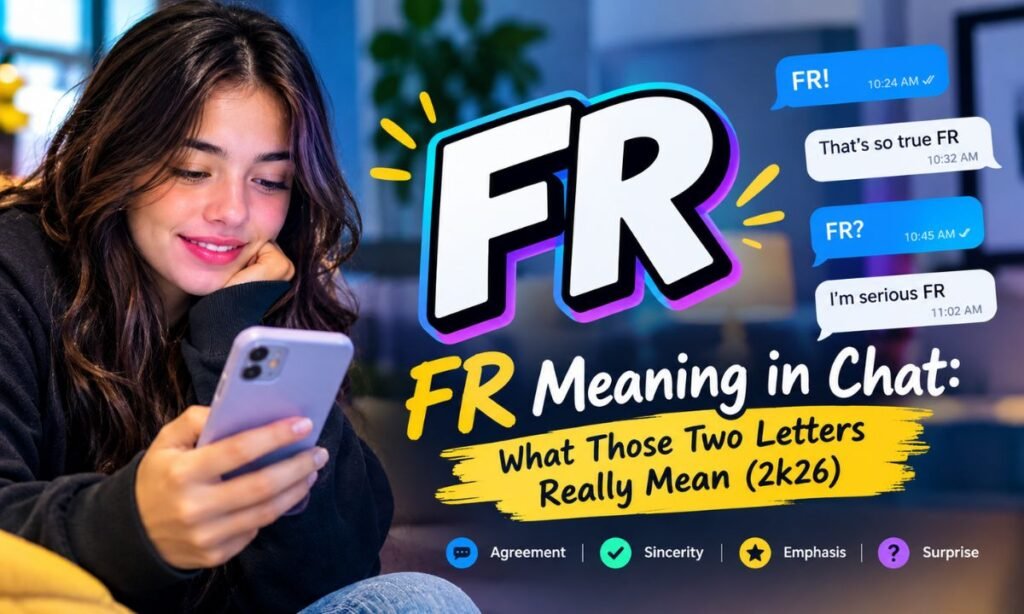
If someone sends you “FR” in a text, comment, or group chat, they are usually not talking about a complicated acronym. In everyday online slang, FR means “for real.” It can express agreement, sincerity, emphasis, surprise, or a request for confirmation.
The tricky part is that FR meaning in chat can change slightly depending on where it appears. A standalone “FR” can mean “I agree,” while “FR?” may mean “Really?” or “Are you serious?” When it appears at the end of a sentence, it often adds extra emphasis.
Because digital conversations move quickly, short expressions like FR have become common across texting, social media, gaming chats, and direct messages. Current slang references consistently identify “for real” as its dominant meaning.
FR Meaning in Chat and Text
The most common FR meaning in chat is “for real.” It is an informal abbreviation used to show that someone is serious, genuinely agrees, or strongly believes what they are saying.
For example:
“That exam was ridiculously hard.”
“FR.”
Here, FR means something like “Seriously” or “I completely agree.”
It can also be placed after a statement:
“I need a vacation FR.”
In this case, the speaker is emphasizing that they genuinely need a break.
Common meanings of FR
| FR usage | What it usually means |
| “FR.” | I agree / Seriously |
| “FR?” | Really? / Are you serious? |
| “That was funny FR.” | That was genuinely funny |
| “FR, I understand.” | I genuinely understand |
| “FRFR.” | For real, for real / Strong emphasis |
The surrounding message is important because abbreviations can have other meanings outside casual internet slang. If “for real” does not make sense in the conversation, context should determine the intended meaning.
Here’s What FR Actually Does in a Conversation
FR is more than a shortened phrase. It works as a small tone marker that tells the other person how seriously to take a statement.
People commonly use FR to:
- Agree strongly with someone
- Confirm that something is true
- Emphasize their own opinion
- Show genuine emotion
- React to surprising information
- Ask whether someone is being serious
Consider these examples:
Agreement:
“This weather is exhausting.”
“FR.”
Emphasis:
“That was the best concert FR.”
Confirmation:
“You actually met her?”
“FR.”
Questioning:
“FR? You quit your job?”
In each example, the basic idea remains connected to “for real,” but its conversational job changes.
Where You’ll Actually See People Using It
The FR meaning in chat is most noticeable in informal digital spaces. Search results consistently associate the abbreviation with texting, social media, group chats, gaming communities, and direct messages.
You may see FR on:
- Text messages
- Instagram DMs and comments
- TikTok comments
- Snapchat chats
- WhatsApp conversations
- Discord servers
- Gaming chats
- Group messages
- Online forums
For example, a TikTok comment might say:
“This is exactly how I feel FR.”
A friend might text:
“FR, we need to go there again.”
The abbreviation works particularly well in fast conversations because it communicates agreement without requiring a complete sentence.
Why Tone Changes Everything
Two people can type exactly the same “FR” and communicate different feelings.
The difference usually comes from punctuation, placement, previous messages, and the relationship between the people chatting.
Compare:
“FR.”
This can sound like strong agreement, but in some situations it may feel short or dry.
“FR!”
This usually feels more energetic or enthusiastic.
“FR?”
This normally asks for confirmation and can mean “Really?” or “Are you serious?”
“fr lol”
This can sound relaxed, humorous, or conversational.
“I’m serious FR.”
Here, FR reinforces the speaker’s sincerity.
This is why reading only the abbreviation is not enough. The surrounding conversation provides most of the emotional meaning.
Times When FR Makes You Look Bad
FR is not inherently rude, but using it at the wrong moment can make your message feel careless.
For example, imagine someone shares a serious personal problem and you respond only:
“FR.”
Even if you mean “I understand,” the reply may look too brief or emotionally distant.
Avoid relying on FR alone when:
- Someone is discussing a serious problem.
- You are speaking to a customer or client.
- You are writing a formal email.
- You are communicating with a teacher or supervisor.
- The other person may not understand internet slang.
- Your message requires a detailed explanation.
Instead of:
“FR.”
You could say:
“I completely understand what you mean.”
The key issue is not that FR is offensive. It is that casual slang does not always communicate enough detail or warmth.
Other Ways to Say the Same Thing
If you want to express the same basic idea without using FR, several alternatives are available.
| FR | Alternative | Tone |
| FR | Seriously | Casual |
| FR | Exactly | Agreeing |
| FR | I agree | Clear |
| FR | Definitely | Positive |
| FR | Honestly | Sincere |
| FR? | Really? | Surprised |
| FR? | Are you serious? | Stronger reaction |
| FRFR | Absolutely | Strong agreement |
The best alternative depends on the conversation. “Exactly” works well when you agree with an opinion, while “Really?” makes more sense when you are surprised by information.
What It Looks Like in Real Messages
The easiest way to understand FR meaning in chat is to see how people naturally place it in messages.
Example 1: Agreeing
Person A:
“This week went by so fast.”
Person B:
“FR.”
Meaning: I completely agree.
Example 2: Emphasizing an opinion
Person A:
“That restaurant is expensive.”
Person B:
“It is expensive FR.”
Meaning: It really is expensive.
Example 3: Showing surprise
Person A:
“I just bought a new car.”
Person B:
“FR?”
Meaning: Really? Is that actually true?
Example 4: Confirming something
Person A:
“Are you actually coming tonight?”
Person B:
“FR.”
Meaning: Yes, seriously. I really am coming.
Example 5: Stronger emphasis
Person A:
“I’m never doing that again.”
Person B:
“FRFR.”
Meaning: Seriously, for real. I strongly agree or relate.
These examples show why the position of FR matters almost as much as the abbreviation itself.
A Bit of History (And Why It Matters)
The phrase “for real” existed long before internet slang. It has traditionally been used in informal English to question whether something is genuine or to emphasize sincerity.
Digital communication shortened the phrase into FR, following a broader pattern in online language where longer expressions become compact abbreviations.
The abbreviation became especially useful in fast-moving conversations because two letters can perform the work of a longer response. Current slang references commonly describe FR as an initialism for “for real” and connect its use with modern digital communication.
This history also explains why FR feels natural in casual conversation. It is not a completely new expression; rather, the internet gave an existing phrase a shorter digital form.
Ways People Get FR Wrong
Understanding FR meaning in chat is easy, but using it naturally requires attention to context.
Here are some common mistakes:
1. Assuming FR always means agreement
A standalone “FR” often means agreement, but “FR?” usually works as a question.
2. Using it in every conversation
FR is informal slang. Repeating it constantly can make your messages sound forced.
3. Ignoring the tone
A one-word FR can look dismissive during an emotional conversation.
4. Confusing FR with FRFR
FRFR adds repetition for extra emphasis. It generally means something like “for real, for real.”
5. Assuming it has only one meaning
“FR” can represent different things in other contexts. The surrounding topic should always be considered.
6. Using it in formal communication
A professional email usually benefits from complete wording instead of internet abbreviations.
The safest approach is simple: use FR when the conversation is clearly casual and the other person is likely to understand it.
FAQs
Is FR rude to use?
No, FR is not inherently rude; it is casual slang, although a short “FR” reply can seem dry in a serious conversation.
Does it mean the same thing everywhere?
Usually, FR means “for real” in casual chat, but its meaning can change in technical, professional, or specialized contexts.
Should I use FR in professional messages?
Generally, avoid FR in formal emails or workplace communication unless you already know the setting is very informal.
What’s the difference between FR and FRFR?
FR means “for real,” while FRFR means “for real, for real” and adds stronger emphasis or sincerity.
Can older people use FR without seeming weird?
Yes. Anyone can use FR naturally if they understand the context, although forcing unfamiliar slang into a conversation may sound less natural.
Final Thoughts
The simplest answer to FR meaning in chat is “for real.” But those two letters can do several conversational jobs. They can show agreement, confirm sincerity, emphasize an opinion, or ask whether something is actually true.
The punctuation and placement often provide the biggest clues. “FR” commonly expresses agreement, “FR?” usually asks for confirmation, and “FRFR” adds extra emphasis.
If you are chatting casually with friends or participating in social media conversations, FR is a useful and widely understood abbreviation. For formal situations, however, writing the full phrase or using clearer wording is usually more appropriate.