

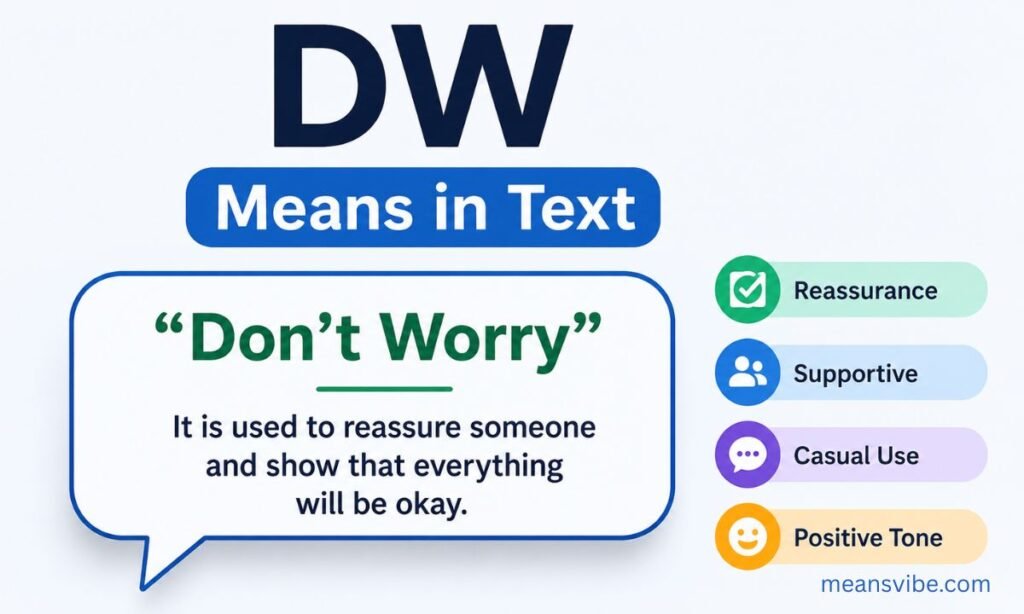
DW means in text almost always translates to “don’t worry.” It’s a quick, casual way to reassure someone after an apology, a small mistake, or a moment of doubt. You’ll see DW constantly on WhatsApp, Snapchat, Instagram, and in everyday group chats nearly always used as a two-letter way of saying “it’s fine, relax.”
That’s the short answer. But once you start noticing DW in real conversations, you’ll realize it carries a few other meanings too, its tone shifts with punctuation, and the right way to reply isn’t always obvious. Here’s the full breakdown of what DW means in text really covers.
Every Meaning of DW, Explained
DW means in text isn’t limited to one definition. The correct read depends entirely on where you saw it and who sent it.
| DW Stands For | Where You’ll See It |
| Don’t Worry | Texting, DMs, group chats, gaming |
| Dear Wife | Marriage forums, older couples’ messages |
| Doctor Who | Fan communities, TV discussion threads |
| Down for Whatever | Casual plans between friends |
| Digital Watch / Data Warehouse | Tech and product discussions |
| Driving While (as in DWI) | Legal shorthand, rarely in casual texting |
If you’re texting a friend, a partner your own age, or scrolling a comment section, DW means in text is almost certainly “don’t worry.” The other meanings only apply in narrow, specific contexts; the surrounding conversation usually makes it obvious which one fits.
What Does DW Mean From a Girl?
When a girl texts “dw, it’s really not that deep,” she’s usually offering genuine reassurance telling you whatever happened isn’t worth stressing over. It often shows up with a softer tone: an emoji, a follow-up line, or extra warmth in the wording.
- Usually means she’s letting the issue go, not holding it against you
- Signals she’d rather move the conversation forward than dwell on it
- Rarely hides a negative or passive-aggressive meaning on its own
If a “dw” from her feels short or cold, that’s more likely about her mood at the moment than a hidden message behind the abbreviation itself.
What Does DW Mean From a Guy?
From a guy, a reply like “dw, it’s handled” is usually literal and to the point don’t worry, nothing more. Guys tend to send DW without much extra punctuation or softening.
One pattern worth knowing: some guys lean on “dw, forget it” to sidestep a longer emotional conversation. It’s not automatically dismissive, but if it keeps showing up whenever a serious topic comes up, that’s a habit worth noticing rather than the word itself being a red flag.
DW in Real Conversations: Examples by Relationship
DW means in text shifts slightly depending on who’s sending it. Here’s how it actually plays out across different relationships.
With a close friend
“Bro I totally forgot to send you the notes last night.” “dw man, I found them from someone else”
With a crush or partner
“Sorry I’ve been slow replying, work’s been chaos this week.” “dw 🤍 I’m not going anywhere”
With a coworker
“Apologies for the late reply on that report.” “dw, I only needed it by Friday anyway”
With a parent or older relative DW is best avoided here entirely. A full sentence like “don’t worry about it, I’ve got it handled” reads far better than an abbreviation they may not recognize.
Is DW Rude, Flirty, or Offensive? A Tone Guide
On its own, DW means in text is neither rude nor offensive; it’s a reassurance word by design. But punctuation changes how it feels:
| Style | How It Usually Reads |
| dw | Neutral, casual |
| dw. | Can feel blunt or slightly cold |
| dw!! or dwww | Warm, enthusiastic |
| dw 😊 / dw ❤️ | Friendly, sometimes flirty between two people who are into each other |
Timing matters too. A quick “dw” right after someone opens up about something serious can feel dismissive not because of the word itself, but because it cuts a conversation short when more was expected.
DW in Businesses and Organizations
Outside of texting, DW also shows up as shorthand for real brands and organizations. It’s worth knowing so you don’t confuse these with the “don’t worry” meaning:
| DW As | What It Is |
|---|---|
| Deutsche Welle | Germany’s international public news broadcaster |
| Daniel Wellington | Swedish watch brand |
| Drum Workshop (DW Drums) | American drum kit and hardware manufacturer |
| Development Workshop | Non-profit organization |
| DW Sports Fitness | Defunct British sports and fitness retailer |
How to Respond When Someone Texts DW
You don’t need to overthink a reply. Match the energy, and move on:
- “Okay, thanks!”
- “Appreciate that 🙏”
- “All good then.”
- A simple thumbs-up or heart reaction
If a topic still feels unresolved after someone sends “dw, it’s fine,” it’s okay to gently push back with something like “you sure? I don’t mind talking about it.”
DW on Social Media & Messaging Apps
Across WhatsApp, Snapchat, and Instagram, DW means in text stays the same “don’t worry” but usage differs slightly by app:
- WhatsApp: Common in one-on-one chats and family or friend groups, often after a missed call: “saw your missed call, dw I’ll call back tonight.”
- Snapchat: Fits the platform’s fast pace, usually a one-word reply to a story: “dw 😂 happens to everyone.”
- Instagram: Shows up in comments and DMs, frequently paired with an emoji to keep the tone light: “dw about the typo, we all saw what you meant.”
The meaning doesn’t change across platforms, only the pace and formality of the conversation around it does.
Common Misunderstandings About DW
- Assuming DW means in text is always “dear wife” that’s rare outside couple-specific or forum contexts
- Reading a short “dw” as rude when the sender was simply typing fast
- Missing that DW can occasionally dodge a deeper conversation instead of genuinely reassuring
- Mixing up texting DW with unrelated uses like the media brand or the legal abbreviation
DW vs. Similar Slang Terms
DW belongs to a small family of reassurance shorthand. Here’s how they differ:
| Term | Meaning | Best Used When |
| DW | Don’t worry | Reassuring someone after a small issue |
| NP | No problem | Responding to thanks or a request |
| NBD | No big deal | Downplaying an inconvenience |
| IKR | I know, right | Agreeing enthusiastically |
| ATP | At this point | Marking frustration or a turning point |
DW and NBD sit closest in meaning, but DW responds to worry specifically, while NBD responds to an inconvenience or favor for example, “dw about splitting the bill” reassures, while “nbd, I’ve got this one” downplays a favor.
When You Should Avoid Using DW
- Professional emails or workplace messaging
- Serious conversations where someone needs more than two letters of reassurance
- Formal apologies, where a full sentence shows more effort
- Chats with someone unfamiliar with texting slang, like an older relative or new coworker
FAQs
What does DW mean in a text message?
DW means in text almost always means “don’t worry” , a quick way to reassure someone or downplay a small issue.
Can DW mean something other than don’t worry?
Yes. It can mean “dear wife” between couples, or refer to Doctor Who, “down for whatever,” or technical terms depending on context.
Is it okay to use DW in professional messages?
It’s best avoided at work; it can come across as too casual for formal communication.
What does DW mean on Snapchat and WhatsApp?
On both, DW means in text stays “don’t worry” and is used to reassure friends quickly.
How do you reply when someone texts DW?
A short, matching reply like “okay, thanks” or a simple reaction is enough. DW doesn’t need a long response.
Does DW mean the same thing between a guy and a girl?
Usually yes “don’t worry” though guys tend to send it more plainly, while girls often soften it with emojis or extra words.
Is dw. with a period different from dw?
It can read more blunt or final, especially without an emoji, even though the meaning stays the same.
What’s the difference between DW and NBD?
DW responds to worry or concern; NBD downplays an inconvenience or favor. They overlap but aren’t interchangeable.
Conclusion
At its core, DW means in text is one of the simplest, most-used pieces of texting shorthand in nearly every everyday conversation, it means “don’t worry.” The tone shifts slightly with punctuation and who’s sending it, but the intent stays the same: to reassure, not to dismiss. Keep it for casual chats, skip it in professional or serious ones, and you’ll never misread a “dw” text again.