

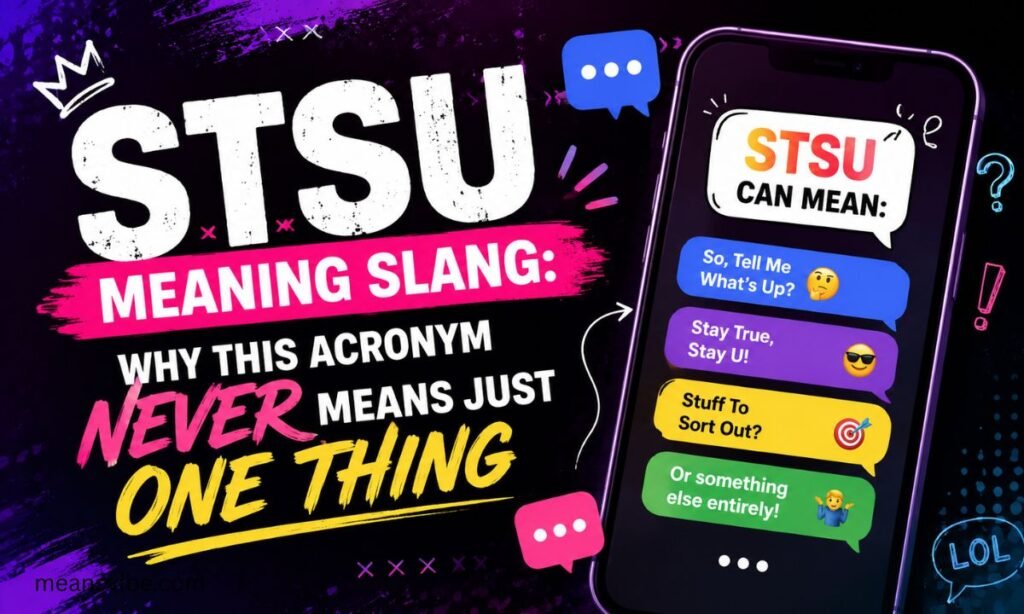
Ever been scrolling through a group chat, feeling totally fine, when someone drops “STSU” out of nowhere and your brain just stalls for a second? You’re not alone. This four-letter internet slang term shows up everywhere TikTok comments, Discord threads, Instagram replies, Snapchat messages and it rarely means the exact same thing twice.
That’s the real story behind STSU meaning slang: it’s less of a fixed definition and more of a tone-dependent reaction. This guide breaks down every common reading, shows how context and platform change its impact, and gives you real chat examples so you’re never left guessing again.
Quick meaning points:
- STSU is a texting abbreviation, most often read as a softened version of “shut up”
- It can express annoyance, playful teasing, disbelief, or even excitement depending on delivery
- Tone, emojis, and relationship between users decide the real meaning
- Common on TikTok, Discord, Instagram, Snapchat, and WhatsApp
- No single dictionary-style definition context always drives intent
STSU Meaning Slang – Quick Explanation
STSU is most commonly understood as a censored, less harsh stand-in for a blunter phrase telling someone to be quiet. Because it’s internet slang rather than standard English, it doesn’t have one official meaning it shifts based on who’s typing it and why.
Here’s what STSU can signal, depending on context:
- A direct command “stop talking,” used bluntly during an argument
- Playful teasing a lighthearted reaction between close friends
- Genuine surprise similar to saying “no way!” or “stop, I can’t believe it”
- Mild frustration a quick way to shut down a rant without escalating
The letters stay the same; the emotional weight behind them doesn’t.
STSU Meaning in Different Platforms
The same acronym carries different weight depending on where you encounter it. Platform culture shapes how blunt or playful STSU comes across.
| Platform | Typical Use of STSU | Common Tone |
| TikTok comments | Reacting to a bold or funny statement | Playful, exaggerated |
| Instagram DMs & comments | Teasing a friend mid-conversation | Casual, friendly |
| Discord servers | Interrupting a rant or inside joke | Blunt, humorous |
| Snapchat chats | Quick reaction to gossip or a wild update | Light, reactive |
| Twitter/X replies | Shutting down a take publicly | Sharper, sometimes rude |
| Group texts (WhatsApp/iMessage) | Fast reaction to news or drama | Casual, situational |
Key takeaways from this comparison:
- Public platforms like X tend to carry a sharper, more dismissive tone
- Private chats among friends usually keep STSU light and joking
- Comment sections favor short, punchy slang because of character limits and fast scrolling
Tone & Context Variations
STSU rarely stands alone without emotional coloring. The punctuation, emojis, and relationship between the sender and receiver all shape how the message actually lands.
Signals worth watching for:
- Followed by 😂 or “lol” almost always playful, not meant to offend
- Typed in all caps with no emoji usually signals genuine irritation
- Sent right after a compliment or inside joke affectionate teasing between close friends
- A blunt, one-word reply with no prior context likely dismissive or rude
- Sent after unexpected news often means surprise, not annoyance (“STSU, no way!”)
Skipping emojis is one of the most common mistakes people make with this slang without a visual cue, a message that was meant as a joke can easily read as cold or serious. When tone feels unclear, asking directly beats assuming the worst.
Real Chat Examples (Authentic & Relatable)
Seeing STSU in action makes the meaning click faster than any definition. Here are a few realistic snippets showing the acronym doing different jobs.
Playful teasing between friends:
- Friend 1: “I definitely could beat you in a race lol”
- Friend 2: “STSU 😂 you haven’t run since gym class”
Reacting to unexpected good news:
- Friend: “I just won free concert tickets!”
- You: “STSU! No way!” here it means genuine surprise, not silence
Genuine frustration in a group chat:
- “Can everyone STSU for a second, I’m trying to explain what happened”
Sharper, argument-style use:
- Person A: “Stop bothering me.”
- Person B: “STSU.” in this context, it reads as a blunt insult
These four examples alone show STSU functioning as a joke, an exclamation of disbelief, a request for quiet, and a harsh dismissal proof that meaning depends entirely on the conversation around it.
Grammar & Language Role
STSU typically functions as an imperative, a short command similar to “stop” or “quiet down.” That’s why it almost always appears as a standalone reply instead of being woven into a longer sentence.
A few grammar and usage notes:
- It’s not part of standard English texting slang taught in style guides it’s community-created shorthand
- It can double as an interjection when used to express surprise (“STSU!” = “no way!”)
- It’s typically written in uppercase for emphasis, though lowercase use is common in casual chats
- It works as a reaction rather than a descriptive word, so it rarely appears mid-sentence
Because it’s built from a censored phrase, it also acts as a softer alternative to more direct profanity-based slang, keeping messages casual enough for platforms with content filters or younger users in the thread.
How to Reply When Someone Says STSU
How you respond depends entirely on the tone it was sent with and your relationship with the sender. There’s no universal comeback, but a few guidelines help:
- If it’s clearly a joke: laugh it off or send it right back to match the energy
- If the tone feels unclear: Ask a quick “wait, you good?” before assuming they’re upset
- If it feels genuinely rude: say it came off harsh; a short, honest reply usually resolves it
- If it’s from a stranger online: muting or ignoring is often the simplest option in public comment sections
- If it followed exciting news: treat it as excitement, not an insult, and keep the conversation going
Reading the situation before reacting saves a lot of unnecessary back-and-forth.
Who Uses STSU?
STSU is most common among teens and young adults active on TikTok, Instagram, and Discord spaces where quick, informal reactions are the norm. It fits naturally into fast-paced group chats and comment sections where full sentences feel unnecessary.
A few usage patterns worth noting:
- Popular in Gen Z and meme-culture communities
- Less common in professional or formal writing
- Older internet users may not recognize it without added context
- Popularity often spikes alongside trending audio clips or viral comment threads
Origin & Internet Culture Insight
STSU grew out of a broader internet habit of softening blunt phrases into shorter, less harsh acronyms similar to how “SMH” or “IDC” became shorthand for longer expressions. Rather than typing something more direct, users adopted a censored version that reads as casual instead of aggressive.
Why acronyms like this spread so fast:
- They fit character limits on comment sections and captions
- They carry a recognizable punch without needing full spelling
- Once a few viral videos or popular comments used it, the phrase caught on without needing an explanation
- Meme culture and chat abbreviations evolve quickly, so slang like STSU can shift meaning within the same year
Why People Say STSU on TikTok
TikTok comment sections thrive on quick, reactive humor, and STSU fits that pace. It’s short enough to type in seconds, works as a punchline to a bold opinion, and often appears in trending joke formats where creators respond to outrageous claims with a blunt, funny reply.
Safety & Appropriateness
Like most internet slang, STSU sits in a gray area fine among friends, riskier in mixed company. Knowing when it’s appropriate keeps you from sending the wrong message to the wrong person.
- Fine for casual chats with close friends
- Riskier in public comment sections or with people you don’t know well
- Best avoided in formal, professional, or sensitive conversations
- Should never be assumed to have one fixed meaning always read the context first
Is STSU rude?
It can be, depending on delivery. Among close friends it’s usually harmless teasing, but sent to someone you don’t know well, it can come across as dismissive or blunt.
Is it a bad word?
STSU itself isn’t classified as profanity, but it references a censored version of a stronger phrase. Some people still consider it inappropriate for formal or sensitive settings.
Should you use it in school or office?
No STSU is casual slang meant for informal chats with friends. It’s best avoided in school assignments, professional emails, or workplace messaging.
FAQs
What does STSU mean in text?
STSU is internet slang most often used as a softened way of telling someone to stop talking, though it can also express surprise or excitement depending on context.
Is STSU the same as STFU?
They’re related. STSU uses a censored placeholder, making it feel less harsh than the more direct STFU, even though the underlying message is similar.
Can STSU be used as a compliment or reaction to good news?
Yes. When someone shares exciting news, replying “STSU!” often means “no way!” or “I can’t believe it,” not an actual request for silence.
Where did STSU come from?
It emerged from internet slang culture as a softened alternative to blunter phrases, spreading through comment sections and short-form video platforms like TikTok.
Is STSU appropriate for kids to use?
It’s milder than uncensored alternatives, but it still implies a stronger phrase, so it’s best used with discretion depending on age and setting.
Does STSU mean the same thing on every platform?
No. Tone shifts by platform it tends to read sharper on public platforms like X and lighter in private chats with friends on Snapchat or Instagram.
Conclusion
STSU is one of those internet slang terms that changes completely depending on who’s saying it, where, and why. Sometimes it’s a joke between friends, sometimes it’s genuine surprise, and occasionally it’s real irritation. Reading the tone and platform around it not just the letters is the real key to understanding what someone means.
Now that you know the different sides of STSU meaning slang, you won’t be left second-guessing the next time it shows up in your notifications.