

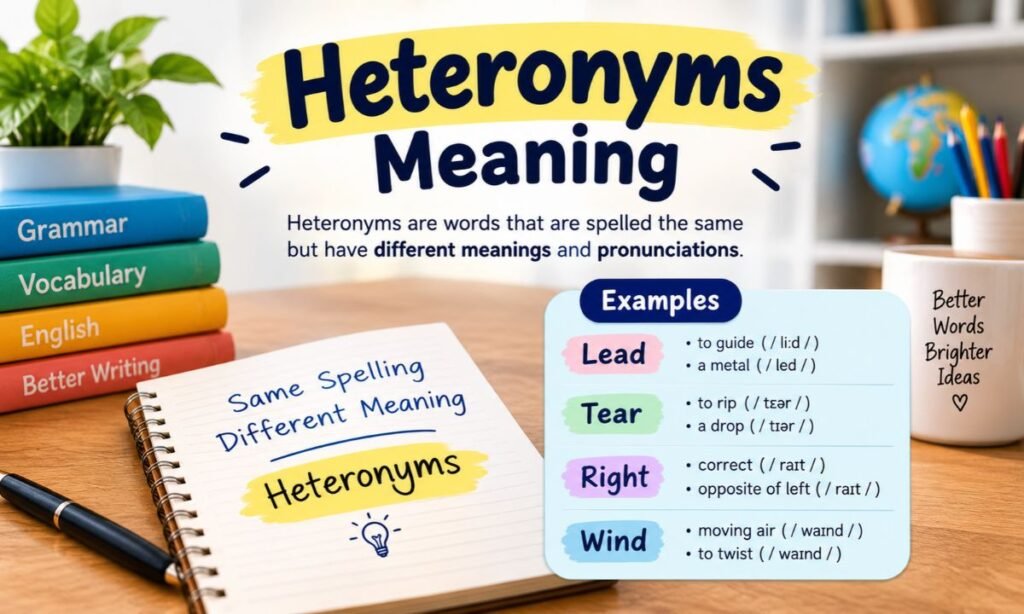
Have you ever read a sentence aloud and stopped at a word that could be said two ways? That word is probably a heteronym. This guide explains the heteronyms meaning in plain words, shows real examples with pronunciation, and gives simple tricks to pick the right sound every time you read or speak.
What Does Heteronyms Mean? A Simple Definition
Heteronyms Meaning in One Line
A heteronym is a word that is spelled the same as another word but has a different pronunciation and a different meaning. Take “lead.” Said as “leed,” it means to guide. Said as “led,” it is a soft metal. The spelling never changes, so only the sound and the sentence tell you which word is meant.
Where the Word Comes From
The term comes from Greek. “Heteros” means different and “onoma” means name, so a heteronym is literally a different name. Linguists also use the word heterophone, which means different sound. Both labels point to the same idea: one written form can stand for two spoken words, and your ear must decide.
Why English Has So Many
English spelling was largely fixed when printing spread, but pronunciation kept changing. Borrowed words and shifting stress added more splits. As a result, spelling often no longer shows how a word sounds. Heteronyms are one visible effect of that gap, and many are noun and verb pairs.
How Heteronyms Work: Same Spelling, Two Sounds
Different Sound, Different Meaning
Every heteronym pair has three parts: one spelling, two pronunciations, and two meanings. Remove one part and it becomes another kind of word. If only the sound changes but the meaning stays the same, it is just an accent difference. A true heteronym needs both the sound and the meaning to shift.
The Noun and Verb Pattern
Many heteronyms are noun and verb pairs. The noun usually puts stress on the first syllable, while the verb puts it on the second. Compare the noun “REcord” with the verb “reCORD.” Not every heteronym follows this pattern, but it is a very common one, and it gives you a quick first clue.
Stress Changes the Word
In some pairs, stress is the main change. The stressed syllable gets a full vowel, while the unstressed one often softens. Say “OBject” and “obJECT” slowly and you will hear it. This is why the same letters can be said in two ways without any change in spelling.
Heteronyms vs. Homophones, Homographs and Homonyms
| Term | Spelling | Sound | Meaning | Example |
| Heteronym | Same | Different | Different | lead / lead |
| Homophone | Usually different | Same | Different | see / sea |
| Homograph | Same | Same or different | Different | bank / bank |
| Homonym | Same | Same | Different | bat / bat |
Heteronyms vs. Homophones
Homophones sound the same but are usually spelled differently, such as “see” and “sea.” Heteronyms are the opposite. They look the same but sound different. A quick memory trick is that “phone” means sound. Homophones share a sound, while heteronyms share a spelling and split on sound.
Heteronyms vs. Homographs
Homographs are words with the same spelling and different meanings. Some are said the same way, like “bank” for a river and “bank” for money. Others are said differently. Those are heteronyms. So every heteronym is a homograph, but not every homograph is a heteronym.
Heteronyms vs. Homonyms
Homonym is the loosest of the four terms. Some sources use it for words that share both spelling and sound, like “bat” the animal and “bat” the club. Others use it for any homograph or homophone. Because usage varies, this guide treats heteronyms as the one group where the sound clearly differs.
Common Heteronym Examples With Pronunciation
Everyday Examples (Lead, Wind, Tear)
These three are classic because the two meanings have nothing in common. A person can shed a tear or tear a page, wind can blow or you can wind a clock, and a pipe can be made of lead or you can lead a team.
| Word | Sound 1 and meaning | Sound 2 and meaning |
| lead | “leed”: to guide | “led”: a heavy metal |
| wind | “wind”: moving air | “wined”: to turn or coil |
| tear | “teer”: a drop from the eye | “tair”: to rip |
Noun and Verb Pairs (Record, Present, Object)
Here the stress moves, and so does the part of speech. This is the easiest group to learn because the rule repeats. Words like “permit” and “produce” follow it too, though a few exceptions exist, so check a dictionary whenever you feel unsure.
| Word | Noun (stress first) | Verb (stress second) |
| record | REC-ord: a written or audio account | re-CORD: to save or capture |
| present | PREZ-ent: a gift | pre-ZENT: to give or show |
| object | OB-ject: a thing | ob-JECT: to disagree |
| permit | PER-mit: an official paper | per-MIT: to allow |
| produce | PROD-uce: fresh fruit and vegetables | pro-DUCE: to make |
Tricky Pairs Learners Miss (Bass, Row, Close)
These pairs are tricky because the change is small or regional. “Row” meaning a noisy argument is more common in British English, so many learners never hear it. “Close” changes only its last consonant, from an s sound to a z sound, which is easy to miss when you speak fast.
| Word | Sound 1 and meaning | Sound 2 and meaning |
| bass | “bayss”: a low sound or instrument | “bass” (short a): a fish |
| row | “roh”: a line, or to paddle | “rau”: a noisy argument |
| close | “klohs”: near | “klohz”: to shut |
Heteronyms in Sentences
Simple Sentences for Beginners
Start with short sentences where the meaning is easy to guess. Read each one aloud and notice how the sound changes with the job the word is doing. Say the bold word slowly first, then at normal speed. Do this a few times and the pattern starts to feel natural.
- I read (reed) a book every night. Yesterday I read (red) the last chapter.
- Please close (klohz) the door. The shop is close (klohs) to my house.
- The wind (wind) is strong today. Please wind (wined) the clock.
- I will record (reCORD) the song. This is a record (REC-ord) of the meeting.
One Sentence, Both Meanings
The most useful sentences use both forms together. They show why context matters, because your voice has to switch sounds in the middle of one thought. Try reading each example aloud, and check that the verb gets stress on the second syllable and the noun on the first.
- I did not object to the strange object on the table.
- She will present the present to the winner.
- The farm can produce more produce this year.
Test Yourself: Pick the Right Sound
Pick the right sound for each bold word before you look at the answers. Say both versions aloud, then choose the one that fits the sentence. Do not rush, since the goal is to notice the clues. If you get three out of four, you already read heteronyms well.
- The nurse will wind the bandage around my arm.
- There was a tear in my coat.
- The old pipe is made of lead.
- Please close the window.
Answers: 1. “wined” (to coil). 2. “tair” (a rip). 3. “led” (the metal). 4. “klohz” (to shut).
How to Tell the Right Pronunciation From Context
Check the Part of Speech
Ask what job the word does. If it names a thing, it is probably a noun. If it shows an action, it is a verb. For many pairs, that one question settles the stress. “I need a permit” uses the noun, and “They will permit it” uses the verb.
Read the Words Around It
Small words give strong clues. After “a,” “the,” or “my,” you usually expect a noun. After “to,” “will,” or “can,” you usually expect a verb. Nearby topic words help too. “Fish” points to the animal sense of bass, while “guitar” points to the music sense.
When the Sentence Is Unclear
Sometimes a sentence fits both readings. “The bass was huge” could be a fish story or a music story. In writing, add a clue word. In speech, listen for the speaker’s stress, or just ask. If the text is a poem or a headline, check the surrounding lines, because the rhyme often settles it.
Why Heteronyms Confuse English Learners
Spelling Does Not Show the Sound
Some languages spell words close to how they sound. English often does not. A learner who sees “lead” has no spelling clue to choose between “leed” and “led.” They must know the word, the sentence, and sometimes the dialect. That is a lot to process in real time, even for fluent speakers.
Easy Tips to Remember Them
You do not need to memorize every pair at once. A small routine works better than a long list. Try these steps with a few new pairs each week. Short, repeated practice helps you hear the difference, not just see it.
- Learn the pair together, not one word at a time.
- Write one sentence for each sound.
- Say each sentence aloud and record yourself.
- Group noun and verb pairs by the stress rule.
- Check any new pair in a dictionary with audio.
Mistakes to Avoid When Speaking
Most errors come from guessing the sound from the spelling alone, so slow down and check the clues first. Watch for these common slips when you speak or read aloud. A wrong stress rarely blocks meaning completely, but it can slow the listener down.
- Saying “read” as “reed” when talking about the past
- Stressing the verb “present” on the first syllable
- Using the “klohs” sound in “close the door”
- Mixing up “wound” the injury (“woond”) with “wound” as the past of wind (“wownd”)
Fun Facts About Heteronyms
Heteronyms in Poems and Word Games
Writers and puzzle makers enjoy heteronyms because one line can carry two sounds. Teachers use them in sentence games, and poets use them for wordplay. Because the words rhyme with different partners, a poem can change its reading as you go.
- “Read” is the best-known case where the sound marks present and past tense of the same verb.
- “Does” can be the verb “duz” or the plural of a female deer, “dohz.”
Rare Triple Heteronyms
Most heteronyms come in pairs, but a few reach three. A commonly cited example is “sin.” It can mean wrongdoing, it can be read “sine” in maths, and it also names a Hebrew letter. Triples are extremely rare, so you will almost always meet pairs.
Heteronyms in Other Languages
Heteronyms are not only an English thing. Languages that leave out vowels in writing can create similar cases. In Arabic, for example, the written form “ktb” can be read as “he wrote” or as “books,” depending on the vowels a reader supplies. It is debated whether these truly count, since full vowel marks remove the doubt.
Frequently Asked Questions
What is a heteronym in simple words?
It is a word spelled like another word but said differently and with a different meaning, such as “lead” (leed) and “lead” (led).
What are some examples of heteronyms?
Lead, wind, tear, record, present, object, bass, row, and close are common ones. Each has two sounds and two meanings.
Is “read” a heteronym?
Yes. “Read” (reed) is the present tense, and “read” (red) is the past tense.
What is the difference between a heteronym and a homonym?
A heteronym is said differently from its twin. A homonym is usually said the same way, though some sources use the term more loosely.
Are heteronyms and homographs the same thing?
No. Every heteronym is a homograph, but a homograph can sound the same, like “bank” and “bank.”
How many heteronyms are there in English?
There is no official count, because lists include different borderline pairs.
Conclusion
Heteronyms are simple once you see the pattern: one spelling, two sounds, two meanings. Start with the classic pairs, learn the noun and verb stress rule, and use context to choose. Keep a short list of your own, read it aloud, and you will handle most heteronyms with confidence.