

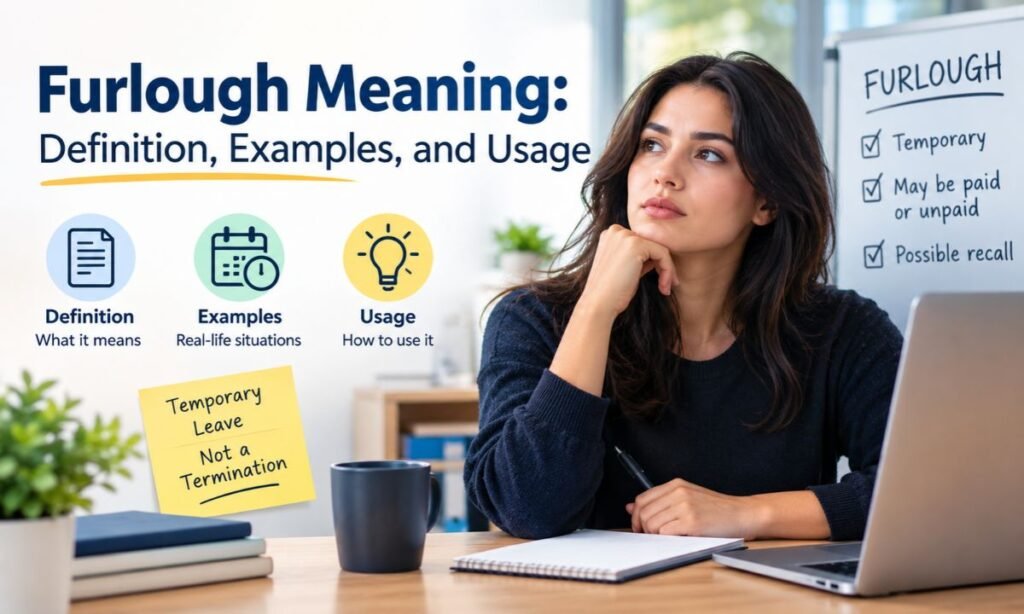
Understanding the furlough meaning can help employees make informed decisions when an employer temporarily suspends work or reduces working hours. A furlough commonly occurs when an organization faces financial difficulties, seasonal changes, a temporary shutdown, or a disruption in funding. Instead of immediately ending employment, the employer may place workers on a temporary leave or reduce their scheduled hours.
However, a furlough does not always mean an employee will receive full pay, keep every benefit, or automatically return to work on a particular date. The outcome depends on the employer’s policy, the employment agreement, and applicable laws. Understanding these details can help employees prepare financially and know which questions to ask their employer.
Furlough Meaning: What the Word Actually Covers
The furlough meaning generally refers to a temporary period when an employee is required to stop working or work fewer hours while the employment relationship may continue. Employers often use furloughs to manage temporary financial or operational challenges without permanently dismissing their workforce.
For example, a company experiencing a temporary drop in customer demand might ask employees to take several unpaid days off. Similarly, a government agency facing a funding interruption may temporarily furlough certain employees.
The exact arrangement matters. Some furloughs involve complete unpaid leave, while others involve reduced schedules. The word alone does not establish whether the employee will receive compensation, retain benefits, or return on a specific date.
What Does Furloughed Mean for the Person Receiving the News?
When someone is furloughed, the employer has temporarily stopped their work or reduced their hours under a particular arrangement. The person may remain employed, but their income and work schedule can change significantly.
For instance, imagine that a business closes its office for two weeks because of a temporary budget problem. Employees may be told not to work during that period and to wait for further instructions. They may still have an employment relationship with the business, but their pay and benefits depend on the applicable rules and policy.
If you are furloughed, ask your employer whether the leave is paid or unpaid, how long it is expected to last, whether benefits will continue, and whether you are permitted to work elsewhere during the period.
Furlough vs. Layoff vs. Reduction in Hours
Understanding the furlough meaning becomes easier when you compare it with a layoff and a reduction in working hours. Although these terms can overlap in everyday conversation, they may describe different employment arrangements.
| Employment term | What it generally means | What employees should know |
| Furlough | A temporary suspension of work or reduction in hours | Employment may continue, but pay and return dates are not guaranteed. |
| Layoff | A reduction in the workforce, which may be temporary or permanent depending on the circumstances | Ask whether the employer expects to recall workers. |
| Reduction in hours | Employees continue working but have fewer scheduled hours | Earnings may decrease even when employment continues. |
| Termination | The employment relationship ends | Final wages, benefits, and other rights depend on the circumstances and applicable law. |
These distinctions are important because an employer’s chosen term does not necessarily determine the legal outcome. The actual arrangement and local employment laws matter more than the label alone.
The Choice Is Usually About Duration and Certainty
A furlough is often intended to be temporary, whereas a permanent layoff or termination may mean the employer does not expect the employee to return. Nevertheless, employers may change their plans as business conditions develop.
If your employer announces a furlough, request written information about the expected duration, your employment status, and the conditions for returning to work. A projected return date is not always a guarantee.
The furlough meaning can also vary between industries. Government agencies, educational institutions, seasonal businesses, and private companies may use different policies to manage temporary work interruptions.
What Happens to Pay and Benefits During a Furlough?
One of the most important questions employees ask is whether they will receive money during a furlough. There is no universal answer. Some furloughs are unpaid, while others involve reduced working hours or compensation arrangements established by a contract or workplace policy.
In the United States, federal wage rules generally require covered nonexempt employees to be paid for hours they actually work. Employers must also follow applicable minimum-wage and overtime requirements. State laws, contracts, and other rules may provide additional protections.
Before accepting the employer’s explanation, review your written furlough notice and ask payroll or human resources to explain how your pay will be calculated.
Exempt Employees and the Full-Workweek Rule
Certain employees classified as exempt under U.S. federal wage law may be subject to salary-basis rules. In general, an employer cannot make deductions from an exempt employee’s salary for a temporary business closure during a workweek in which the employee performs any work, subject to applicable exceptions.
A full workweek in which the employee performs no work may be treated differently under the federal salary-basis rules. These requirements are technical, and an employee’s classification and circumstances matter.
Employees should not assume that a furlough automatically permits an employer to reduce every salary payment. For specific concerns, consult the U.S. Department of Labor or the relevant state labor agency.
Health Coverage, COBRA, and the ACA Measurement Problem
A furlough can also affect health insurance and other workplace benefits. Whether coverage continues depends on the employer’s plan documents, the number of hours worked, and the rules governing the benefit.
Under U.S. federal law, a termination of employment or reduction in hours may trigger COBRA continuation-coverage rights for eligible individuals when the applicable conditions are met. COBRA generally allows qualifying beneficiaries to continue group health coverage temporarily, often at their own expense.
Employees should ask whether their existing insurance will remain active, whether they must pay a larger share of the premium, and whether a reduction in hours affects eligibility. They may also explore coverage options through the Health Insurance Marketplace if their circumstances qualify.
The furlough meaning therefore extends beyond the work schedule: it can affect household budgeting, insurance decisions, and access to workplace benefits.
Recall: The Half of a Furlough Nobody Plans
A recall occurs when an employer asks furloughed employees to return to work. Some organizations provide a clear recall date, while others wait until funding, customer demand, or operating conditions improve.
A furlough does not automatically guarantee recall. Employees should understand whether the employer has made a firm commitment or merely expressed an expectation that work may resume.
The Six-Month Line
In the United States, the federal Worker Adjustment and Retraining Notification (WARN) Act includes specific rules for certain plant closings and mass layoffs. Under the law, a layoff lasting more than six months can count as an employment loss for WARN purposes. Certain reductions in work hours can also qualify under the statute.
There are exceptions and detailed notice requirements, so the six-month threshold is not a universal maximum length for every furlough. The law’s application depends on the employer, the number of affected workers, the nature of the employment action, and other facts.
Employees who believe a furlough may be turning into a longer-term separation should seek clarification rather than assuming that a particular date automatically guarantees recall or triggers the same rights in every situation.
What a Recall Notice Needs to Contain
A useful recall notice should clearly explain the next steps. Although the exact information varies by employer, employees should look for:
- Return date: The date they are expected to resume work.
- Reporting instructions: The location, schedule, or manager they should contact.
- Work arrangements: Whether their previous position, hours, and duties will remain the same.
- Pay and benefits: Any changes to compensation, insurance, or other employment benefits.
- Response deadline: The date by which they must confirm availability or respond.
If a notice is unclear, ask for written clarification. Keep copies of communications so you can refer to the employer’s instructions later.
The Selection Question You Will Be Asked Later
When an employer recalls workers, it may need to decide who returns first. The selection process can depend on seniority, job requirements, qualifications, staffing needs, contracts, collective bargaining agreements, and applicable laws.
Employees should ask whether the employer has a written recall policy and how decisions will be made. They should also keep their contact information current and respond promptly to official communications.
A furlough should not be treated as a guarantee that every affected employee will return under identical conditions.
What a Furlough Does to Your Open Hiring Pipeline
If you are job hunting while furloughed, you do not necessarily need to stop your search. Your employment status, the employer’s recall policy, and any contractual restrictions may affect your decisions, so review them before accepting another role.
When speaking with prospective employers, explain your situation accurately. You can say that your current employer has temporarily suspended your work or reduced your hours and that you are exploring other opportunities. Avoid describing a temporary arrangement as a permanent termination unless that is what occurred.
Keep copies of your employment documents, track your applications, and compare new opportunities based on salary, benefits, stability, and start date. If your current employer later offers recall, evaluate the terms alongside your other options.
Knowing the furlough meaning in practical terms helps you explain your circumstances clearly without making assumptions about your future employment status.
Frequently Asked Questions
Do You Get Paid During a Furlough?
Not always. Many furloughs are unpaid, while others involve reduced hours or specific compensation arrangements. Your pay depends on the employer’s policy, your employment classification, your agreement, and applicable laws.
What Does It Mean When You Are on Furlough?
It generally means your employer has temporarily stopped your work or reduced your hours. You may remain employed, but your pay, benefits, and return date depend on the arrangement.
What Is Furlough vs. Layoff?
A furlough usually describes a temporary work suspension or reduction in hours, while a layoff may be temporary or permanent. The employer’s actual actions and applicable law determine the relevant employment consequences.
How Long Is a Furlough?
A furlough may last days, weeks, or longer. Its duration depends on the reason for the work interruption and the employer’s plans. There is no single duration that applies to every furlough.
How Long Can a Company Furlough an Employee?
There is no universal time limit for all company furloughs. Employment contracts, state laws, benefit rules, and specific federal requirements may affect the situation. Certain longer layoffs can also trigger additional legal obligations.
Can an Employee Be Terminated While on Furlough?
Depending on the circumstances and applicable law, an employer may end employment while an employee is furloughed. However, the employer must still comply with relevant contractual obligations and legal protections.
Is Furlough the Same as Being Laid Off for Unemployment?
Not necessarily. Eligibility for unemployment benefits depends on the jurisdiction and the employee’s circumstances. In the United States, a temporary reduction or suspension of work may qualify in some situations, so check with your state unemployment agency.
Conclusion
The furlough meaning centers on a temporary suspension of work or reduction in working hours, often used when an employer faces a short-term operational or financial challenge. However, furloughs do not always guarantee continued benefits, full pay, or a return to the same position.
If you receive a furlough notice, read it carefully, request written details about pay and benefits, confirm the expected duration, and keep records of employer communications. Understanding your rights and the terms of the arrangement can help you make better decisions about your finances and future employment.