

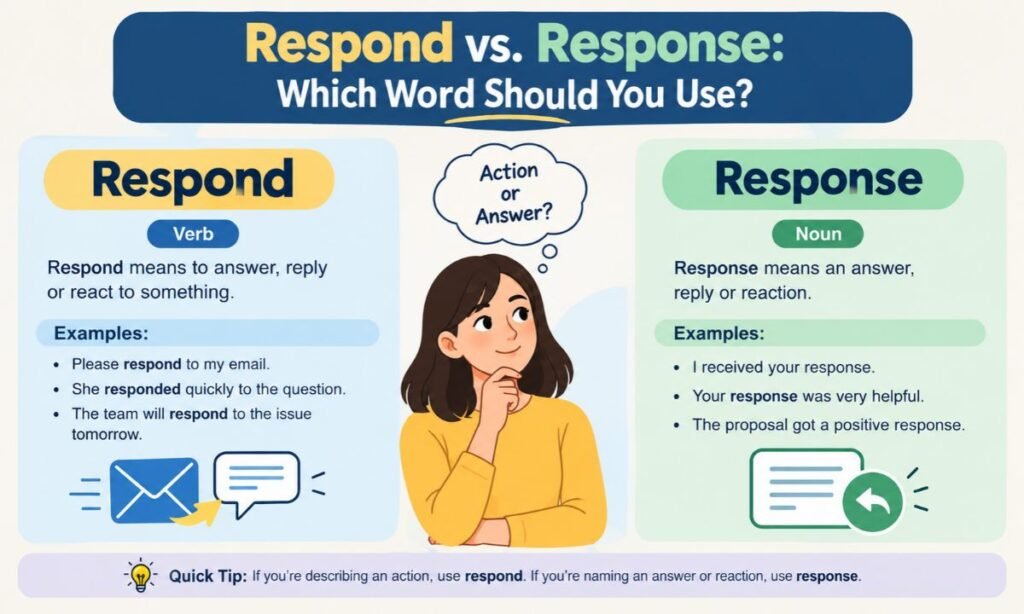
Understanding Respond vs. Response can help you write clearer emails, text messages, school assignments, and professional documents. Although the two words are closely related in meaning, they perform different jobs in a sentence. One describes an action, while the other names an answer or reaction.
The good news is that you do not need complicated grammar rules to understand the difference. Once you learn how each word works, you can choose the correct one naturally. This guide explains their meanings, sentence structures, everyday uses, common mistakes, and practical examples to help you improve your English.
What Is the Difference Between Respond and Response?
The main difference between respond and response is their part of speech. Respond is a verb, meaning to answer or react to something. Response is a noun, meaning an answer, reply, or reaction. Both words can describe communication, but they are used differently depending on the structure of the sentence.
Consider this example: “I will respond to your email when I have time.” Here, respond describes an action. Now consider “I appreciate your response.” In this sentence, response refers to the answer received.
| Feature | Respond | Response |
| Part of speech | Verb | Noun |
| Main meaning | To answer or react | An answer or reaction |
| Example | Please respond today. | I received your response. |
| Past form | Responded | Not applicable |
| Other forms | Responds, responding | Responses |
| Common phrase | Respond to a question | Response to a question |
What Does Respond Mean?
Respond means to answer a question, reply to a message, or react to an event or situation. It describes something a person, organization, animal, or system does after receiving information or experiencing something.
You can respond by speaking, writing, making a decision, or taking action. For example, a customer might respond to an email, a student might respond to a teacher’s question, and a driver might respond to a warning by slowing down.
How to Use Respond in a Sentence
The word respond changes according to the tense and subject of the sentence. Learning its common forms makes it easier to use correctly in everyday English.
- Respond: I respond to important messages promptly.
- Responds: She responds politely to customer questions.
- Responded: He responded to the invitation yesterday.
- Responding: They are responding to the feedback.
- Will respond: The office will respond to your request soon.
Notice that these examples describe actions rather than naming an answer. When a sentence requires a verb, respond or the appropriate form of that verb is usually the right choice.
Examples of Respond in Everyday Situations
Here are some original examples showing how the verb works in different contexts.
- Please respond to the teacher’s message before class.
- My colleague responded calmly when I explained the problem.
- The company will respond to customer concerns this week.
- He is responding to the invitation after checking his schedule.
- The dog responded to its owner’s call.
- She responded to the unexpected news with a thoughtful question.
Each sentence explains what someone or something does. This is the key reason respond works in these examples.
What Does Response Mean?
Response is a noun that refers to an answer, reply, or reaction. It can describe something written, spoken, emotional, physical, or official. Unlike respond, it does not describe the action of answering; it names the answer or reaction itself.
For example, if you ask your manager a question and receive an explanation, that explanation is the response. Similarly, if a group reacts positively to a new idea, you can describe its reaction as a positive response.
How to Use Response in a Sentence
The noun response commonly appears after words such as a, the, your, and their. It can also be used with adjectives that explain the type or quality of an answer.
- A response: I received a response this morning.
- Your response: Your response helped me understand the issue.
- A detailed response: The customer requested a detailed response.
- A positive response: The proposal received a positive response.
- In response to: In response to the feedback, we changed the schedule.
These structures are useful in both formal and informal writing. They also help you recognize when a noun is required instead of a verb.
Examples of Response in Everyday Situations
- Your response arrived just before the deadline.
- The teacher appreciated the student’s honest response.
- We are waiting for a response from the supplier.
- Her response to the suggestion was encouraging.
- The announcement received a mixed response from the audience.
- In response to your question, I have included the missing information.
In these examples, response identifies an answer, reaction, or reply. The surrounding words help explain whose response it is and what prompted it.
A Simple Trick to Remember Respond vs. Response
If you are unsure which word to choose, ask yourself one question: Am I describing an action or naming an answer?
If you are describing an action, use respond. If you are naming an answer or reaction, use response. This simple test works in most everyday situations and can help you avoid common grammar mistakes without memorizing long lists of rules.
Compare these pairs:
- Action: I will respond to the invitation.
- Answer: I sent a response to the invitation.
- Action: The manager responded to the complaint.
- Result: The manager’s response explained the decision.
- Action: Please respond when you are available.
- Answer: I look forward to your response.
The words have related meanings, but their grammatical roles determine where they belong.
Grammar Rules for Using Respond and Response
Understanding a few common sentence patterns can make your writing more accurate. You do not need to analyze every sentence in detail; simply notice which words appear before and after the word you want to use.
Sentence Patterns for Respond
Use respond as a verb in structures such as these:
| Pattern | Example |
| Subject + respond | They respond quickly. |
| Subject + respond to + object | I responded to the question. |
| Subject + will + respond | We will respond tomorrow. |
| Subject + respond with + noun | She responded with a smile. |
| Subject + respond by + verb-ing | He responded by offering assistance. |
Remember that respond to identifies the question, message, event, or situation receiving the reaction. Meanwhile, respond with introduces the words or action used in the reaction.
Sentence Patterns for Response
Use response as a noun in these common structures:
| Pattern | Example |
| A + response | We received a response. |
| Possessive + response | Her response was helpful. |
| Adjective + response | They gave a thoughtful response. |
| Response to + noun | His response to the question was clear. |
| In response to + noun | In response to the request, we revised the report. |
These patterns are particularly useful when writing emails, reports, assignments, and other documents where grammar needs to be clear and professional.
Common Mistakes When Using Respond and Response
Writers sometimes confuse these words because they share a similar meaning. The easiest way to correct the mistake is to identify whether the sentence needs a verb or a noun.
| Incorrect | Correct |
| I will response later. | I will respond later. |
| Please give me a respond. | Please give me a response. |
| Thank you for your quick respond. | Thank you for your quick response. |
| She didn’t response to my email. | She didn’t respond to my email. |
| We received a positive respond. | We received a positive response. |
| In respond to your message, I called you. | In response to your message, I called you. |
One important rule concerns did and didn’t. When either word is used to form a past-tense negative or question, the following main verb takes its base form. Therefore, “She didn’t respond” is correct, not “She didn’t responded” or “She didn’t response.”
Another common issue is the phrase respond back. Although people use it in casual conversation, back is often unnecessary because respond already conveys the idea of answering or reacting. In polished writing, “Please respond to my message” is usually clearer.
Respond vs. Response in Emails and Professional Writing
Choosing the correct word is especially important in workplace communication. Emails often include requests for replies, updates about communication, and explanations of decisions. Using respond and response accurately helps make those messages sound natural and professional.
Consider these examples:
When requesting an action:
“Please respond to the meeting invitation by Thursday.”
Here, respond asks the recipient to do something.
When discussing an answer:
“Thank you for your detailed response to my questions.”
Here, response refers to the information the recipient provided.
When explaining a decision:
“In response to your feedback, we have updated the document.”
In this sentence, response appears in the expression in response to, which explains why an action was taken.
These distinctions are useful when communicating with customers, managers, teachers, colleagues, and clients.
Respond vs. Response in Medicine, Science, and Daily Life
The distinction also applies beyond conversations. In medical contexts, a patient may respond to treatment, while a clinician may describe the patient’s response to treatment. The verb describes what happens; the noun identifies the reaction or observed outcome.
For example, “The patient responded to the treatment” describes an event. “The patient’s response was monitored” refers to the reaction being observed. The word alone does not establish whether a treatment is effective; that conclusion depends on the relevant clinical evidence.
The same pattern applies to science and everyday situations. A plant may respond to changes in light, and its response can be measured. An emergency team responds to an incident, while an emergency response describes the action taken. In each case, the correct word depends on whether you mean the action or the reaction itself.
Practice Questions: Test Your Understanding
Choose the correct word to complete each sentence.
- Please _____ to my email when you have time.
- I appreciate your quick _____.
- The manager _____ to the customer’s concern yesterday.
- We are waiting for a _____ from the school.
- In _____ to the feedback, the team changed its plan.
Answers:
- Respond
- Response
- Responded
- Response
- Response
The first sentence needs a verb, while the second needs a noun. The third describes an action in the past. The fourth names an answer, and the fifth uses the established expression in response to.
Frequently Asked Questions
How do I quickly tell the difference between respond and response?
Respond is a verb describing an action, while response is a noun naming an answer or reaction. You respond to a message and may receive a response.
Can response be plural?
Yes. The plural form is responses. For example, “We received several responses to the questionnaire.”
Is respond back grammatically correct?
It is common in casual speech, but back is usually redundant. “Please respond to my email” is more concise and suitable for formal writing.
What verb goes with response?
Common expressions include give a response, receive a response, provide a response, and make a response. The best expression depends on the context.
Is responding always verbal?
No. Responding can involve speaking, writing, behavior, emotions, or physical reactions. For example, a person can respond to a warning by stepping away without saying anything.
Is response a noun or a verb?
Response is a noun. The related verb is respond. For example, “She responded quickly” describes an action, while “Her response was quick” names the answer or reaction.
Should I write respond to or response to?
Both expressions are correct, but they serve different grammatical purposes. Use respond to for an action and response to when referring to an answer or reaction.
Which is correct: I didn’t respond or I didn’t response?
“I didn’t respond” is correct because didn’t must be followed by the base form of a verb. Response is a noun and cannot be used in that position.
Conclusion
The difference between respond vs. response comes down to one basic grammar rule: respond describes the action of answering or reacting, while response names the answer or reaction. Once you recognize this distinction, it becomes much easier to use both words correctly in conversations, emails, assignments, and professional documents.
Remember the practical example: you respond to a question, and your answer is your response. Use this rule when checking your sentences, pay attention to the words surrounding each term, and choose the form that fits the sentence naturally.