

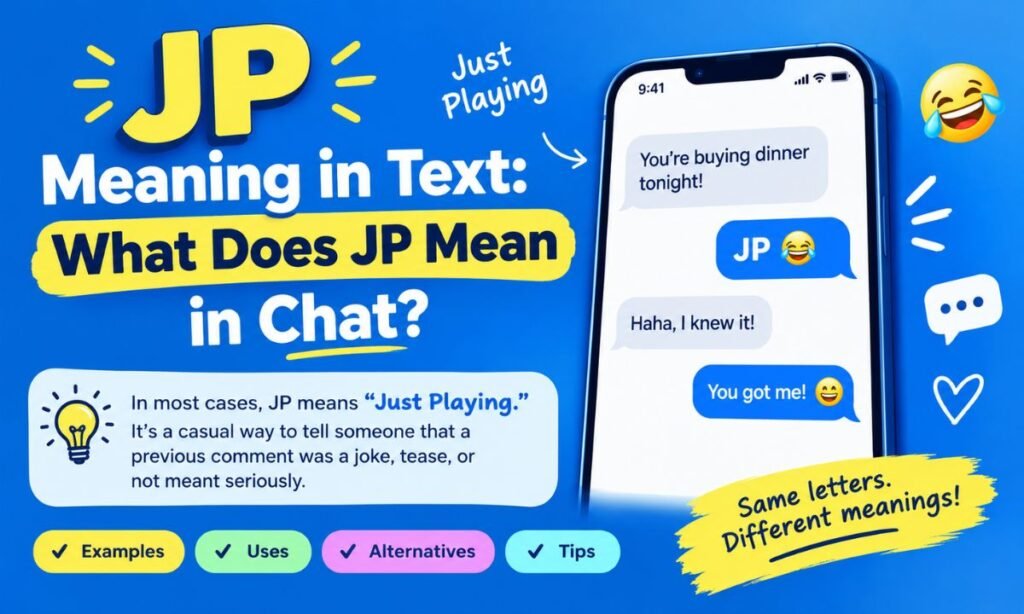
If you’ve seen JP at the end of a text message, you may have wondered what those two letters mean. The most common JP meaning in text is “Just Playing,” a casual way to tell someone that a previous comment was a joke, tease, or playful remark rather than something serious.
JP usually means “Just Playing” in casual chats. It tells the reader not to take the previous statement too seriously. For example, someone might say, “You’re buying dinner tonight. JP 😂.” The first sentence sounds serious, but JP shows that the person is only joking.
What Does JP Mean in Text?
The basic JP meaning in text is connected to the phrase “Just Playing.” Here, “playing” means fooling around, teasing, or joking with someone. It doesn’t necessarily refer to playing a sport or video game.
People often add JP after a statement that could otherwise be taken seriously. It works as a quick tone signal that helps the reader understand the sender’s intention.
Common examples include:
- “You’re banned from my house. JP 😂”
- “I’m taking your fries. JP.”
- “You really thought you could beat me? JP 😭”
- “You’re doing all the work today. JP 😂”
In each example, JP tells the reader that the statement wasn’t meant literally.
What Does JP Stand For?
In casual texting, JP stands for Just Playing. It has a similar purpose to saying “I’m kidding,” “I’m joking,” or “I’m only messing with you.”
For example:
“You’re officially my least favorite friend. JP 😂”
The sender isn’t necessarily expressing real dislike. They’re using JP to soften the teasing statement and signal a playful mood.
How Is JP Used in Chat?
Understanding JP meaning in text becomes easier when you look at what comes immediately before the abbreviation.
JP commonly appears after:
- A joke
- Friendly teasing
- A fake complaint
- An exaggerated statement
- A playful insult
- A sarcastic comment
- A surprising claim
Consider this example:
“You’re paying for everyone’s pizza tonight. JP 😂”
Without the last two letters, the reader might think the sender is making a real demand. JP changes the tone by explaining that the statement was playful.
This is especially useful in text conversations because readers can’t hear the sender’s voice or see their facial expression.
Why Do People Use JP?
A major part of the JP meaning in text comes from the need to communicate tone online. In a face-to-face conversation, people can use their voice, facial expressions, gestures, and timing to show that they’re joking.
Text messages don’t provide those signals in the same way. Short expressions such as JP can therefore help make the sender’s intention clearer.
People may use JP to:
- Make teasing sound lighter
- Clarify that a statement wasn’t serious
- Add humor to a conversation
- Avoid a misunderstanding
- Playfully challenge a friend
- Follow an exaggerated claim
- Show that they are fooling around
However, JP isn’t a magic word that makes every joke harmless. If the original comment is insulting or hurtful, adding JP afterward may not completely change how it feels.
JP Meaning in Text Across Different Platforms
The general JP meaning in text remains the same across many casual platforms, but the surrounding communication style can change.
Text Messaging
In ordinary texting, JP is most likely to appear between friends, partners, siblings, or people who already have a relaxed relationship.
For example:
“You’re definitely buying me coffee tomorrow. JP 😂”
The abbreviation works because both people understand the casual tone.
Social Media
JP can appear in comments, replies, direct messages, and group conversations. Someone might use it after making a dramatic or funny statement.
“Bro really thinks he’s famous. JP 😭”
The meaning is usually clear from the playful context.
Gaming Chats
Gamers may use JP after joking about another player’s performance.
“You’re never beating my score. JP 😂”
However, gaming communities sometimes use JP for other terms. If the conversation is about a specific game mechanic, server, player, or location, don’t automatically assume it means “Just Playing.”
Casual Conversations
Among close friends, JP can make teasing feel less serious.
“I’m never speaking to you again. JP ❤️”
The heart emoji reinforces the friendly tone, but the meaning still depends on the relationship.
Is JP Appropriate for Professional Communication?
The casual JP meaning in text is generally better suited to informal conversations than professional writing. You may see abbreviations in workplace chats, but they aren’t always appropriate for clients, managers, teachers, or formal contacts.
Instead of writing:
“Don’t forget the report, JP 😂”
a clearer workplace message would be:
“Just a reminder to send the report when you have a chance.”
Complete wording avoids confusion and keeps the tone professional.
When Might JP Be Acceptable at Work?
JP may be understood in a relaxed conversation with a coworker you know well. Even then, consider whether the abbreviation fits the workplace culture.
If you’re communicating with someone you don’t know well, it’s safer to write “just kidding” or “I’m joking.”
Can JP Have Other Meanings?
Yes. One important part of JP meaning in text is understanding that the abbreviation isn’t universal.
Depending on the topic, JP may refer to:
| Meaning | Common context |
| Just Playing | Casual texting |
| Japan | Travel, geography, sports, gaming |
| Japanese | Language or cultural discussions |
| Justice of the Peace | Legal or official contexts |
| Personal initials | Names and private conversations |
| Job Posting | Employment discussions |
| Specialized abbreviation | Specific online communities |
This means context matters more than the two letters themselves.
If someone writes “JP 😂” after teasing you, “Just Playing” makes sense. If someone is discussing countries, a legal matter, or a person’s initials, a different meaning may be intended.
How Can You Tell Which Meaning Someone Means?
The easiest way to understand JP meaning in text is to examine the entire conversation rather than focusing only on the abbreviation.
Ask yourself:
- Was the person joking before writing JP?
- Does the previous sentence sound playful?
- Is the conversation about Japan or Japanese culture?
- Are you discussing a legal topic?
- Could JP be someone’s initials?
- Is there a specific gaming or workplace context?
If JP appears directly after a joke or tease, Just Playing is usually the most natural interpretation.
If it appears in a formal or specialized conversation, consider the subject before deciding what it means.
JP vs. JK: Are They the Same?
People often compare JP meaning in text with JK because both abbreviations can tell someone that a previous statement wasn’t serious.
JP means “Just Playing.”
JK means “Just Kidding.”
They can often be used in similar situations, but they have slightly different wording.
| Slang | Full form | Typical use |
| JP | Just Playing | Teasing or fooling around |
| JK | Just Kidding | Directly saying a joke wasn’t serious |
| LOL | Laughing Out Loud | Showing amusement |
| J/K | Just Kidding | Older form of JK |
For example:
“You’re so annoying. JK 😂”
and:
“You’re so annoying. JP 😂”
can communicate almost the same general idea. However, JK may be easier for someone unfamiliar with JP to understand.
Does JP Have a Special Meaning in Dating Chats?
The JP meaning in text can appear in dating conversations when someone is teasing, flirting, or making an exaggerated statement.
For example:
“You’re way too cute. JP 😏”
or:
“You’re taking me out this weekend. JP 😂”
The first example could sound flirtatious, while the second may simply be playful.
Don’t treat JP as a secret romantic code. The person’s overall behavior, wording, and relationship with you are much better clues than the abbreviation itself.
How Should You Respond to JP?
Once you understand the JP meaning in text, responding is usually simple. Your reply should match the tone of the conversation.
Casual Responses
- “Haha, I knew you were joking.”
- “You got me 😂”
- “Okay, fair enough.”
- “Lol, you’re funny.”
Funny Responses
- “Too late, I believed you.”
- “Nice save 😂”
- “Sure you were.”
- “I almost blocked you!”
Neutral Responses
- “Got it.”
- “Haha, okay.”
- “I understand.”
- “No worries.”
Professional Response
If JP appears in an informal workplace conversation, you can simply respond to the actual message:
“Got it, thanks for clarifying.”
You don’t have to use the same slang just because someone else does.
Regional and Cultural Differences
The JP meaning in text may not be understood equally by everyone. Internet slang varies across countries, age groups, social circles, and online communities.
Someone who frequently uses texting abbreviations may immediately understand JP. Another person may know JK but have never encountered JP.
This becomes especially important in international conversations. If you think the other person may not understand the abbreviation, saying “just kidding” or “I’m only joking” is clearer.
Different communities can also assign their own meanings to short abbreviations. Always consider the topic before assuming the slang definition.
Common Mistakes When Using JP
Knowing the JP meaning in text doesn’t mean you should add JP to every joke. The way you use it can affect how your message is received.
Using JP after a harsh comment:
A hurtful statement may still feel hurtful even when you say you were joking.
Using it with strangers:
Someone who doesn’t know the abbreviation may misunderstand you.
Using it in formal emails:
Professional communication usually benefits from clear and complete language.
Assuming everyone knows it:
Not every person follows the same internet slang.
Adding it too late:
If someone already misunderstood your message, simply adding JP afterward may not fix the problem.
Frequently Asked Questions
What does JP mean in text?
JP meaning in text usually refers to “Just Playing.” People use it after a joke, tease, exaggeration, or playful comment to show they weren’t being completely serious.
Is JP the same as JK?
No, but they’re similar. JP means “Just Playing,” while JK means “Just Kidding.” Both can be used to clarify that a previous comment was meant as a joke.
Is JP commonly used online?
JP appears in casual texting, social media, gaming chats, and other informal online conversations. However, familiarity varies from person to person.
Can JP mean something else?
Yes. Depending on context, JP can refer to Japan, Japanese, Justice of the Peace, initials, a job posting, or a specialized term. The subject of the conversation usually provides the strongest clue.
Is JP appropriate for work emails?
Usually, no. In a formal email, it’s better to use clear phrases such as “just kidding” or “I’m joking” if a joke is necessary.
What does JP mean in gaming?
JP can mean “Just Playing” when it follows a playful gaming comment. However, gaming communities may also use JP for other terms, so you should check the surrounding conversation.
Final Takeaway
The simplest JP meaning in text is “Just Playing.” It is a casual abbreviation people use to show that a previous statement was playful, exaggerated, or not meant to be taken seriously.
For example:
“You’re the worst teammate ever. JP 😂”
means something similar to:
“I’m only messing with you.”
Still, JP meaning in text isn’t always the same in every conversation. The letters can have different meanings when the topic involves Japan, law, work, names, gaming, or another specialized subject.
The best way to interpret JP is to read the message before it, consider the relationship between the people, and look at the overall topic. When the context is clearly playful, “Just Playing” is usually the meaning you’re looking for.
.


1 thought on “JP Meaning in Text: What Does JP Mean in Chat?”