

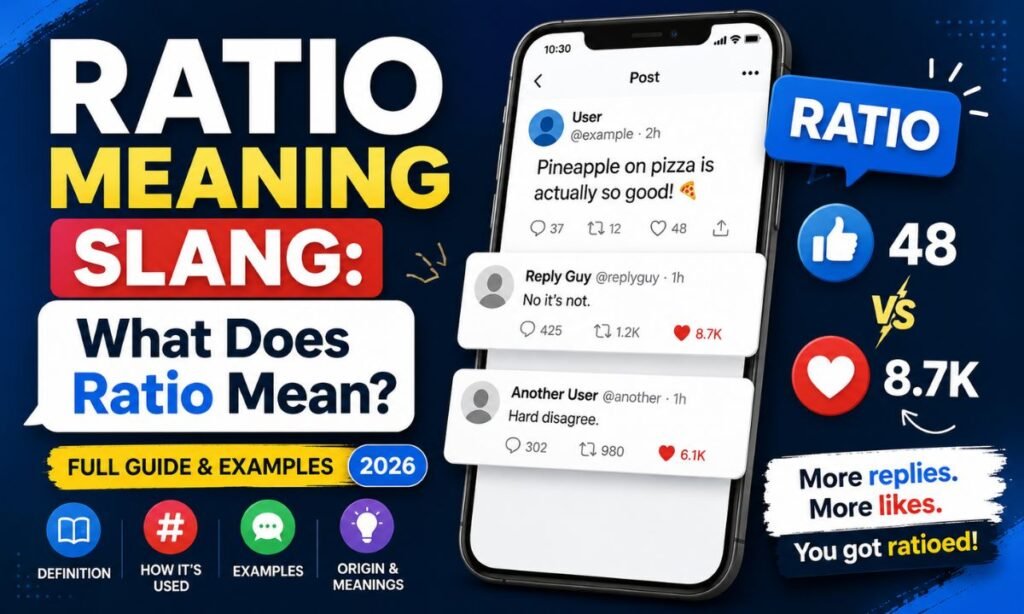
If you have seen someone comment “ratio” under a post, you may wonder what it means. In internet slang, ratio usually refers to a social media post receiving much more criticism, replies, or negative engagement than support. It can also mean that a reply or comment gets significantly more attention than the original post.
The word is especially common in online discussions, memes, comment sections, and fast-moving social media conversations. You may see variations such as “ratioed,” “ratio this,” or “L + ratio.” The meaning can change slightly depending on the platform and context.
This guide explains the ratio of meaning slang, how people use it in text and social media, where the expression came from, and how to understand it in real conversations.
🔎 What Does Ratio Mean in Slang?
In slang, ratio means that a post or opinion appears to receive more opposition or negative engagement than support. It can also describe a reply that becomes more popular than the original post.
For example, imagine someone posts an unpopular opinion and receives 50 likes but 500 critical replies. Someone might simply comment “Ratio.” They are pointing out that the response to the post is overwhelmingly negative.
The expression is not a mathematical calculation in this context. Instead, it has become a form of online commentary.
Simple Definition
Ratio slang means that a post has received disproportionately more negative reactions, replies, or engagement than positive support.
The term can also be used as a challenge, meaning someone wants their reply to receive more engagement than the post they are responding to.
📱 How Is “Ratio” Used on Social Media?
The meaning becomes easier to understand when you look at how people use it online.
Common uses include:
- Ratio: A short way of predicting or pointing out an unfavorable response.
- Ratioed: Saying that a person or post has already received a poor engagement response.
- Ratio this: Encouraging others to support a reply so it outperforms the original.
- L + ratio: A mocking expression combining “loss” with the idea of being ratioed.
- Counter-ratio: Attempting to outperform someone who previously tried to ratio another post.
The expression is often playful between friends, but it can also be sarcastic, dismissive, or hostile during arguments.
🐦 What Does Ratio Mean on X?
On X, formerly known as Twitter, ratio traditionally refers to an imbalance between a post’s replies and its likes or reposts, often suggesting that people are responding negatively rather than supporting the original message. Another common version occurs when a reply receives more likes or engagement than the original post.
For example:
Original post: “Nobody likes this new trend.”
Reply: “Actually, millions of people are enjoying it.”
If the reply receives substantially more likes than the original post, users may describe the situation as a ratio.
The term became strongly associated with Twitter/X because the platform made public engagement numbers easy to compare.
🎵 What Does Ratio Mean on TikTok?
On TikTok, ratio can carry the same general idea but may appear in slightly different situations.
Someone might comment “ratio” when they believe another comment is unpopular and want their own comment to receive more likes. The term can also be used when discussing engagement numbers, such as likes compared with views.
For example:
- A video receives a large number of views but relatively few likes.
- A controversial comment receives many replies but little support.
- A user writes “ratio” to challenge another comment.
Because TikTok conversations often move quickly, the word can function more like a meme or reaction than a precise measurement.
💬 What Does Ratio Mean in Texting?
In texting and group chats, ratio is usually borrowed from social media slang.
It may be used jokingly when friends disagree about something.
Example:
Friend 1: “Pineapple belongs on every pizza.”
Friend 2: “Ratio.”
Here, “ratio” does not mean that an actual social-media engagement calculation happened. It is simply a humorous way of saying, “Everyone is going to disagree with you.”
The context matters. Between friends, it can be harmless banter. During an argument, it may sound dismissive or mocking.
⚖️ Ratio vs. Ratioed: What Is the Difference?
These two forms are closely related but are used differently.
| Term | Meaning |
| Ratio | A challenge, reaction, or reference to an unfavorable engagement balance |
| Ratioed | Describes someone whose post or reply has already been outperformed or heavily criticized |
Example
“Ratio.”
Someone is challenging another user or predicting that their response will win more support.
“You got ratioed.”
Someone is saying that the other person’s post received an unfavorable reaction.
This distinction is useful when reading comments because ratio can describe an action or reaction, while ratioed usually describes the result.
😂 What Does “L + Ratio” Mean?
L + ratio is a more mocking version of the slang.
The “L” commonly represents “loss,” while “ratio” refers to the unfavorable social-media response. Together, the phrase basically means that someone has taken a public loss and is being outperformed or criticized online.
For example:
User A: “My opinion is obviously correct.”
User B: “L + ratio.”
The reply is essentially dismissing the opinion and suggesting that the audience will disagree with the original poster.
Because it is deliberately mocking, L + ratio is more confrontational than simply saying “ratio.”
📊 What Does a Ratio Look Like?
There is no single universal number that automatically qualifies as a ratio. The meaning depends on the platform, audience, post, and engagement pattern.
Consider these simplified examples:
- Post: 1,000 likes and 50 replies — generally strong positive engagement.
- Post: 100 likes and 800 critical replies — users may call this a ratio.
- Reply: 4,000 likes while the original post has 500 — the reply may be described as having ratioed the original.
These numbers are only illustrations. A ratio is about the relationship between types of engagement, not a fixed mathematical threshold.
🧠 Why Do People Say “Ratio”?
People use the term because social media turns public reactions into visible numbers.
Instead of writing a long explanation about why they disagree, a person can simply say “ratio.” The word communicates the idea that the audience’s reaction is going against the original post.
Common reasons include:
- 😏 Mocking an unpopular opinion
- 💬 Supporting a stronger reply
- 😂 Joining an internet joke
- 🔥 Calling attention to controversy
- 👀 Predicting that a post will receive backlash
- 🏆 Celebrating a reply that becomes more popular
This makes “ratio” particularly useful in fast-moving online conversations.
🕰️ Where Did the Slang “Ratio” Come From?
The social-media meaning developed from the ordinary word ratio, which refers to a relationship between quantities.
The slang use became closely associated with Twitter around 2017, when users began pointing to situations where replies or other reactions significantly outweighed positive engagement. The expression then spread into broader internet culture and later appeared across platforms such as TikTok and other social networks.
The original mathematical idea remained the same at a basic level: users were comparing quantities. Internet culture simply turned that comparison into a social signal.
🌐 Is Ratio Used on Instagram?
Yes, people can use ratio on Instagram, although the exact meaning depends on the conversation.
For example, someone might use “ratio” under a comment when they expect another comment to receive more likes. It can also appear in discussions where users believe a post has attracted more criticism than support.
Instagram’s format differs from X, so the traditional reply-to-like pattern may not always apply in exactly the same way. That is why context is especially important.
💡 Ratio Meaning: Real Text Examples
Here are some natural examples showing how the slang can appear in conversation.
Example 1: Social Media
User A: “This is the worst movie of the year.”
User B: “Ratio.”
Meaning: User B believes many people will disagree with User A.
Example 2: Reply Becomes More Popular
Original post: 300 likes
Reply: 5,000 likes
Comment: “That reply ratioed the original.”
Meaning: The reply received much stronger engagement.
Example 3: Group Chat
Friend A: “Nobody likes this song.”
Friend B: “Ratio.”
Meaning: Friend B is jokingly predicting that others will disagree.
Example 4: L + Ratio
User A: “Everyone agrees with me.”
User B: “L + ratio.”
Meaning: User B is mocking the claim and suggesting that the audience disagrees.
🚫 Is “Ratio” a Bad Word?
No. Ratio is not inherently a profanity or offensive word. However, the way it is used can make it rude or antagonistic.
A friendly group may use it as a joke, while strangers may use it to ridicule someone’s opinion.
Before using it, consider:
- Who are you talking to?
- Is the conversation serious or playful?
- Could the comment embarrass or provoke someone?
- Are you disagreeing with an idea or personally attacking someone?
The word itself is generally harmless, but the surrounding conversation determines its tone.
⚠️ Common Mistakes When Using Ratio
Understanding the slang does not mean every use of “ratio” is accurate.
Avoid these common mistakes:
- Treating every high-comment post as a ratio
High comment numbers alone do not automatically mean people disagree. - Assuming there is one fixed ratio rule
Different platforms and communities use the term differently. - Using it without considering context
A joke among friends can sound hostile in a serious discussion. - Confusing engagement with agreement
A post can receive many comments because it is interesting, controversial, or widely discussed—not necessarily because everyone dislikes it. - Assuming a ratio proves someone is wrong
Engagement measures audience reaction, not objective truth.
That last point is particularly important. A popular response can still be incorrect, while an unpopular opinion can still be valid.
🔥 Related Internet Slang You May See
Once you understand ratio meaning slang, several related expressions become easier to recognize.
- Ratioed: Outperformed or overwhelmed by another response.
- L: Short for “loss.”
- L + ratio: A mocking way to say someone has taken a loss.
- Cooked: Slang suggesting someone is in a difficult or losing position.
- Clowned: Used when someone is being mocked online.
- Dragged: Describes receiving strong public criticism.
- Take: An opinion or viewpoint, often used in phrases such as “hot take.”
- Bad take: A negative description of an opinion someone considers poorly reasoned.
These terms can overlap in online arguments, but they are not exact synonyms.
These links can help readers move from one unfamiliar internet expression to another without interrupting their reading experience.
📚 Helpful External Source Opportunities
For readers who want an authoritative background, useful external references include established dictionary and technology resources covering internet language and social-media terminology.
Merriam-Webster provides a dedicated explanation of the social-media verb ratio, while Dictionary.com covers both the social-media use of “ratio” and the related phrase “L + ratio.”
❓ Frequently Asked Questions
What does ratio mean in slang?
Ratio usually means a social-media post is receiving disproportionately more criticism, replies, or negative engagement than support.
What does it mean to get ratioed?
Getting ratioed means a post or reply has been publicly outperformed or received a much more negative response than expected.
What does ratio mean on TikTok?
On TikTok, ratio can indicate disagreement with a comment or creator, or refer more generally to an unfavorable engagement comparison.
What does ratio mean on X?
On X, ratio traditionally describes a post receiving many more replies than likes or a reply receiving substantially more engagement than the original post.
What does L + ratio mean?
“L + ratio” combines “L,” meaning loss, with “ratio” and is commonly used as a mocking way to say someone has lost an online argument or exchange.
Is ratio a bad word?
No. Ratio is not a swear word, but using it toward someone can sound sarcastic, dismissive, or mocking depending on the context.
Where did ratio slang originate?
The social-media use of ratio became strongly associated with Twitter around 2017 before spreading more broadly across internet culture.
Can ratio be used in texting?
Yes. In private chats and group messages, people often use “ratio” humorously to suggest that others will disagree with someone’s statement.
🎯 Final Thoughts
The ratio meaning slang is fairly simple once you understand the social-media context. It generally points to an unfavorable engagement pattern, a reply that becomes more popular than the original post, or a quick way of challenging someone’s opinion.
You may encounter ratio, ratioed, ratio this, and L + ratio across social platforms and group chats. Just remember that a ratio reflects audience reaction—it does not automatically prove that an opinion is right or wrong.
If you come across another unfamiliar slang term, checking the surrounding conversation is often the best way to understand what the speaker actually means. Save this guide for later or share it with someone who keeps asking, “What does ratio mean?”


4 thoughts on “Ratio Meaning Slang: What Does Ratio Mean? (2026)”