

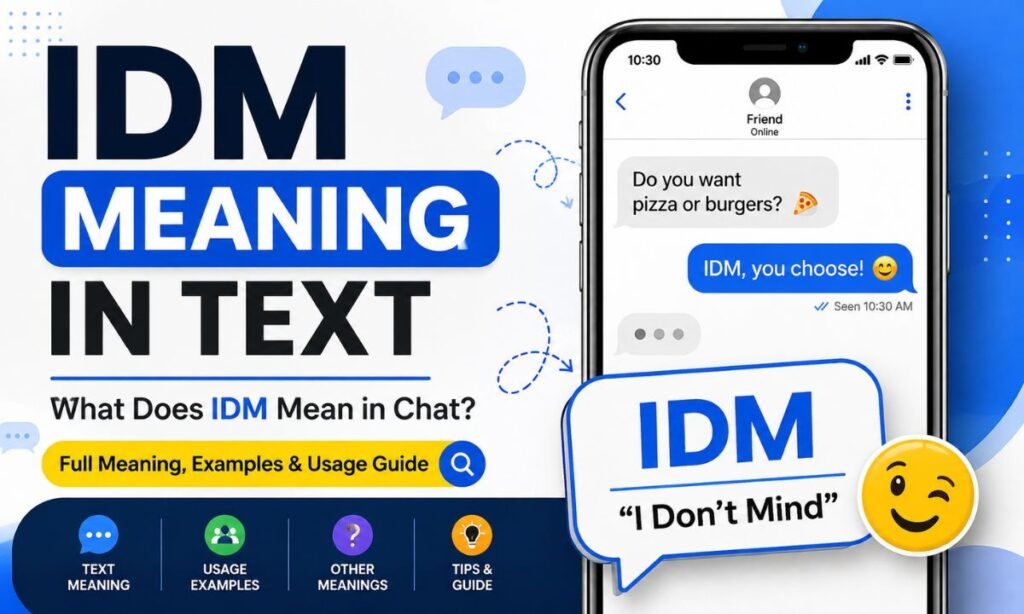
If someone sends you “IDM” in a text, chat, or social media message, it usually means “I Don’t Mind.” In simple words, the person is saying they are okay with something, have no strong preference, or are happy to let you decide.
For example, if someone asks, “Pizza or burgers?” and you reply, “IDM,” you mean either option is fine with you. The exact tone can depend on the conversation, punctuation, and relationship between the people texting.
What Does IDM Mean in Text?
IDM means “I Don’t Mind” in most casual text messages and online chats. It is an informal abbreviation used when someone has no objection or preference about a choice.
Simple Definition
IDM = I Don’t Mind
It can communicate:
- I’m okay with it.
- Either option works for me.
- I have no preference.
- You can choose.
- That’s fine with me.
Example:
Friend: Do you want coffee or tea?
You: IDM, you choose.
Here, IDM shows that you do not particularly care which option is selected.
Tone and Intent
IDM is generally neutral, relaxed, and casual. However, a one-word “idm” can sometimes sound uninterested if the conversation is emotional or the sender normally writes longer messages.
Compare:
- “IDM 😊 you choose!” → friendly and relaxed
- “idm” → neutral and brief
- “IDM, whatever works.” → flexible but slightly detached
So, do not judge the tone from the abbreviation alone. Look at the whole conversation.
Why Is IDM Popular in Texting?
Texting encourages people to communicate quickly. Short forms such as IDK, IDC, IMO, BRB, NGL, and IDM reduce typing and make casual conversations faster.
IDM is especially useful when someone asks a question with multiple acceptable answers.
For example:
- “Movie or dinner?”
- “6 PM or 7 PM?”
- “Blue or black?”
- “Should we go today or tomorrow?”
Instead of writing “I don’t have a preference,” someone can simply type “IDM.”
How Is IDM Used in Everyday Conversations?
IDM normally appears when someone wants to show flexibility rather than make a strong decision.
Casual Examples
Example 1
A: Pizza or pasta?
B: IDM, both are good.
Example 2
A: Should we meet at 5?
B: IDM.
Example 3
A: Do you want to watch a comedy or horror movie?
B: IDM, you pick.
Example 4
A: Is it okay if I bring my friend?
B: IDM.
In each case, IDM communicates acceptance or a lack of strong preference.
Different Contexts Where IDM Appears
1. Text Messages and Chats
In ordinary texting, IDM is most commonly used to mean “I Don’t Mind.” It works well between friends, family members, classmates, and other people you communicate with casually.
2. Social Media Comments
You may also see IDM in comments, replies, or direct messages. Someone might use it when responding to a suggestion or giving a quick opinion.
For example:
“Which one should I post?”
“IDM, both look good.”
3. Group Chats
IDM can be especially useful in group conversations where people are trying to make plans.
Person 1: Saturday or Sunday?
Person 2: IDM
Person 3: Saturday works for me.
The person using IDM is essentially saying that either option is acceptable.
4. Dating and Relationships
In dating conversations, IDM can mean the same thing, but tone becomes more important.
For example:
“Want to call tonight?”
“IDM 😊”
This can sound relaxed and positive.
However, replying only “idm” to an important relationship question could feel less enthusiastic. In those situations, a complete sentence is often clearer.
Less Common Meanings of IDM
Although “I Don’t Mind” is the usual meaning in casual texting, IDM can represent other terms in different fields.
IDM as “In Direct Message”
Some people may interpret IDM in connection with direct messaging, but “In Direct Message” is not a standard or widely established texting definition. Do not automatically assume this meaning unless the surrounding conversation clearly supports it.
Professional or Technical Meanings
Outside texting, IDM can refer to completely different concepts.
For example, IDM can stand for Intelligent Dance Music, a genre or classification associated with electronic music. It can also appear as an abbreviation in technology and other professional fields.
This is why context matters. A message saying “IDM, you choose” is clearly different from IDM appearing in a music or technical discussion.
How to Tell Which Meaning of IDM Is Intended
Use the surrounding words to identify the intended meaning.
Ask yourself:
- Is this a casual conversation?
If yes, “I Don’t Mind” is highly likely. - Is someone asking for your preference?
IDM probably means either option is acceptable. - Are you discussing music, technology, or another specialized subject?
IDM may have a different meaning. - Does the message mention choosing between options?
“I Don’t Mind” usually fits naturally. - Does the abbreviation appear in a professional document?
Consider the terminology used in that field before interpreting it as texting slang.
Common Misunderstandings About IDM
Misconception 1: IDM Means Disinterest
Not necessarily. “I Don’t Mind” means the person has no objection or preference, not automatically that they are uninterested.
For example, “IDM, you choose” can simply mean they trust you to make the decision.
Misconception 2: IDM Is Rude
IDM itself is not a rude expression. However, a very short response can sometimes sound cold depending on the situation.
Compare:
- “IDM 😊” → warm and casual
- “IDM, whatever you want.” → neutral
- “idm.” → potentially dry, depending on context
Misconception 3: IDM Is Only for Teenagers
No. Text abbreviations are used by people of different ages, particularly in informal digital communication. The important distinction is formal versus casual communication, not age.
Is IDM Formal or Informal?
IDM is informal. It is appropriate for casual texts, DMs, social media conversations, and friendly chats.
Avoid it in formal writing such as:
- Business emails
- Academic assignments
- Official applications
- Professional reports
- Formal customer communication
In these situations, write “I don’t mind,” “Either option works for me,” or another complete expression.
Alternatives to IDM in Texting
Sometimes spelling out the phrase makes your meaning clearer.
Common Alternatives
- I don’t mind.
- Either is fine.
- Either works.
- You choose.
- Whatever works.
- I’m okay with that.
- That works for me.
- I’m fine either way.
Slightly More Polite Versions
For professional or semi-formal conversations, try:
- “Either option works for me.”
- “I’m comfortable with either choice.”
- “I’m happy with whichever option you prefer.”
- “Either time works for me.”
These phrases remove the ambiguity that can sometimes come with short texting abbreviations.
IDM vs Similar Text Acronyms
| Acronym | Common Meaning | Main Idea |
| IDM | I Don’t Mind | No strong preference |
| IDC | I Don’t Care | Lack of concern or interest |
| IDK | I Don’t Know | Uncertainty |
| IMO | In My Opinion | Giving an opinion |
| IKR | I Know, Right? | Strong agreement |
| NGL | Not Gonna Lie | Honest or direct statement |
The biggest difference is between IDM and IDC. They can appear similar, but IDM is usually softer.
“IDM” often means either choice is fine, while “IDC” can suggest I don’t care about the matter and may sound more dismissive.
When You Should Avoid Using IDM
IDM is convenient, but it is not appropriate for every situation.
Avoid it when:
- The topic is serious or emotional.
- The other person needs a detailed answer.
- You are communicating professionally.
- Your response could easily be misunderstood.
- You actually have a preference but are avoiding saying it.
If someone asks an important question, replacing “IDM” with a complete sentence can prevent unnecessary confusion.
Why Understanding IDM Matters
Understanding texting slang is not just about learning abbreviations. Tone and context are a major part of digital communication.
A short message does not always carry the same emotional meaning as a spoken sentence. Someone may type “IDM” because they are busy, because they genuinely have no preference, or simply because they normally communicate using short forms.
The safest approach is to interpret the conversation as a whole rather than assuming the abbreviation reveals someone’s attitude.
Examples of Correct and Incorrect Usage
Correct Usage
“Do you want to eat at 7 or 8?”
“IDM, either time works.”
This is a natural use because the sender has no preference.
Another example:
“Should we watch a movie or play games?”
“IDM, you decide.”
Again, the meaning is clear.
Incorrect Usage
Using IDM when you actually mean “I don’t know” is incorrect.
“What time does the store close?”
“IDM.”
If you do not know the answer, IDK would be the appropriate abbreviation.
Likewise, if you strongly dislike both options, IDM may not accurately express your opinion.
How IDM Reflects Modern Communication Trends
Digital communication favors speed, convenience, and short messages. Abbreviations allow people to express familiar phrases with only a few characters.
IDM is a good example because its meaning is easy to understand once the abbreviation is familiar. At the same time, short replies can remove some emotional context that would normally be obvious during face-to-face conversation.
That is why punctuation, emojis, previous messages, and the relationship between the people involved can all affect how IDM meaning in text is interpreted.
For related slang terms, you can create internal links to articles such as IDK Meaning in Text, IDC Meaning in Text, IMO Meaning, NGL Meaning, and IKR Meaning.
For authoritative external references, a useful citation opportunity is Dictionary.com for acronym definitions and Wiktionary for the broader meanings of IDM.
Frequently Asked Questions (FAQs)
1. What does IDM mean in texting?
IDM usually means “I Don’t Mind.” It tells someone that you have no strong preference or are okay with their choice.
2. Is IDM rude or disrespectful?
No. IDM is normally neutral and casual, although a very short “idm” can sometimes sound cold depending on the conversation.
3. Can IDM mean something else besides “I don’t mind”?
Yes. IDM can have different meanings in music, technology, and other fields, so the subject and context should always be considered.
4. Is IDM okay to use at work?
It is better to avoid IDM in formal workplace communication. Use “Either option works for me” or “I don’t mind” instead.
5. How do I respond to IDM?
If someone says IDM, you can simply make the decision yourself. For example, reply “Okay, let’s go with 7 PM.”
6. Is IDM the same as IDC?
Not exactly. IDM usually means “I Don’t Mind,” while IDC means “I Don’t Care,” which can sound more dismissive.
7. Should I spell out “I don’t mind” instead of using IDM?
Use the full phrase when clarity or formality matters. IDM is best suited to casual texts, DMs, and informal conversations.
Final Thoughts
The simplest answer to IDM meaning in text is “I Don’t Mind.” It is a casual abbreviation used when someone has no strong preference, accepts an option, or is happy to let another person decide.
The key is context. In a friendly chat, “IDM” can be perfectly relaxed and positive. In a serious or professional conversation, however, spelling out “I don’t mind” or saying “Either option works for me” can make your intention much clearer.
Once you understand the difference between IDM, IDC, IDK, and similar texting abbreviations, interpreting everyday online conversations becomes much easier.