

If you’ve seen “tysm” pop up in a text, a DM, or an Instagram comment and paused to figure out what it meant, you’re not alone. It’s one of the most common gratitude acronyms online, and the TYSM meaning carries more nuance than a quick glance suggests. This guide breaks down what TYSM actually means, where it came from, how to use it correctly across different situations, and when you should reach for something else instead.
What Does TYSM Mean? (Full Form & Origin)
TYSM stands for “Thank You So Much.” It’s an intensified version of a simple “thanks,” used when someone wants to express gratitude that feels a little warmer or more enthusiastic than a plain “ty” or “thx.”
Breaking down the letters:
- T – Thank
- Y – You
- S – So
- M – Much
It functions as a standalone reply, a closing line in a message, or a quick reaction to something kind someone did. Unlike more ambiguous acronyms, the TYSM meaning stays consistent across nearly every platform and age group, which is part of why it spread so widely.
How Did TYSM Originate?
TYSM grew out of early texting and instant-messaging culture, where character limits and the sheer speed of typing pushed people to compress common phrases. SMS plans once charged by the character, and chatroom culture rewarded fast replies, so shorthand like “brb,” “lol,” and “ty” became second nature long before smartphones existed.
Is TYSM Considered Slang?
Yes, TYSM is internet slang, though a mild and widely accepted form of it. It sits in the same category as “omg,” “brb,” or “idk”: abbreviations that started in informal digital spaces and are now understood well beyond their original context.
It doesn’t carry the generational gatekeeping that terms like “rizz” or “no cap” sometimes do, which makes it one of the safer pieces of slang to use across different audiences.
Because the TYSM meaning is so widely understood, it rarely causes the confusion that newer slang terms can.
TYSM Meaning in Different Contexts
The core TYSM meaning never changes, but the emotional weight behind it shifts depending on who’s using it and where.
From a Guy
When a guy sends TYSM, it typically reads as genuine, low-key appreciation. It’s a common way to acknowledge a favor, a gift, or help with something practical without sounding overly emotional or formal.
From a Girl
From a girl, TYSM often carries a bit more warmth or enthusiasm, especially when paired with emojis or exclamation points. It’s frequently used to express excitement, not just polite acknowledgment.
In Gen Z Slang
Among Gen Z, TYSM is a default response in group chats, comment sections, and captions. It’s used so often that it barely registers as an abbreviation anymore; it functions more like a standard word.
In the Autism Community
Some autistic individuals and advocates use structured, text-based communication styles like TYSM because it offers a clear, low-pressure way to express gratitude without navigating the tone and timing expectations of spoken conversation.
How and When to Use TYSM in Conversations
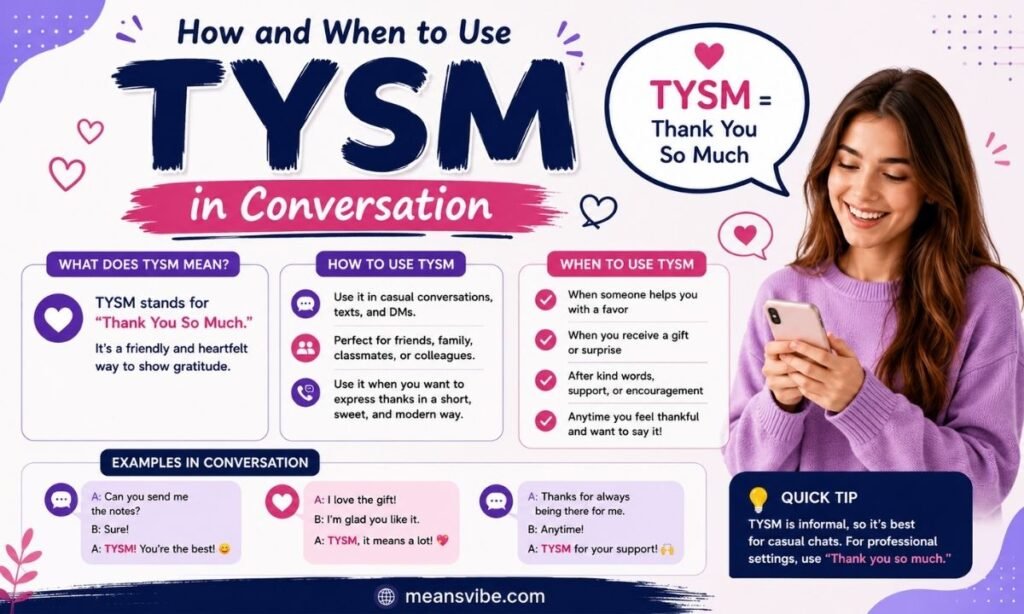
TYSM works best in casual, personal exchanges where a full sentence feels unnecessary. A few quick examples:
After a favor:
“tysm for helping me move this weekend 🙏”
After a gift:
“omg tysm, I love it!!”
After a compliment:
“tysm, that means a lot”
In a group chat:
“tysm everyone, you’re the best”
After advice:
“tysm, I’ll try that”
Keep it for people you’d normally text casually, and add a specific detail when you can, so it reads as genuine rather than generic.
Is It Okay to Use TYSM in Professional or Work Emails?
Generally, no. TYSM is too casual for formal emails, client communication, or messages to a manager or hiring team.
It can come across as unpolished in contexts where professionalism is expected.
How to Pronounce TYSM
TYSM isn’t typically spoken aloud as a word. When people do say it out loud, they usually read each letter individually: “T-Y-S-M.” It hasn’t developed a common pronunciation the way acronyms like “lol” (said as “lawl” by some) or “yolo” have, largely because it’s almost exclusively a written form of communication.
Also Read This:Casi Algo Meaning What “Almost Something” Really Means (2026 Guide)
TY vs. TYSM: What’s the Difference?
Both mean “thank you,” but they carry different levels of emphasis and effort.
| Feature | TY | TYSM |
| Full form | Thank You | Thank You So Much |
| Tone | Quick, neutral | Warmer, more enthusiastic |
| Best used for | Small favors, quick replies | Meaningful help, gifts, kind gestures |
| Formality | Very casual | Casual, slightly more expressive |
| Common platforms | Texts, gaming chats | Social media, DMs, group chats |
Choosing between them usually comes down to how much you want your gratitude to stand out. TY works for a fast acknowledgment; TYSM signals you actually paused to appreciate what someone did.
TYSM Meaning in Different Languages
While TYSM itself is an English abbreviation, the underlying TYSM meaning, an intensified thank you, exists as shorthand in other languages too, especially in texting culture.
| Language | Equivalent Shorthand | Full Meaning |
| Spanish | Grax, Muchas grax | Thanks, Thank you so much |
| French | Mrc bcp | Merci beaucoup (thank you very much) |
| German | Dankeschön, Danke sehr | Thank you so much |
| Hindi | Bahut dhanyawad | Thank you so much |
| Portuguese | Vlw dms | Valeu demais (thanks a lot) |
TYSM itself has also been adopted directly into casual texting in many non-English-speaking countries, especially among younger users who mix English slang into everyday conversation online.
TYSM With Emojis: Adding Emotional Nuance
Pairing TYSM with emojis changes how it lands. The acronym alone can feel a little flat in text, so emojis fill in the tone that facial expressions or voice would normally carry.
- 🙏 TYSM — humble, heartfelt appreciation
- ❤️ TYSM — affectionate, close-relationship gratitude
- 😭 TYSM — overwhelmed or emotional thanks
- 🥹 TYSM — touched, sentimental response
- 😂 TYSM — playful or joking gratitude
The emoji does most of the emotional work. Without one, TYSM can sometimes read as slightly generic; with the right emoji, it becomes specific and personal.
TYSM vs. Other Thank-You Acronyms
TYSM has several close relatives, each with a slightly different tone.
| Acronym | Full Form | Tone |
| TY | Thank You | Quick, neutral |
| TYSM | Thank You So Much | Warm, enthusiastic |
| TYVM | Thank You Very Much | Slightly more formal-casual |
| THX | Thanks | Fast, informal |
| TYT | Thank You Too | Reciprocal thanks |
| TIA | Thanks In Advance | Preemptive gratitude |
TYVM is worth noting as the closest competitor to TYSM. It reads as marginally more polished, which makes it a reasonable middle ground when TYSM feels too casual but a full sentence feels like overkill.
The Sarcastic Side of TYSM
Like most gratitude phrases, TYSM can flip meaning entirely depending on context. Sent after someone cancels plans last-minute, gives unhelpful advice, or does something mildly annoying, TYSM becomes a dry, sarcastic jab rather than genuine thanks.
Tone cues that signal sarcasm include:
- Extra punctuation, like “tysm!!” after a clearly negative event
- Pairing it with unrelated emojis such as 🙄 or 😑
- Using it immediately after a complaint or frustrated message
- All-caps formatting: “TYSM FOR NOTHING”
Context is everything here. The same three letters can express real appreciation or pointed irritation, depending entirely on what surrounds them.
Smart Alternatives to TYSM
TYSM isn’t always the right fit. Depending on the setting, these alternatives can express gratitude more appropriately:
- “Thank you so much” — for professional or formal writing
- “I really appreciate it” — for heartfelt, sincere thanks
- “Thanks a ton” — for casual but slightly more grown-up phrasing
- “You’re a lifesaver” — for bigger favors
- TYVM — a middle ground between casual and formal
- “Much appreciated” — clean and professional without sounding stiff
Switching between these depending on the audience is a simple way to sound intentional rather than repetitive.
TYSM Across Generations and Platforms
TYSM’s usage shifts depending on who’s typing and where.
Gen Z:
Uses it constantly, often stripped of any self-consciousness; it’s closer to default vocabulary than slang.
Millennials:
Use it selectively, usually in texting or social media, but less in professional contexts.
Older generations:
Tend to use the full phrase “thank you so much” and may only occasionally adopt TYSM after seeing it used by younger family members or coworkers.
| Platform | How Common TYSM Is | Typical Tone |
| Very common | Warm, casual, often with emojis | |
| TikTok | Very common | Playful, quick reactions |
| WhatsApp and iMessage | Common | Personal, familiar |
| Slack (internal teams) | Occasional | Depends on team culture |
| Rare | Usually replaced with full phrase | |
| Formal email | Rare to none | Almost always spelled out |
This pattern holds across most digital spaces: the more public and personal a platform feels, the more natural TYSM becomes, while professional-network platforms lean toward the spelled-out version regardless of the user’s age.
Frequently Asked Questions
What does TYSM mean in texting?
The TYSM meaning in texting is “Thank You So Much,” used as a quick, warm way to express gratitude in a text or chat.
Is TYSM appropriate for work emails?
No, it’s generally too casual for formal emails, though it can sometimes work in informal chats with close coworkers.
How do you say TYSM out loud?
Most people spell it out letter by letter as “T-Y-S-M” rather than pronouncing it as a word.
What’s the difference between TY and TYSM?
TY is a quick, neutral “thank you,” while TYSM adds emphasis and warmth for more meaningful gratitude.
Can TYSM be sarcastic?
Yes, depending on tone, punctuation, and context, TYSM can be used sarcastically rather than sincerely.
Final Thoughts
TYSM has earned its place as one of the more dependable pieces of internet shorthand, precisely because the TYSM meaning rarely gets lost in translation. Whether it’s showing up in a heartfelt DM, a sarcastic reply, or a quick comment on social media, understanding the tone behind those four letters helps you use it, and read it, the right way.


2 thoughts on “TYSM Meaning: Full Form, Origin & How to Use It (2026)”